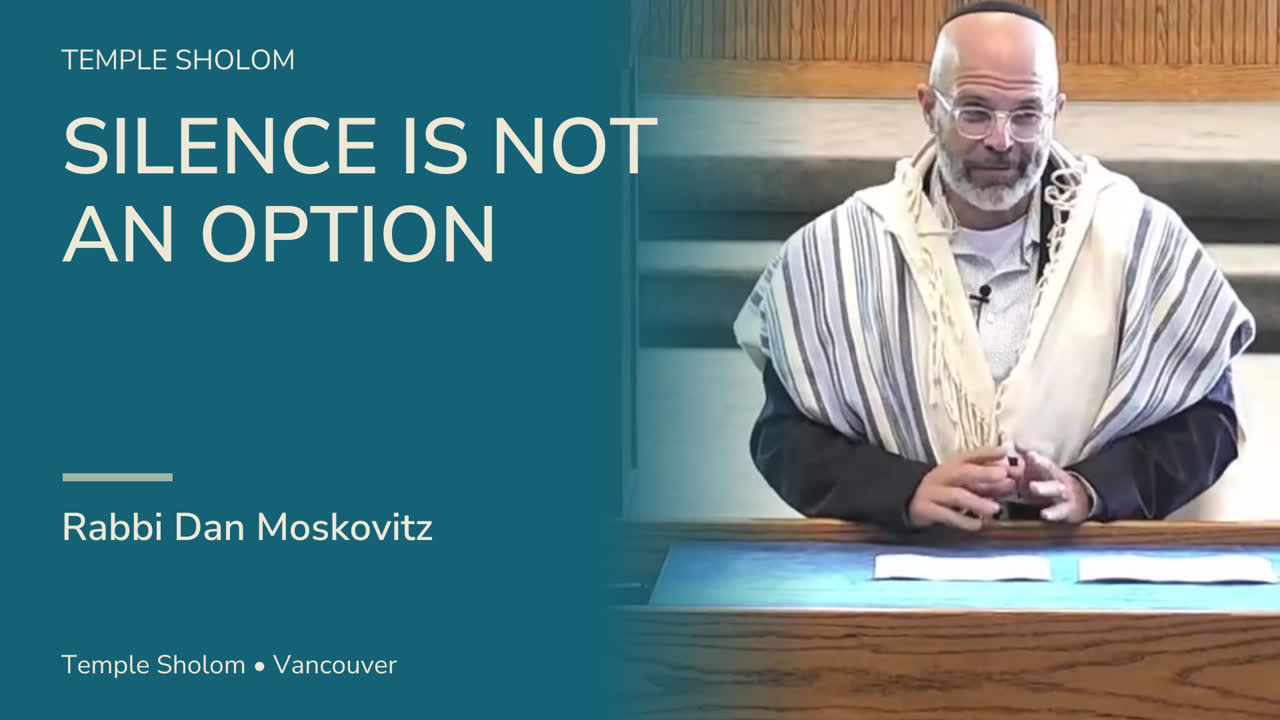
Silence Is Not an Option
Rabbi Dan Moskovitz
Temple Sholom - Vancouver BC
August 2, 2025 / 8 Av 5785
There is a caution, really an admonition in the Talmud that has long guided me: "Silence is assent" (Ketubot 22a). The Shulchan Aruch (Choshen Mishpat 75:13) deepens this idea, teaching that if someone does not protest a claim or act they had the opportunity to contest, their silence may be interpreted as consent. In other words: to say nothing is to say something. And in moments of moral crisis, that silence is not neutral, it’s dangerous.
One of the unexpected blessings of my rabbinic sabbatical was the time and space to be alone with my thoughts. I never had the luxury of tuning out what was happening to Jews in Canada, or to Israelis, or to Palestinians in Gaza and the West Bank. But I did have the chance to sit with the complexity of it all, the pain, the contradictions, the grief.
Now that I’ve been back at the shul for a month, your emails, conversations, and those moments you pull me aside after services make it clear: people want their rabbi to say something. Not just anything. Something that resonates. Something that makes sense of the senseless. Something that affirms what they already believe, or challenges them in just the right way. Something that will help them sleep at night.
Say that Israel is right.
Say that Gaza is starving.
Say that Hamas is evil.
Say, “I told you so.”
Say Canada should act. Or shouldn’t.
Say that it meets the definition of X, Y, or Z. Say that it doesn’t.
Say something.
And yet, I am deeply aware of the risks of speaking. As my colleague Rabbi Asher Knight has observed, “speaking from the heart in times like this feels perilous. Every day brings new horror, new headlines, new heartbreak. Clarity becomes elusive, and words feel inadequate, even futile.”
But still, I cannot remain silent. Not because I have the answer. Not because I know how to end the war or how to bring the hostages home or how to deliver aid to every starving child in Gaza. I don’t. I’m not a general, or a diplomat, or a policymaker. They may not have any viable solutions either, they haven’t thus far.
I’m a rabbi.
And as a rabbi, I feel compelled to speak to you this Shabbat morning and after shabbat by sending this sermon as a letter to our congregation.
My aim here is not to solve, but to hold. To witness. To name the unbearable pain so many of us are feeling: the pain of witnessing suffering across borders and identities; the pain of losing what we once held to be certain; the pain of distorted truths and unraveling relationships.
I am holding tensions that refuse to be smoothed over; I honestly hope we all are, because the last thing we should be in this moment is so certain that we have all the answers that we stop looking for better ones.
And still there are facts, there are things I know:
I know that the people of Gaza are starving. I have seen the images, I have read the reports. As the Talmud reminds us, because we forget, or honestly in our privilege have never known, “One who has bread in his basket is not like one who does not have bread in his basket.” (Yoma 74b)
Someone who has everything is not at all like someone who has nothing. Because someone who has everything is tempted to forget what it is like to have nothing. The reasons there is starvation in Gaza are complex and there are plenty of parties to blame, but to quote Rabbi Abraham Joshua Heschel speaking about inequality in the United States in the 1960s, “Some are guilty, but all are responsible.” All means all.
As Jews must never forget what it is like to be the world’s unwanted, to be running for our lives, to have every door and border and shore closed off to us. Empathy is not weakness, it is a mitzvah.
We must ‘love our neighbor as ourselves,’ and yes, the same teaching is found in Islam (Surah An-Nisa 4:36). Neither Jew nor Muslim is free from the obligation, nor blameless in not adhering to it, and Hamas has not accepted us or Israel for one day and I believe them when they say they never will. The world should too.
I know and the world too often forgets, ignores, or even celebrates that Hamas is a terrorist organization that has chosen cruelty and exploitation, not care and compromise. In spite of that fact many now see Israel as the sole source of Palestinian suffering, ignoring or excusing the actions of Hamas, whose fundamental plan for survival is the humanitarian suffering of the people of Gaza, to say nothing of their sworn promise to annihilate Israel and Jews “from the river to the sea”.
I know that as Jews we are carrying the burden of our history, and the blessing of our covenant to be a light unto the nations. Our torah reminds us again and again, there are limits to what you can do even when fighting an existential war.
I know that Israel has made decisions in the conduct of this war, some of them necessary, some of them devastating, that have caused death and destruction to civilians. Many fear we are losing our moral compass, or the world's empathy, or both.
Israeli philosopher Yitz Greenberg once observed: “If the Jewish army was 10% more moral, it would be a light unto nations. If 25% more moral the Messiah would come. If it was 50% more moral, the state would cease to exist.”
This is the impossible paradox of being a Jewish state in a real and brutal world: to defend ourselves fiercely, and still ask—how do we remain a people of conscience? How do we fight without forgetting who we are? How do we hold power without losing our soul?
This war tests what Judaism has always tested: whether we can demand a higher standard of ourselves, even in conflict, even as our enemies exploit that very moral burden, and even as the world demands more of us than it demands of anyone else.
I know that our loyalty to Torah, Zionism and to Israel demands that we reject Jewish extremism and settler violence. I do not fault Canada and other nations for condemning it or sanctioning its perpetrators. I fault them for not applying the same condemnation and moral outrage when Jews are the targets. There is no moral universe where it can be acceptable to celebrate terrorists and violent protestors. Everyone on every side must stop excusing the inexcusable.
I know that antisemitism is rising—again. That Jews are being targeted not for their actions, but for their identity. And I know that in 2025, seventy-five plus years after the founding of the Jewish state in our ancestral homeland, you cannot separate Judaism from Zionism. The “Jewish Question” as it was once and now again referred to has been answered by 7 million remarkable Israelis and all their future descendants. I’m proud of Israel, even in its imperfection. The right of Israel to exist is not a question anymore and to even ask it is antisemitism.
But not all of the pain we carry comes from those who hate us. Some of it comes from those who claim to stand with us, who offer us love or solidarity, so long as we stay quiet. So long as we don’t make things uncomfortable. So long as we don’t name what hurts.
And here is something else I know: love that demands silence is not love. And solidarity that suppresses truth is not solidarity. If you are not free to speak your truth in the presence of those who claim to love you, then that love is a lie. If their solidarity depends on you denying your pain or someone else’s, it’s not solidarity; it’s performance.
Part of why rabbis need sabbaticals is that we sit with people in the messiness of their lives every day. It’s a blessing, I’m grateful, and it’s heavy and raw. Holding the hands of grieving parents, listening to a couple at the breaking point, comforting someone whose sense of identity is unraveling, or someone who no longer recognizes the political or religious world they once found a home in is - simply - a lot to hold.
And maybe that’s why this moment in Jewish life feels so familiar to me. Because what we are facing right now as a people, these ruptured relationships, this spiritual disorientation, this aching grief, it’s not so different from what I witness every week, just writ large. Families torn over politics. Friends suddenly speaking a different moral language. A sense of belonging that once felt secure now shaken, or even lost.
This is what it feels like when the ground shifts beneath you. When something you love breaks. And the pastoral wisdom I’ve learned in those quiet, raw moments—between diagnosis and death, between betrayal and forgiveness, between fear and resilience—is what I can bring to this hour of communal heartbreak.
Those moments and these aren’t about having the right answer. They’re about staying in the room when it gets hard. They’re about refusing to reduce people to positions. They’re about witnessing pain without needing to fix it. They are about finding moral meaning and prophetic purpose.
Over the years, I’ve learned this: certainty is often a disguise for fear. But humility, humility is holy. And grief, especially collective grief, can fracture us, but it can also open us. To quote Leonard Cohen, “the cracks are how the light gets in.” Grief can make us more tender with one another, more honest, more attuned to what’s sacred. It can heal.
And isn’t that what Torah teaches? That we’re not meant to go it alone. That we’re meant to speak the truth in love. To sit shiva with each other, not only for those who have died, but for the dreams that have shattered, for the relationships that feel broken, for the moral clarity we once believed was easy to hold.
As your rabbi, I will not be silent. Because silence in the face of suffering is not neutrality, it is betrayal. And even when the world demands that we choose a side, we can still choose to stand on the side of our humanity.
And maybe that’s the most important thing I’ve learned, sitting with so much heartbreak, not just as a rabbi, but as a human being.
Our task right now as Jews and human beings isn’t to win arguments, it’s to hold on to our humanity. To listen more deeply. To hold complexity with courage. And to keep showing up for each other, not despite our differences, but because of them.
That is what I can offer. Some will say it’s not enough or that I’ve gone too far but I cannot be silent; none of us can.