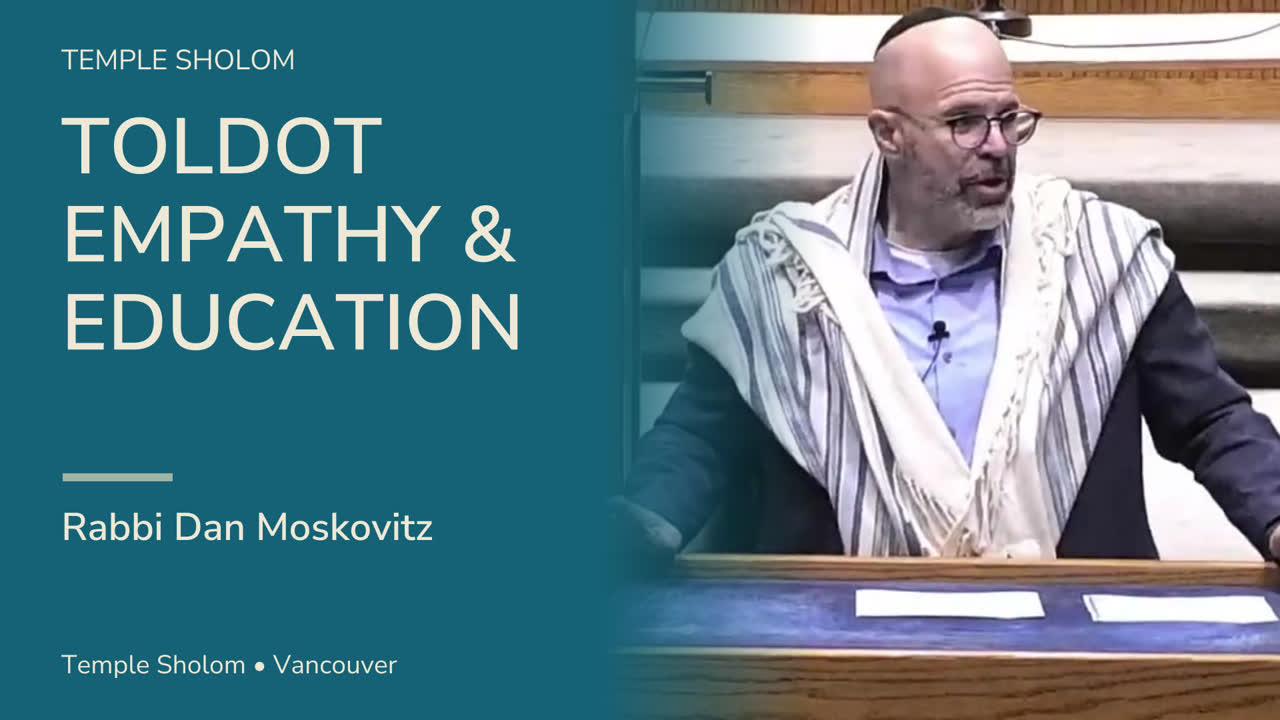
Toldot - Empathy in Education
Rabbi Dan Moskovitz
Temple Sholom - Vancouver BC Canada
November 21, 2025
This week’s Torah portion, Toldot which Noah and his family will chant tomorrow, begins one of the most intimate and emotionally complex family narratives in the Torah. It is a story about two children Jacob and Esau who enter the world already struggling with each other, parents who love them but fail to understand them, and a reconciliation that arrives only after decades of distance and pain.
At the beginning of the parasha there is a small line that carries an enormous lesson. וַֽיִּגְדְּלוּ֙ הַנְּעָרִ֔ים (Vayidgadlu Ha’na’arim) “When the boys grew up…” The Torah says almost nothing before that moment about Jacob and Esau, except that they struggled together even in the womb and that one was red and hairy the other, Jacob was grasping at his heel, hence the name Ya’acov.
Nothing is mentioned about their early years, how they were raised, their character, their desires. From this the rabbis conclude that as they were fraternal twins their parents, Isaac and Rebekah, raised their sons without differentiating between them.
The midrash, Jewish folklore asserts that later conflict between the brothers all stems from Isaac and Rebekah’s failure to understand and nurture each child’s character.
“They did not train each child according to his own nature, which led to hatred between them.” (Midrash Tanchuma Toldot 5)
Rabbi Samson Raphael Hirsch is explicit in blaming the parents. he wrote:
“The striking contrast in the grandsons of Abraham may have been due not so much to a difference in their temperaments as to a mistake in their upbringing. Both were given the same instruction and care. No attention was paid to their differences.”
Hirsch concludes that Isaac and Rebekah gave the boys one educational style, failing to match the unique emotional, spiritual, and psychological needs of each child.
They assumed that fairness meant sameness. They did not notice early enough that each child needed something different from them. Proverbs teaches, “Chanoch l’na’ar al pi darko / raise each child according to their own path”. The Torah is reminding us that children grow best when they are understood as individuals, with their own personalities, challenges, and gifts.
Beneath the surface of all of this lies a single spiritual thread that can guide us in our lives as parents, teachers, and human beings. That thread is empathy.
Empathy in Judaism asks us to notice what is happening inside another person without being swallowed by their feelings. It asks us to recognize their individuality without trying to reshape them into our own image. This is one of the most difficult spiritual practices in Jewish life, in human existence. And it is the foundation of all healthy relationships.
The first half of Toldot gives us a painful example of empathy gone missing. As I mentioned, the Torah tells us that even before birth, Jacob and Esau struggled within their mother. Rebekah senses that something unusual is happening inside her and seeks out God. She receives a prophecy that her children will be very different and that the older will serve the younger. Yet once the boys are born, the text offers no evidence that either parent pays much attention to the striking individuality of their sons.
The voice from the heavens tells her they will be different and the parents raise them as though they were the same.
Esau grows into a hunter, guided by instinct, intuition, and physicality. He is a person of action and appetite. Jacob grows into a quiet thinker, someone drawn to a more reflective life inside the tents. These differences are not subtle. They are woven into the very nature of the boys.
And yet the Torah tells us something troubling. Isaac loves Esau because he enjoys eating the game that Esau brings him. The love is rooted in Isaac’s appetite, not Esau’s essence. Rebekah gravitates to Jacob, whose temperament mirrors her own. Their parental connections reflect their own preferences rather than the children’s needs. In a home where two boys require two different forms of care, attention, and guidance, neither receives it.
This is one of the earliest examples in our tradition of “one-style-fits-all” parenting. It is presented to us not as a model to follow, but as a cautionary tale.
A parent who does not recognize a child’s inner world cannot guide them well. A teacher who assumes all students learn the same way will lose the attention of those whose learning flows differently. A leader who ignores the complexity of human diversity will fail the people they serve.
This is the Torah’s early lesson in empathy. Empathy is not pity. Empathy is not indulgence. Empathy is the determined effort to understand another person’s reality. It is seeing the child standing in front of us rather than the child we might have imagined. Without that, Jacob and Esau become strangers. Their estrangement grows into deceit, then resentment, then a family fracture that lasts twenty years.
The Torah does not tell this story to shame Isaac and Rebekah. It tells this story because they are us. Every parent knows what it is like to misread a child. Every teacher has met a student whose nature does not match their expectations. Every family knows that pain can grow where understanding is thin.
The power of the story is that it does not end in tragedy.
When Jacob returns home many years later, something inside him has changed. He has been wounded and humbled by life. He has wrestled through the night with a mysterious stranger. He has learned that blessings are not possessions but responsibilities. Esau has changed too. The text gives us no insight into his inner world, but his actions speak clearly. He runs toward Jacob. He embraces him. He kisses him. These gestures reveal a man who has released the earlier resentments of childhood.
Jacob responds with words that have echoed through Jewish history. “Seeing your face is like seeing the face of God.” It is a profound moment of empathy. Jacob looks at the brother he once feared and sees something holy. He sees Esau not as a rival, not as a threat, but as a person who has carried his own burdens, grown in his own way, and suffered in his own silence.
This reunion is not only the resolution of a family conflict. It is a masterclass in empathy restored. Two men, shaped by their own stories, learn to see each other again. They reclaim a relationship that was broken by a lack of understanding in childhood.
Toldot invites us to learn from both halves of the story. The empathy that was missing in the beginning leads to pain. The empathy that reappears in the end leads to healing. Loving someone requires seeing them. Guiding someone requires understanding them. Parenting and teaching ask us to walk a delicate line between support and challenge, between listening and leading.
Judaism holds this balance as a sacred practice.
Jewish education is rooted in this kind of balanced empathy. The Talmud teaches that a parent must teach a child Torah, a trade, and how to swim. Swimming is more than a physical skill. It symbolizes the capacity to face deep water and trust one’s own strength. Children develop that confidence not through pressure, but through adults who recognize them as individuals and give them what they need to thrive.
Jewish education has always aimed for more than academic knowledge. It asks: Who is this child becoming? What spiritual muscles do they need to develop? How can we help them understand themselves and respond to the world with compassion and clarity?
That is why Jewish learning matters. It shapes identity, values, purpose, and vision. It teaches us that the world cries out for people who can notice brokenness and take responsibility for repair. It teaches empathy that is grounded and strong.
This kind of educational vision requires steady leadership.
Tonight, as we celebrate Noah’s bar mitzvah, I also want to acknowledge the work of Jen Jaffe, Noah’s mom but our Educator and school principal. Jen guides our school with thoughtfulness and integrity. She helps create an environment where each child is known, where differences are welcomed, where learning is rooted in curiosity, and where teachers approach their students with empathy that is balanced and wise. She works closely with families, strengthens our faculty, and helps our children experience Judaism as something they can walk with throughout their lives.
While doing this, she is also completing her master’s degree in Jewish Education at HUC. This pursuit is not academic alone. It enriches our community and deepens the quality of learning our children receive. Tonight is a good moment to recognize that devotion and express our gratitude.
And tonight, we celebrate Noah, who brings thoughtfulness, openness, and sincerity to his learning. He approaches ideas with curiosity and has taken his preparation seriously. The empathy he shows toward others reflects the environment and family in which he has been raised. Loving parents, Jen and Joel who act with tireless intention toward all of their children and teachers who have guided Noah and many others.
Noah’s torah portion reminds him that relationships require work, patience, honesty, and the courage to see others as they are. Jen and Joel have modeled that for their children and all our children here at Temple Sholom; and for that on this shabbat of gratitude and blessing we are all deeply blessed and grateful for this family and the wisdom of our tradition.
SERMONS & WRITING · 2025
Toldot - Empathy in Education
November 21, 2025