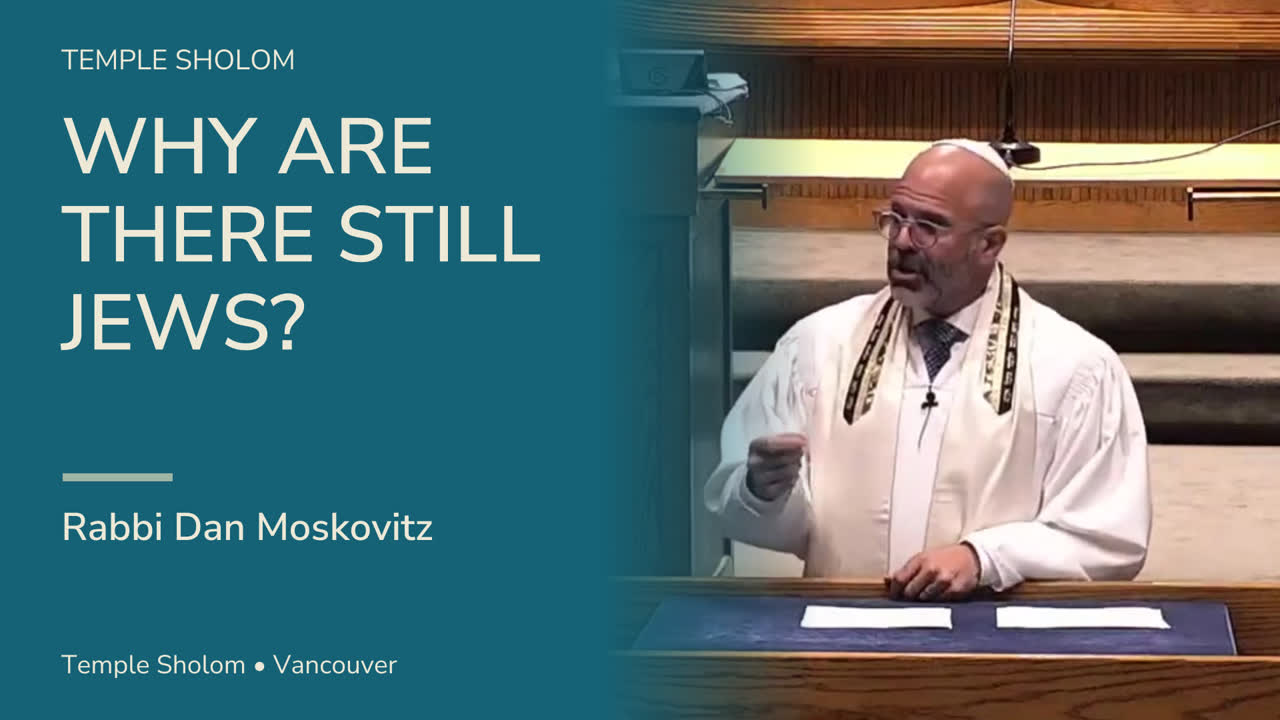
Why Are There Still Jews?
Rabbi Dan Moskovitz
Erev Rosh Hashanah 5785
Temple Sholom - Vancouver BC Canada
October 3, 2024
Video: https://youtu.be/TulQW6ustM4
In 1898, more than 100 years ago Mark Twain wrote, “All things are mortal except the Jew. All other forces pass, but the Jew remains.” And then he asked, “What is the secret of their immortality?”
Perhaps the most perplexing element of the history of the Jews is that there are still Jews at all. How have we survived such a history of trauma?
One of the things I discovered about myself on October 7th and in the weeks and months that followed is that I was experiencing generational trauma, something I’ve never encountered before.
As far as I know, I have no close relatives that died in the Shoah. My family came to the United States in the mid 1800s. It is not clear if they were running from something in Odessa and Kiev where we have traced our ancestral roots, or if they were running to something in America?
What is clear is that Jewish trauma was not a story that I grew up with around our seder table. Even still, on October 7, 2023 I had the horrible feeling deep in my soul that, “it was happening again”. The “it” was the attempt to annihilate my people. The “again” was every story of pogrom and persecution, blood libel and expulsion, forced conversion and genocide that has haunted our history.
Psychologists speak about the fight or flight response, the well documented binary of either fighting back in the face of adversity or running away from it.
Both are predicated on the instinctive human response to survive. In my own experience there is a third response that has been employed by the Jewish people for thousands of years and is one of the answers to the question, “why are there still Jews?”
Adapt
Time and again, too many times, again and again, the Jewish people have faced moments like October 7. In each instance our response has been to adapt in order to survive.
Sometimes that meant run, as generations of Jews did, from the Crusaders, the Cossacks, the Inquisitors, the Nazis.
Sometimes that meant fight like Moses did with the Egyptian TaskMaster who was beating a Hebrew Slave, like the Maccabees during the story of Hanukkah, the fighters of the Warsaw Ghetto, the Haganah in the war for Israel’s Independence, as the IDF has been called to do, even on our holiest of days.
But in countless smaller moments that preceded or followed those calamities the Jewish response has been to adapt, to exhibit resilience through flexibility and creativity, setting the preservation of our people, our faith, our tradition above any reflexive response to fight or flee.
In the Talmud (Taanit 20a), the rabbis debate which is the better example for the Jewish people. To stand strong like a cedar tree that grows by the side of the river standing tall and firm as it gets battered by the winds, the river rushing past its roots, eroding the soil beneath it, until the wind blowing from just the wrong angle uproots it and topples it over. Or is it better for the Jewish people to be like a reed bending and flexing with the current, adapting and adjusting to the pressures coming from all directions, surviving against the forces aligned against it, even generating offspring in the midst of the tumult?
Rabbi Elazar ben Shimon says, “A person should always be flexible like a reed and not rigid like a cedar.” Our tradition emphasizes the value of humility, flexibility, and the ability to bend with challenges, rather than being rigid and potentially uprooted like a cedar, which though strong, may be inflexible and prone to breaking under pressure. It highlights the virtue of adaptability and resilience in navigating life’s difficulties.
“Resilience is generally defined as the ability of an individual to bend but not break, to bounce back, and to adapt well in the face of adversity, trauma, tragedy, threats or even significant sources of stress”[1]
Look at the story and history of the Jewish people. We are resilient. We have an uncanny superpower to adapt and reinvent ourselves, to meet crises with creativity.
All the great books of our tradition were written in response to catastrophe.
Freed from an immoral slavery in Egypt, we received and wrote Torah, a moral, ethical code that would attest to our covenant with G-d the source of our redemption, and demand that we identify the Pharaohs of future generations.
When the Temple was destroyed and with it our means and medium for worship we adapted, we replaced sacrifice with prayer, conceiving a whole new relationship with G-d through study and inquiry. We recorded the evolution of that new way of observing the covenant in the Mishnah and the Talmud. We called it Halacha, literally “The Way”, as in a new way to live in an uncertain and unprecedented time for the Jewish people.
When enlightenment thinkers emphasized reason and empirical evidence over faith and tradition, many questioned religious doctrines and the validity of divine revelation. Judaism's response was to develop Kabbalah and the Zohar, a mystical lens through which we could still experience the awe and wonder of the natural world while embracing science and reason at the same time.
In the 19th century, the rise of nationalist movements in Europe threatened Jewish survival. Rather than capitulate or assimilate and lose our identity, Jewish leaders asserted their own national identity. Zionism framed the Jewish people as a distinct nation deserving of their own homeland.
After the Shoah, we asked, “where was God?”. Some abandoned their faith, but many others created Jewish communities and institutions that became the God we wanted to worship.
The Canadian Jewish community is a product of that adaptation and resilience. We redeemed suffering Jews, because G-d redeems, we liberated, because God liberates. We worked for civil rights and social justice, because God instructs us, Justice, Justice we must pursue. We became the God that we missed in the holocaust. (Yitz Greenberg)
In every moment when we are lost, when we face uncertainty, when we are in the wilderness our response is not fight or flight, but improvise, adapt and overcome.
Torah was given, received and cultivated in the wilderness. Jews became a people in the wilderness. The wilderness is harsh and unforgiving but time and again throughout history it’s been the most formative and transformative experience of our people. The law of the wilderness is adapt or perish, we learned that l’dor v’dor, from generation to generation and inspire of all efforts to destroy us, we are still here.
Maybe that is the burden and the blessing of being a Jew, we are always in the wilderness, striving toward a promised land, a promised time, but never quite getting there, confronting the brutal reality of the world as it really is. In the striving, in the wilderness journey our true character is formed and the dangers to our survival are revealed so we can confront them and as our people have done time and again for 5785 years - adapt, survive and often, thrive in the face of them.
Psychologists tell us that we can think of resilience as a set of skills that can be, and often are, learned. Part of the skill-building comes from exposure to very difficult — but manageable — experiences.
“Stress isn’t all bad, if you can cope today with all that’s happening in the world around you then when you are on the other side of it, you’ll be stronger.”[2] That has been true for the Jewish people and it is true for so many of us in this room as families and individuals.
How we cope depends on what is in our resilience toolbox. For some people the only tools they have are a hammer to hit back or a saw to cut and run.
I like to think that over the millennia Jews have assembled an eclectic toolbox filled with implements of resilience, “the right tool for the right job”, as the saying goes.
The tools common to resilient people are:
* Optimism: resilient people don’t dwell on negative information and instead look for opportunities in bleak situations.
* A moral compass: Highly resilient people have a solid sense of what they consider right and wrong, and it tends to guide their decisions.
* A religious or spiritual belief in something greater than themselves. The community support that comes from being part of a religion, part of this Temple community has never felt more valuable and essential.
* Emotional flexibility and social connectedness. Resilient people reappraise a difficult situation, look for meaningful opportunities within and others to help navigate it.
* Resilient people have a mission, a meaning, a purpose which gives them courage and strength. Resilient people are dedicated to causes they find meaningful and that give them a sense of purpose. How true has that been for so many this past year, volunteering, attending rallies, educating and advocating for the Jewish people and Jewish values.
* Resilient people also have a sense of humor about their trials and travails. The old joke about Jewish History being summed up in the statement, “They tried to kill us, we survived, let’s eat” is a classic example of Jewish resilience through humor.
Jews are still here because we adapt, because we are resilient and because of one other indispensable characteristic - hope.
Rabbi Hugo Gryn famously told a story of his father in the winter of 1944, while they were together in a concentration camp called Lieberose. Having announced that it was the eve of Chanukah, he took a homemade clay bowl and lit a wick immersed in his precious, now melted ration of margarine.
Before he could recite the blessing, Hugo looked at his father and protested “we need the food – we can’t afford to waste it on a candle” his father looked at Hugo and then at the lamp, then back at Hugo—and responded, “You and I have seen that it is possible to live up to three weeks without food. We once lived almost three days without water; but you can’t live at all without hope.”
Rabbi Lord Jonathan Sacks z’l points out, “People often confuse optimism and hope. They sound similar. But in fact, they’re very different. Optimism is the belief that things will get better. Hope is the belief that, together, we can make things better.”
“Optimism is a passive virtue, hope an active one. It takes no courage – only a certain naivety – to be an optimist. It takes great courage to sustain hope. No Jew – knowing what we do of the past, of hatred, bloodshed, persecution in the name of God, suppression of human rights in the name of freedom – can be an optimist. But Jews have never given up hope.” (Sacks)
“Hope and tragedy do not differ about facts but about interpretation and expectation... [And] that makes a moral difference. Those who hope, strive. Those who are disillusioned, accept. In that respect, they are self-fulfilling prophecies. A morality of hope lives in the belief that we can change the world for the better.” (Sacks)
In this not unprecedented time, the task of sustaining hope may seem daunting. Yet, it is our sacred duty, and it is embedded deep within the soul of the Jewish people. Even now, in the face of rising antisemitism, violence, and the trauma we carry from this past year, we must refuse to give in to despair. “Od lo avdah Tikvatenu” / “Our hope is not lost”, as the Israeli national anthem reminds us. Now we must remind ourselves and one another that, while history shows us many dark days, it also shows the strength, resilience, and adaptability of our people.
Our survival is not only a testament to our strength; it is a call to action. It asks each of us: How will you adapt and practice resilience?
How will you preserve our tradition, fight for justice, build community, and bring light to the world?
And that is where hope comes in. Hope, as Rabbi Sacks taught, is not passive; it is a choice, an action. When we light the candles of Hanukkah, when we stand up for Israel, when we teach our children Torah and bring them to services, when we walk into this sanctuary on this holiest of holy days we are choosing hope. We are choosing to believe that our future, like our past, will be filled not just with suffering, but with resilience, with creativity, and with transformation.
Hope is why we are still here. It’s why we continue to adapt and practice resilience. It’s why, even in the wilderness of a post October 7 world, we continue to believe we can make a better one.
As we begin this new year, embrace hope. Let it be the flame that lights our way. Let it give us the courage to adapt, to change, and to build. Because as long as we have hope, there will always be Jews. And as long as there are Jews, the world will always have hope.
Shanah Tovah U’metukah—may this year be filled with hope, strength, and sweetness for us all.
Rabbi Dan Moskovitz (10/2/2024)
________________
[1] American Psychological Association . “The road to resilience: what is resilience?” www.apa.org
[2] Steven M. Southwick, professor emeritus of psychiatry, PTSD and Resilience at Yale University School of Medicine “Resilience: The Science of Mastering Life’s Greatest Challenges.”