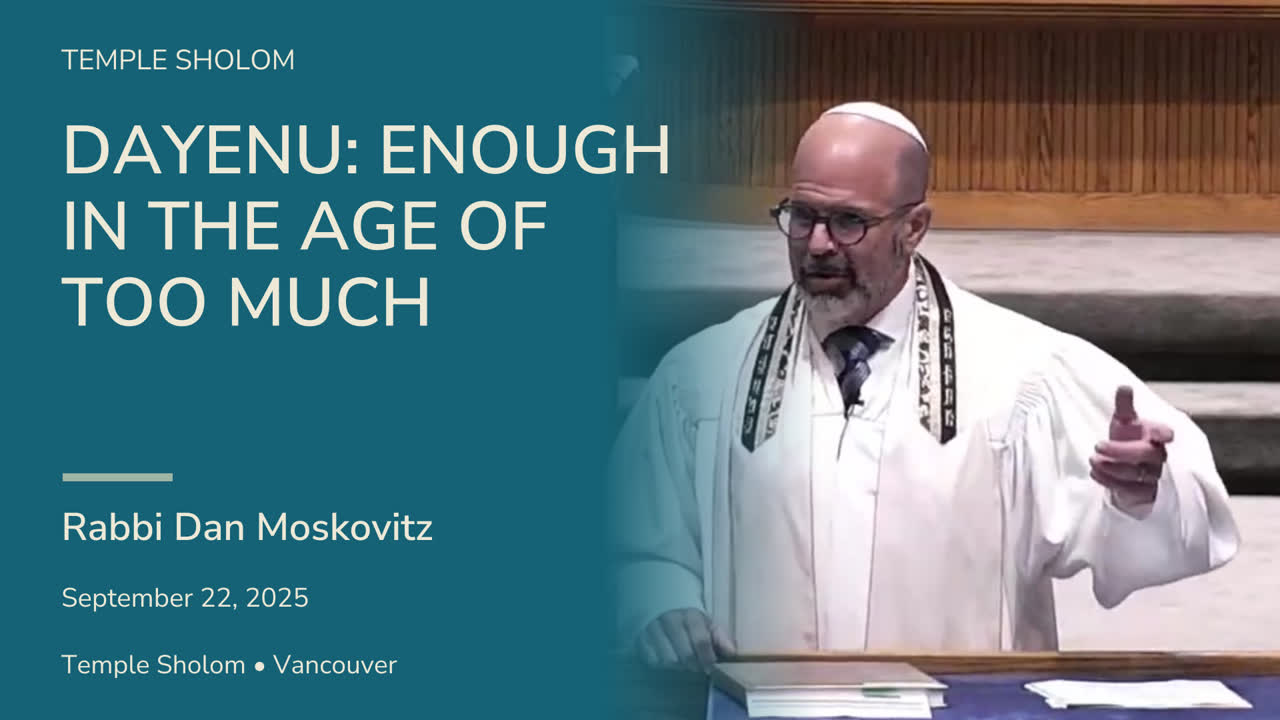
Erev Rosh Hashanah 5786
Dayenu: Enough in an Age of Too Much
Rabbi Dan Moskovitz
Temple Sholom, Vancouver BC Canada
September 22, 2025
Video Link:
https://youtu.be/pVZMsNizCE0?si=hijzlCCJLCwPSTmy
The last night of my sabbatical, when we were in New York City we wanted to go out for pizza — not just any pizza, but the best New York pizza. That simple desire launched us into forty-five exhausting minutes of Google searches, Yelp reviews, blog rankings, text messages to friends who live in the city. It became a mission. By the time we actually sat down, we weren’t joyful, we were tired. And when the pizza came? It was good. Better than average. But not the life-changing meal we had built up in our heads. In truth, the best pizza was probably the one we would have enjoyed if we had just chosen the first place on the corner and eaten without the stress.
That night taught me something: sometimes the pursuit of the “best” ruins what is already good enough.
Voltaire, the French philosopher (1694-1778), very famously phrased this as, "The perfect is the enemy of the good." Same idea, but I doubt he was ordering pizza at the time.
We live in a society drowning in choices. American psychologist Barry Schwartz, in his book The Paradox of Choice, argues that when options multiply, our happiness actually decreases.
He writes about two types of people, listen and see if you hear yourself as one of them:
Satisficers — those who accept “good enough” — are content.
Maximizers — those who seek the best — are restless, anxious, and regretful.
Are you satisfied or endlessly seeking something better? And which is the better way to be?
Former Israeli Prime Minister, Founder of Startup Nation and Noble Peace Prize winner Shimon Perez famously once observed that, “The Jews' greatest contribution to history is dissatisfaction!” He said we're a nation born to be discontented. Whatever exists we believe can be changed for the better.
You know this one? A Jewish grandmother is walking on the beach with her grandson… Suddenly, a rogue wave comes in and sweeps the grandson out to sea. Distraught, the grandmother looks to the sky and says, "Oh god, I have always been true and faithful to you. Please bring my grandson back." And with that, another wave comes in and deposits the grandson safely on the shore. The grandmother once again looks to the sky and says, "He had a hat."
Comedian Larry David has made a career out of poking fun at the Jewish obsession with obsessing over things. We are told that life is about maximizing, optimizing, never settling. The result? We are never satisfied.
This idea is so ingrained in the Jewish psyche, let alone our lives today with their endless reviews, suggestions, star rankings and tomatoes, rotten or not it is as though FOMO — fear of missing out — has become the defining spiritual condition of our time.
But Jewish tradition literally sings a different tune, a countercultural truth.
On Passover we sing dayenu.
If God had only brought us out of Egypt but not split the sea — dayenu.
If God had only given us manna but not Shabbat — dayenu.
Dayenu means: it is enough. It is sufficient. It is not about wanting more; it is about appreciating what you have.
Pirkei Avot teaches: Eizehu ashir? Ha-sameach b’chelko. Who is rich? The one who is content with their portion.
The great Jewish thinker Abraham Joshua Heschel deepened this when he said: ‘Our goal should be to live life in radical amazement. Get up in the morning and look at the world in a way that takes nothing for granted. Everything is phenomenal; everything is incredible; never treat life casually.’
This is not resignation. It is not laziness. It is spiritual courage. Because to say dayenu is to resist the lie that life is measured by comparison, competition, and optimization. To say Dayenu is radical amazement — the strength to see enough as wondrous.
Every morning, Jews wake and say Modeh Ani: I give thanks. Not for the best, not for the most, but simply for being alive. Before we eat, we bless the food — not because it is Michelin-starred or rated highly on Yelp, but because even a simple piece of bread is holy when we receive it with gratitude. With sauce and cheese it’s pizza!
On Shabbat, we embrace “enoughness”. Every week we are commanded to stop creating, to stop consuming, to stop choosing, simply, not so easily to rest. We let the world be unfinished, and ourselves unfinished. Shabbat teaches us that life is not only about improving and advancing. Sometimes holiness lies in stopping and savoring.
And tonight, on Rosh Hashanah we begin a process of Heshbone HaNefesh, of examining our souls. And when we look under the hood, what will we find there? Will we find an engine always running, always grinding and revving up for the next hill to climb and conquer or will we find our soul peacefully at idle, tuned and well maintained, capable of driving hard but also knowing when to put it into neutral and to let things coast?
Not because striving for excellence is bad, but because striving all the time, never being satisfied or appreciative of what we have and are — with ourselves, with others, with society — is destructive. Some of us have vowed silently, in our hearts, that we will never settle for less than the best. That we will find the perfect school, the perfect job, the perfect body, the perfect house, the perfect partner, the perfect life. And those vows exhaust us. Our pursuit of perfection has become for some an unhealthy obsession.
Columnist David Brooks has observed that young adults today face not only too much choice but too much rejection. They apply to dozens of schools, hundreds of internships, thousands of jobs — and are told again and again: you’re not enough. Social media adds its own cruelty: the post nobody likes, the group chat you weren’t included in, the swipe that goes unanswered. In a culture of endless choice, rejection becomes the air we breathe. No wonder so many of us put on armor, polishing stories for others until we begin to believe the illusion ourselves. Judaism cuts through that armor with a different truth: Dayenu. You are enough. What you already have, who you already are, is enough.
These High Holy Days free us by placing upon us sacred limits. Judaism does not ask us to be maximizers. It asks us to be committed. To stop chasing the infinite possibilities and root ourselves in covenant. To stop asking “what is the best I can get?” and start asking “what is the blessing I already have?”
Our culture says: don’t miss out.
Judaism says: don’t overlook.
Our culture says: be everything.
Judaism says: be enough.
Our culture says: more, more, more
Judaism says: Dayenuuuu, Dayenu
This clash between our culture’s obsession with ‘more’ and Judaism’s call to ‘enough’ has been named powerfully by Rabbi Jonathan Sacks. He wrote: ‘The consumer society is constantly telling us that happiness lies in what we buy; Judaism tells us that it lies in what we are.’ In other words, fulfillment is not in the endless search for what’s next, but in the covenantal commitment to who we already are.
The task of this day is not to perfect ourselves, but to return to ourselves. Progress not perfection is the mitzvah of the moment, of every moment and particularly this moment of Teshuvah. Not polish without flaw, but the slow turning of the heart back to what matters most.
Schwartz points out that the burden of too much choice is regret: the feeling that you could have done better, chosen better. Judaism reframes regret as a holy tool. We call it vidui — confession. We own our mistakes, we name them together, and then we move forward. Regret becomes a teacher, not a tormentor.
This year, I want to invite you to let go of FOMO, the Fear Of Missing Out. Stop chasing after what might be happening somewhere else. Instead, try SLOMO — Savor Life, Observe the Moment Only, or as our tradition teaches: menuchat hanefesh, rest for the soul. Because when you live in SLOMO, when your soul is at peace you can finally see what’s right in front of you.
Name one blessing that is already in your life. One relationship that matters. One mitzvah you can commit to.
The truth is: you already have enough. You already are enough.
We are not a people of FOMO. We are a people of Dayenu.
May we learn this year to sit down with what is in front of us — whether it’s a slice of pizza or a slice of apple — and taste its blessing without wondering if there was something better around the corner.
May we sing Dayenu all year long. Shanah tovah.