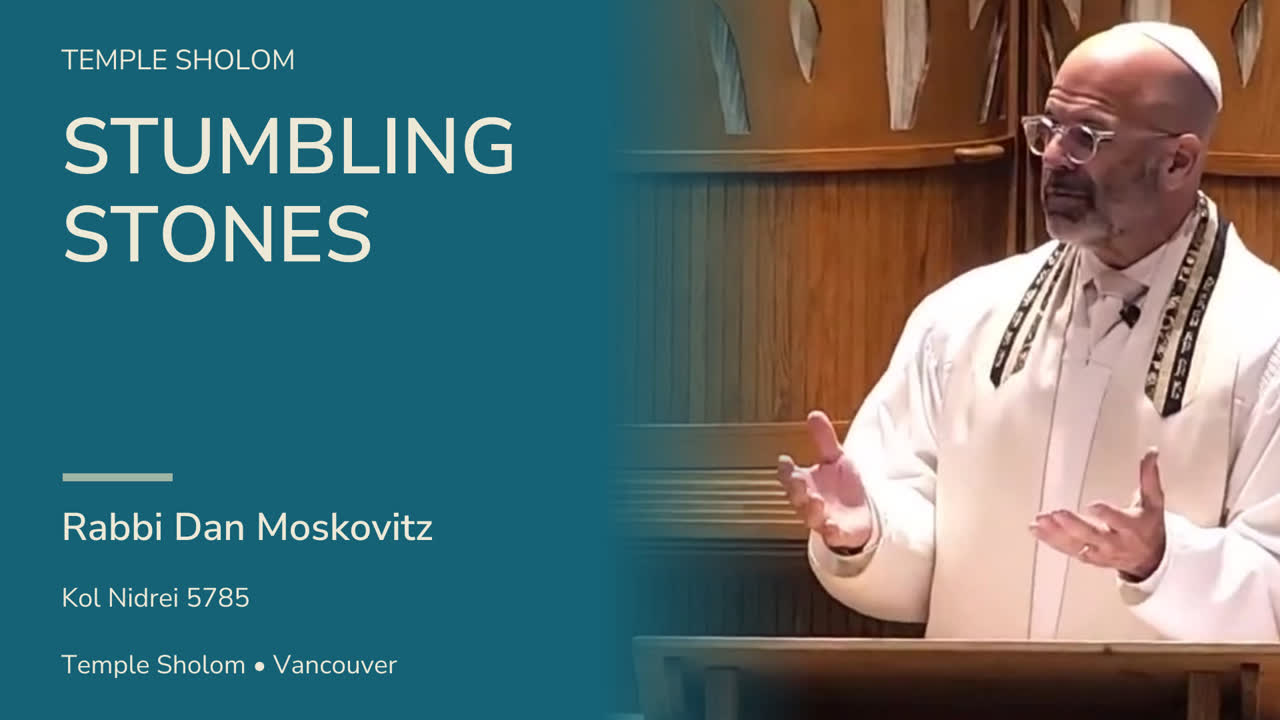
Stumbling Stones
Rabbi Dan Moskovitz
Temple Sholom - Vancouver BC Canada
Kol Nidrei 5785 / October 13, 2024
A video of this sermon as delivered is available here:
https://youtu.be/G01Gl6yjCIE
At the end of a quiet, suburban cul-de-sac in north-eastern Berlin, Michael Friedrichs-Friedländer quickly ushers a reporter into his garage. He casts a watchful glance down the road, as if to check if the reporter has come alone.
Inside, a large-scale map of Germany is pinned to the far wall. In the corner, there’s a simple workbench, where Friedrichs-Friedländer has left a hammer, a set of metal stamps, and a sheet of paper bearing a series of names, dates and the word ‘Auschwitz’.
Friedrichs-Friedländer is the artistic partner of Gunter Demnig who in 1992 created the brass plates found on cobblestone streets throughout Europe. The 4” x 4” hand inscribed plates bear the name and life dates of victims of the Holocaust. Placed at the last known residence of the murdered, the German plates are called StoLperstein, literally, it means 'stumbling stone' and they are intended to stop you in your tracks and make you think of the person whose life was violently ended by the Nazis.
I have been thinking a lot about Demnig and Friedrichs-Friedländer since October 7 because I too have been engraving, one by one the names of Jewish victims of the greatest mass murder of Jews since the Shoah, and the largest in the history of the State of Israel.
For me this holy and heartbreaking task began with a childhood memory.
When I was a teen in the 1980s I remember wearing a metal bracelet with the name of a Soviet Refusenik, a Jew who was denied permission to emigrate to Israel.
As we began to learn the names of the 240+ hostages taken by Hamas during their horrific and barbarous attack on the residents of Southern Israel on October 7, 2023 I recalled that silver metal bracelet I used to wear. The idea struck me that we must hold on to the names of the hostages, share them and never let the world forget their torment and danger.
The imperative to remember is central to Judaism and to this holiest of days, Yom Kippur. The talmud observes, “a person is only forgotten when their name is forgotten”.
This verse served as the motivation for Demnig and Friedrichs-Friedländer’s Stolperstein Project, and it inspired me to create 10,000 stainless steel bracelets each inscribed with the name of one of the hostages held in Gaza. A StoLperstein for your wrist. The bracelets have been distributed all around the world, some of you are wearing one this evening.
Then a few months ago, as the anniversary of October 7th hung over me and the world like a heavy black cloud I thought again about that teaching from Talmud, “a person is only forgotten when their name is forgotten” and how challenging it is to not reduce mass casualty events be they, wars, terror attacks, shootings or natural disasters to the impersonal large numbers we have become numb to. How can we conceive of 6 million, or 1,200, or 250? How can we conceive and hold space in our hearts for the thousands of innocent civilians in Gaza and the wider region that have been killed in this war?
The Talmud teaches that to take one life is to destroy the entire world. Thousands of innocent lives, Jews and non-Jews, Israeli and Palestinian, thousands of worlds; a shattering of hopes and dreams, couples that will never marry, never have children, stories never written, never told.
We must think of people as names and the souls attached to those names. None of us here remember our loved ones as our second or fourth grandparent, our third sibling, our first child. We remember them by name, by the way they embodied the world with their spirit, their humor, their love, their passions, their peculiarities. We remember their soul, it is personal to us. We know them, and we want the world to know and remember them, never as a number, one among many, but as a unique human being, valued for the individual light they brought to the world, distinct in their experiences, thoughts, and contributions.
If you visit a Jewish cemetery and you look closely at the gravestones, you will notice that while every name and date on the stone is unique to the individual buried there, one inscription on the headstone is the same for every Jew. The Hebrew abbreviation taf, nun, tsadi, bet, hey stands for “teheye nishmato tsrurah b’tsror ha-chayyim,” a phrase usually translated as “May their soul be bound up in the bonds of eternal life.”
Yet in Hebrew tsror not only means bond, it can also mean pebble or small stone. This is in part the origin of why you place a small stone or pebble on the marker when you visit a Jewish grave and not flowers as is customary in other faith traditions.
While flowers may be a good metaphor for the brevity of life, stones are better suited to the permanence of memory. Stones, like memories that are held tightly and passed down from generation to generation do not die.
In fact they can grow new life, hosting moss or lichen on their surface and bearing witness to the passage of time. They remain, weathered but steadfast, as silent guardians of history, embodying resilience and continuity. Just as our memories and stories of loved ones live on in us, stones connect us to those who came before, grounding us in the past while allowing us to shape the future.
The small stone is a sign that the person is not forgotten.
Visit a cemetery and you will see.
Look around at the headstones, notice the ones without pebbles on them, and those that have built up great mounds of memory. Look closer still, you will be in awe as I often am to find headstones from the turn of the 20th century that have newly placed pebbles atop their markers. What a mitzvah, what a legacy to be remembered for blessing 100 years later by generations of your family you could have only imagined in your wildest of dreams!
That pebble is not something small, it is a massive monument to the memory of the deceased and it is a custom rich with meaning, connected to the prayer we just chanted a few moments ago, Ki Anu Amecha / “we are your people”.
אָֽנוּ צֹאנֶֽךָ וְאַתָּה רוֹעֵֽנוּ
Anu Tzonecha v’Attah Roaynu
We are Your flock; and You are our Shepherd.
In ancient times, shepherds needed a system to keep track of their flocks. On some days, they would go out to pasture with a flock of 30; on others, a flock of 10. Memory was an unreliable way of keeping tabs on the number of the flock. As a result, the shepherd would carry a pouch over his shoulder, and in it he would keep the number of pebbles that corresponded to the number in his flock. That way he could at all times have an accurate daily count.
When we place stones on the grave and inscribe the motto I mentioned on the stone, we are asking God to keep the departed’s soul in God’s pouch. Among all the souls whom God has to watch over, we wish to add the name — the “pebble” — of the soul of our departed.
Stones have a special character in Judaism. In the Bible, an altar is no more than a pile of stones, but it is on an altar that one offers to God. The stone upon which Abraham takes his son to be sacrificed is called even hashityah, the foundation stone of the world. The most sacred shrine in Judaism after all, is a pile of stones — the Western Wall. In moments when we are faced with the fragility of life, Judaism reminds us that there is permanence amidst the pain. While other things fade, stones and souls endure.
When Jacob and his father-in-law Laban reconcile their differences Jacob suggests they make a covenant as an eternal witness to their pact of peace and reconciliation. Together they erected a stone pillar and gathered a heap of stones (a cairn). This pile of stones acted as a witness to the agreement between them. They named the heap: "Galeed" in Hebrew, meaning "Heap of Witness". The piles of stones that we see on graves represent the unspoken yet profound covenant that we have with the dead. They are a silent but lasting witnesses to the promise that we make to hold on to the memory of the deceased and never forget the lessons of their life.
When a person dies, it is only the body that returns to the earth. The soul is everlasting. However, the soul cannot make a difference in the world anymore. That obligation falls upon us, the keepers of the memory, the ones who hold the promise to ensure the person will continue to influence the world through us and we place the stone as witness to it.
And so as this horrible anniversary loomed and I considered that all of us would be gathered here in this community of sorrow, reflection and memory I wanted to do two things.
First to acknowledge with intention and a mournful heart the loss of innocent lives throughout this conflict, the death of innocents in Gaza, in Lebanon, in refugee camps who are caught between terrorist extremists and a nation trying to defend itself. Both Judaism and Islam hold the same teaching, that to take one innocent life is to destroy an entire world and worlds have been shattered and decimated this past year for both Jews & Muslims, Israelis and Palestinians.
Secondly, I wanted to create a way for us as a congregation to truly hold sacred the memory of each of the 1200+ Israeli victims that were murdered on October 7 and the hundreds of Israeli soldiers, first responders and civilians that have been killed since that horrible date. Not only hold the memory but also to accept the mitzvah, the promise and obligation to be the conduit, the channel through which the souls of those murdered on 10/7 would be kept alive in this world through our actions on their behalf.
Tonight as you leave services you will be given a small black stone, each is inscribed with the name and age of one of the victims of the Hamas attacks of October 7 and the Israelis killed in the war since.
1658 stones, representing 1658 souls. Just for context, there are about 850 seats in this room tonight.
I am asking each of us to take one or two stones home, to study the name engraved on it, consider their age, their gender, how much life they had ahead of them or behind them, the chapters of their story that they will never write or finish. The entire worlds that have been destroyed by their murder.
As you hold the stone, I invite you to also think about your own life as we are commanded to do on this holiest of days. If the memory of the departed is to teach us anything in their death, then the greatest lesson might be to teach us how to live.
A tragedy, among the many of October 7, is that the vast majority of the victims were so young and at the very beginning of the fullness of their lives. As my family and I typed each name so many were in their 20s, from the music festival, soldiers in the IDF. They never for a moment thought they would not have tomorrow, and tomorrow and tomorrow.
There are lessons in death, painful though they may be and one of them is that life is finite, maybe it is the most important lesson we will ever learn, the most important lesson that this Yom Kippur and Judaism in general comes to teach again and again through our rituals around death.
Judaism teaches: “Live each day like it is your last because you don't know, it very well may be.” (Shabbat 153b). The psalmist declares: "The span of our life is seventy or eighty years and they pass by speedily and we are unaware; Teach us therefore to number our days, that we may attain a heart of wisdom."
The German existentialist Martin Heidegger in his masterwork “Being and Time”, taught that in order to truly live authentically we have to confront death head-on. Knowing that I am going to die is what allows me to truly live.
You don’t think like that if you’re a 20 year old dancing at a music festival in the desert or even a soldier looking at video surveillance in a quiet, dusty military base, and now a whole generation of Jews, a whole country of Israelis and a whole region of innocent civilians consider the possibility of death every day. It changes you.
After the holiday, Google the name of the person inscribed on your stone, most have loving tributes posted about them by friends and family. Learn about their life, as a person not as a number, one among hundreds. Remember them for how they lived, not how they died. Hold their memory as a sacred obligation, you’re the conduit now, you hold the lessons of their life in trust with you, incorporate those lessons into your own life and make a commitment to share them personally in the world. Don’t let their name, their n'shama become a number. Our people have been numbered too many times, in too many horrific ways to count.
I will share with you that as my family and I inscribed each of these stones one by one over the past month we were often brought to tears at the unfathomable loss our people and the world experienced on October 7th. The blessing of their memory is that it has made me appreciate life, my Judaism, Israel and the lessons of our people’s traumatic and yet resilient history more than ever before.
Tomorrow or next week, sometime before Simchat Torah, bring your stone back here to the synagogue. If you would like, we will have silver sharpies that you can use to write an indelible message on the back of the stone as a further tribute to the person and a pledge to carry forward their soul’s purpose in your own life.
Then we ask you to place the stone at the base of a special monument that we have commissioned, and that was made possible by our Temple Sholom Sisterhood as a permanent memorial to victims.
The monument, a granite monolith in the shape of Israel, will be installed in the coming days in our Sholom Garden and will be dedicated in a ceremony on Thursday morning, October 24th, Simchat Torah, the Hebrew anniversary of the attacks of October 7th. Bring your stone back before Simchat Torah.
Come dance with the Torah and cry with our community as we remember every name, every soul destroyed and now entrusted into our hands to carry them forward l’dor v’dor for generations to come.
As we meditate and celebrate in our outdoor space in the coming months and years and generations, I pray that the memorial in the Sholom Garden will serve as a stumbling stone for us; as a reminder of lives taken and our commitment to make their memories a blessing, to never forget and to never stop working for peace so that no more monuments to victims of terror will ever need to be built again.
Kein Y’hi Ratzon - may it be G-d’s will and our eternal prayer.
Temporary base for the memorial monument
One of the 1658 stones
Artistic rendering of the monument in place in our garden.
The monument will be surrounded by 33 larger stones each representing one of the 33 communities attacked on Oct 7, 2023