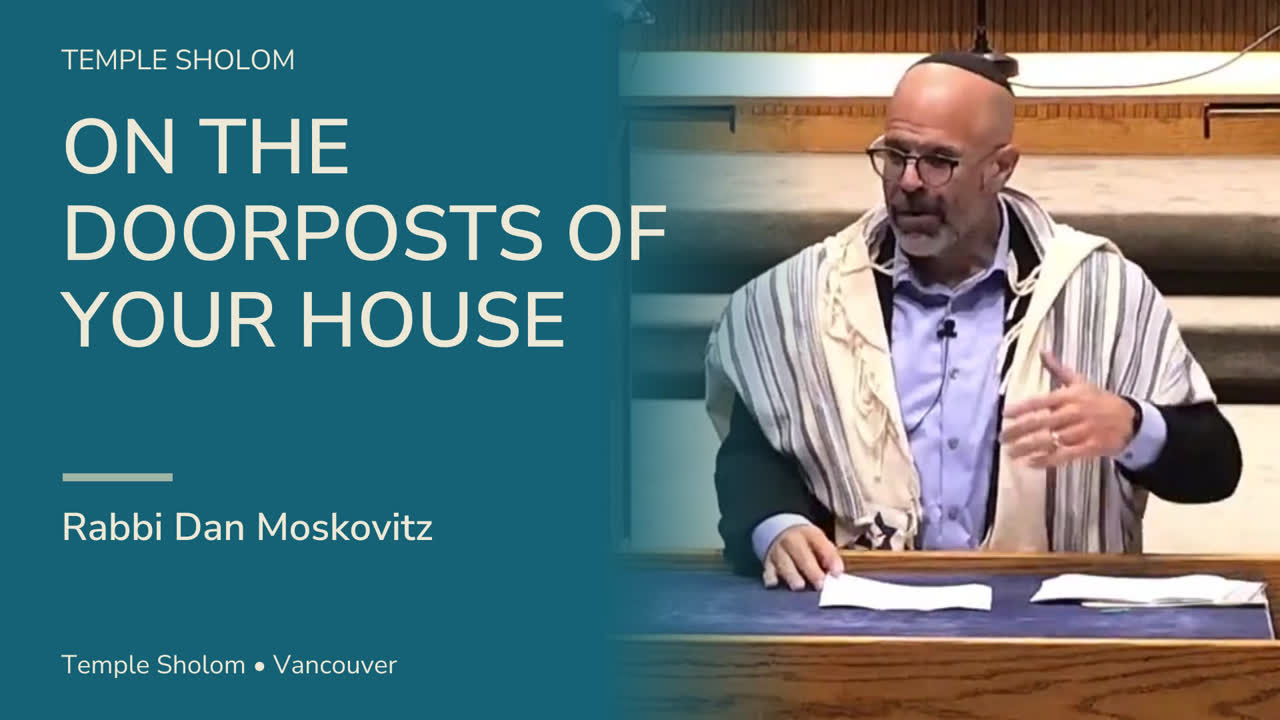
ON THE DOORPOSTS OF YOUR HOUSE
RABBI DAN MOSKOVITZ
TEMPLE SHOLOM
AUGUST 23, 2024
A Jewish man buys a new home, and he brings in a local designer to decorate it.
When the job is finished, the homeowner realizes he’s forgotten to put up mezuzahs. He goes out, buys mezuzahs, and asks the decorator, who is not Jewish, to place them on the right-hand side of each door.
The owner is worried that the decorator won’t put them up correctly, so when he comes home he’s so pleased to find the mezuzahs perfectly affixed by the doors that he gives the decorator a bonus.
As the decorator is walking out the door he tells the owner, “I work in a lot of Jewish houses, I’ve actually become quite an expert at putting up mezuzahs. I don’t even need to use the instructions inside the mezuzah at all, I just throw them away!”
(LAUGH)
For the past number of weeks I have been thinking a lot about mezuzot. That’s the proper plural for mezuzah, the hand sized amulet that is affixed to the doorframe of a Jewish home.
My ruminations on the lonely mezuzah leaning as it does angled toward the entry of the home took me a bit by surprise as the object is so ubiquitous in my daily life that more often than not I honestly fail to notice it. Which is in fact a practice that is in direct contradiction to its intended purpose.
In this week’s parsha, Ekev, which Estee will chant tomorrow morning, we are commanded to place the words of the Shema and V'ahavta on the doorposts of our house and on our gates, those are the words written on the scroll, the “instructions” within. The mezuzah is there so that in fact we will notice it and incorporate the teachings into our life as we leave and enter our home.
One of the reasons I have been thinking about the mezuzah is because, as anyone who has ever been in a home weeks before a B’nai Mitzvah will know, our daughter has been practicing chanting her Torah portion at nearly every waking moment. In her room, the car, at the dinner table, and if you listen closely I think she mumbles it in her sleep too.
I know these words have resonated with Estee because after studying her parasha she asked us a few months ago to hang a mezuzah on the doorframe of her bedroom. That she noticed one was missing was the very essence of the teaching and a victory for Jewish education.
To be clear, in our house we have a mezuzah on our front door and bedroom doors, but at some point in the painting or moving we missed Estee’s door and it wasn’t till she asked, because she had really studied it’s meaning, that I was reminded I needed to put it back up and so we did.
But the soundtrack of Estee chanting, “Uch’-tav-tam al m’-zu-zot bei-te-cha u-vish-a-re-cha,” serves as background music for two other more challenging encounters with mezuzot this past month.
When Vice President Harris was elevated to the Democratic Candidate for President I was reminded of a story I had read about my colleague Rabbi Peter Berg of Hebrew Benevolent Congregation (The Temple) in Atlanta, which loaned a historic mezuzah that had survived the bombing of that synagogue in the 1960s to the VP and her Jewish husband, Doug Emhoff. Shortly after Harris and Emhoff moved into the official VP residence at the Naval Observatory, Rabbi Berg led a private ceremony where he guided the Second Gentleman in installing the first mezuzah on the home. Harris being a candidate for President raises the possibility that there might some day soon be a mezuzah on the White House.
What that says about the acceptance of Jews in US politics is not the full story of course. For those that follow this election with the same attention and passion as your favorite professional sport you’ll note the antisemitism and double standard that was revealed when Josh Shapiro, the Governor of Pennsylvania, was on the short list as Harris’s potential running mate. I’ll leave the discussion of that situation for political pundits and not a sermon.
But the not-yet-realized mezuzah on the White House door is not my immediate concern; my big worry is over the one that will hang on our son Judah’s door when he moves into residence at the University of Ottawa next week.
Yeah there is a lot going on in the MishMosk home this week. We have a bat mitzvah this weekend and then in 3 days our oldest heads off to university, Estee starts High School at King David and in the midst of it all Levi, our middle child, moves into Judah’s room, where thankfully there is already a mezuzah, and an additional 6 square feet of floor space!
So what about the mezuzah on Judah’s dorm room? The commandment is to place it on the outside of the door, visible for all to see. It’s one thing to have it on the front door of our house. Is it something else for our son, so far from home, to put up a sign in the tight knit spaces of a university residence that essentially says “A Jew Lives Here!”? Complicating the situation, Judah is moving into a suite, so he’ll share a front door with a non-Jewish roommate he has never met.
I imagine what their first conversation might be.
“Hi I’m Judah, I’m gonna put up this metal box on our front door so that everyone knows a Jew lives here. I’m sure it’s gonna be great in helping us both make friends and fit in.”
Yeah that could go sideways really quick.
Maybe not, maybe he will find that rare free thinker of his generation of University students, the one who was not indoctrinated by TikTok quote-unquote “news.” Another 18 year old that can see complexity and includes Israel-Palestine in their embrace of non-binary thinking. Maybe he will find an ally, the silent majority of non-Jews in Canada that are appalled at the antisemitism that is flourishing in our streets and on our campuses, and is courageous enough to say and do something about it; like hang a sign on their door that says “a Jew lives here” and mean for it to be a statement of solidarity rather than a call to arms. I hope so, but am I willing to bet our son’s physical and emotional safety on it? Would you?
And still I know Judah, you know him too. He’s a proud Jew, King David grad, raised in this community, a Zionist and a Jewish youth movement leader. He wants that mezuzah on his door, and one of the lessons I am learning as we enter this new phase of parenthood is that this is his decision. Thousands of miles away, and more than a decade removed from when he would do whatever his parents told him to do, he’s going to choose his own path.
Judah’s dilemma is one I have heard many times since 10/7, in a variety of ways. I know many of you have struggled with it too, because we’ve talked about it.
Do I wear my Jewish star to a job interview? Do I wear a kippah in public, a shirt with a Jewish logo or organization? Do I speak up in a staff meeting when something is said that triggers my Jew-dar for antisemitism? Do I post, do I reply, do I engage? And what about within my family and circle of friends. Do I speak up or stay silent? How do I maintain relationships with people I love, but based on what they are saying or posting clearly do not love or have empathy for my people?
These are all versions of the same mezuzah question that confronts Judah, and in one way or another has confronted world Jewry for generations.
For an answer, let’s turn back to Estee’s parasha. A few chapters before the recitation of the Vahavtah and the instruction to put a mezuzah on your doorposts and gates Moses speaks to the Israelites as they stand assembled on the eastern shore of the Jordan, preparing to re-enter the land of their forefathers after fleeting 400 years of slavery in Egypt.
וְזָכַרְתָּ֣ אֶת־כׇּל־הַדֶּ֗רֶךְ אֲשֶׁ֨ר הוֹלִֽיכְךָ֜ יְהֹוָ֧ה אֱלֹהֶ֛יךָ זֶ֛ה אַרְבָּעִ֥ים שָׁנָ֖ה בַּמִּדְבָּ֑ר לְמַ֨עַן עַנֹּֽתְךָ֜ לְנַסֹּֽתְךָ֗ לָדַ֜עַת אֶת־אֲשֶׁ֧ר בִּֽלְבָבְךָ֛ הֲתִשְׁמֹ֥ר מִצְוֺתָ֖ו אִם־לֹֽא׃
Remember the long way that God has made you travel in the wilderness these past forty years, in order to test you by hardships to learn what was in your hearts: whether you would keep the divine commandments or not.
The challenge, the test, is the formation of Jewish character and identity, just as our own personal values and character are shaped not by our successes but by our struggles.
The idea that G-d tests us, what our tradition called yisurin shel ahavah / chastisements of love, is actually a theology long ago rejected by Jewish scholars. Maimonides said - God doesn’t test us, nature tests us, social corruption tests us and our own stubbornness tests us, not G-d. G-d or Jewish teachings is what guides us in how we answer those tests.
The tests themselves are welcome because they push us toward struggling and grappling with our values and our core beliefs. Like when you sat in the school lunchroom as a child and contemplated if you had the courage to take out your matzah sandwich while surrounded by your non-Jewish friends. These are character and identity defining moments.
A struggle, a moral or ethical or social dilemma is not a test from G-d it’s a test from humanity of the godliness within us. A test that reveals our values, our morals, our ethics, our character. These questions reveal where G-d or godliness resides in each of us and how we apply that to the world around us. For that reason they are welcome if deeply challenging blessings.
What is the purpose of the mezuzah – who is it for, is it for them or is it for you?
One Sunday afternoon many years ago I was invited to hang a mezuzah on the door of a small bungalow in a Los Angeles neighborhood. The home was maybe 100 years old. The door jam was wooden and pockmarked with chipped paint and gouges. As I went to take a hammer and nail to tap in the mezuzah in its usual spot I noticed a loose piece of molding. Prying it away with my fingers, revealed beneath was a hidden void and inside that small space was the klaf, the “instructions”, the scroll found inside a mezuzah with the very words Estee will chant tomorrow morning.
The mezuzah was already there. Hidden from the sight of others, but not hidden from the heart and prayers of the Jewish family that once lived in that home.
Here’s the lesson. We don’t hang it for them, we hang it for ourselves, for us. Why ever and whenever the previous Jewish owner of that home chose to conceal the mezuzah, they had good reason to do so and decades later we are still here to tell the story.
Jewish pride yes, but Jewish wisdom too, a Yiddishah Kop as my grandparents would say. How does a people survive and thrive through every conceivable attempt to destroy us? The prophet declared, “lchol tzman leit hefetz tachat haShamayim,” there is a time for everything. We know what time it is, we’ve been here before. Then, as before, our wisdom and creativity in how we answer the tests of this moment will determine our future and reveal our character.
I don’t know if Judah will or should hang his mezuzah on his suite door in the hallway for all to see, or on his bedroom door. Should it be on the outside of the door or with the height of caution and an awareness of the times we live in, for now at least on the inside of his door?
The Vahavtah continues, “v’shinantam l’vanaecha,” and you shall teach or impress these words upon your children.
I don’t know where Judah will hang his mezuzah in Ottawa, but I do know this, without me saying anything - he will hang a mezuzah, because that is what this community has taught him. It’s what you have taught our children who have each read Torah from this bema. V’shinantam l’vanaecha, impress these words upon your children, and you have made quite an impression. As a Jewish parent, as one child enters adolescence and another enters adulthood all I can say is thank you!