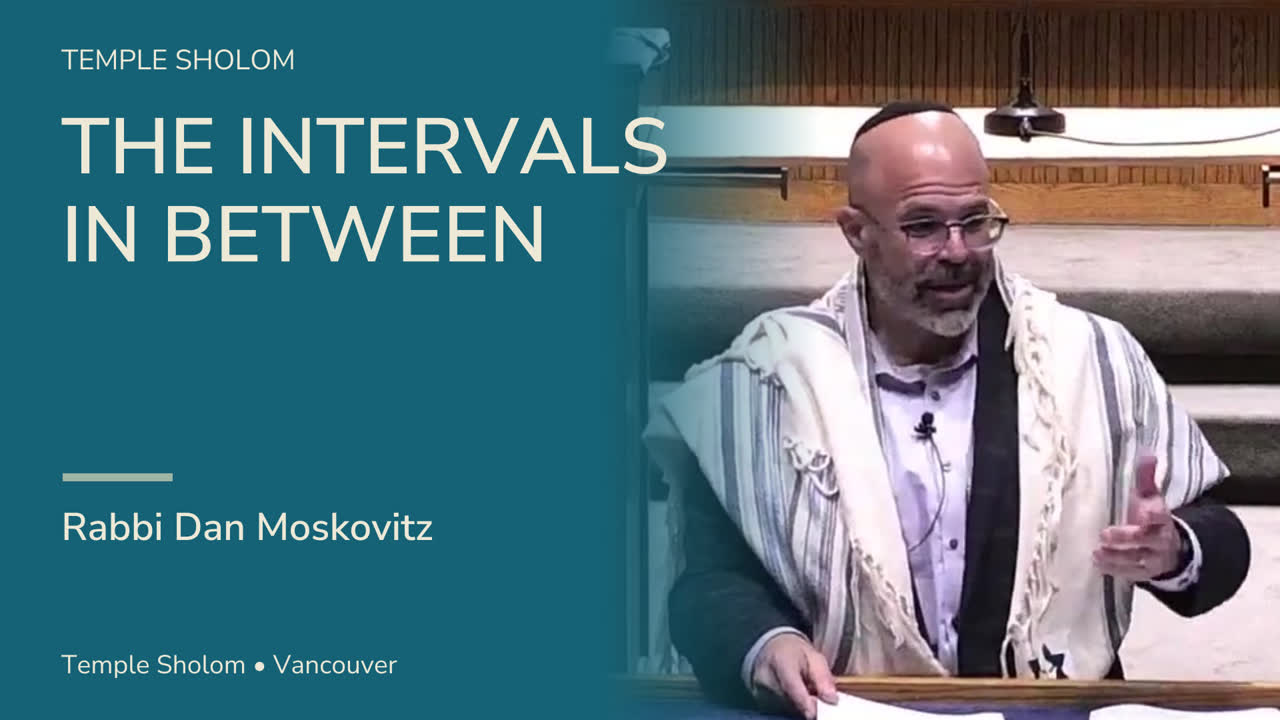
THE INTERVALS IN BETWEEN
Rabbi Dan Moskovitz
Temple Sholom
May 4, 2018
Yesterday marked the 33rd day of the Omer, or Lag B’Omer where the Hebrew characters for
number 33, lamed-gimel form the word LAG.
The date is significant because it was on the 33rd day of the Omer about 2,000 years ago when a
plague that had fallen upon the students of the great Talmudic sage Rabbi Akiva was ended.
That a plague had befallen his students during a period called the Omer was traumatic,
particularly because the Omer had always been a joyous time. Thus when this 49-day span
between the holiday of Passover that celebrates the redemption of the Israeli from bondage in
Egyptian slavery and the receiving of Torah by those same former slaves at Mt Sinai marked by
the holiday of Shavuoth; was marred by such tragedy everyone was devastated. The lifting of
the plague was met with great relief and celebration – even today Jews everywhere and
particularly in Israel celebrate Lag B’Omer with bonfires, cook outs and camping trips to mark
the time when suffering turned to celebration.
Every calendar and culture has its holidays, big and small that mark historical events, moments
in history or seasons that are worth remembering or celebrating. But is a uniquely religious
thing to mark the intervals in between holidays and remembrances.
In Judaism, these times can be the holidays themselves—Passover, for example, is not one day
but a week, giving us a period of time to remember the Exodus and reflect on the themes of
oppression and liberation.
In the fall when we celebrate the High Holy Days of Rosh HaShanah, the New Year, and Yom
Kippur, the Day of Atonement, we do not just mark those individual days, but the period of
time between them takes on heightened importance as the Yamim Nora’im, “The 10 Days of
Repentance”—a week and a half to reflect, repent and take stock of our lives and behaviors.
On the contemporary Jewish calendar, we just recently marked both Yom Hashoah, Holocaust
Remembrance Day, and Yom Ha’atzmaut, Israel’s Independence Day. The former marking the
greatest tragedy of modern Jewry, and the latter marking one of modern Jewry’s greatest
achievements. And the six days between these two events give us the opportunity to reflect on
the interplay between them: not just how the historical fact of one contributed to the historical
fact of the other, but how tragedy and renewal, despair and hope, mourning and celebration
are a continual cycle in our lives.
The lesson of the importance of the intervals between is of course not limited to calendars and
holidays, its also an essential lesson in life.Tonight, marks the beginning of a new interval for Jacob, our Bar Mitzvah boy. Contrary to the
popular Jewish wisdom today you do not become a man (or Fountain pen as was once the
fashion), but you are also no longer a boy, a child. Today, Jacob you enter into the interval in
between, adolescence – a word who’s entomology is derived in part from the fact that for the
next 5 or six years you will addle, as in confuse and befuddle the essence of your parents. Its
not your fault and not really in your control, though at times we might implore you to the
contrary, you’re in that space in between, you’re on the path to becoming.
Ask most adults and they will tell you that not for a million dollars or the cost of one bedroom
apartment in Vancouver would they want to go back to the period you are now entering into,
with all of its teen angst, pimples and social awkwardness. But ask them if the experience was
worth a million dollars in how it shaped, changed and prepared them to be the person they are
today and we will all tell you its was worth that and more.
Its in this interval that you make some of the most important friendships of your life; challenge
your own limits and experience more rapid growth and change than any time since infancy. To
quote the great English author Charles Dickens in a Tale of Two Cities ,it was the best of times,
it was the worst of times”, which I would add therefore made it the most important of times.
Like so many things its never about where you start or where you end up, true learning, growth
and transformation happens along the way, the journey, the interval in between those two
points on our lifeline.
My colleague Rabbi Seth was reflecting on some of these ideas his congregation over Shabbat
and shared that he was approached after the service by a congregant who is a runner. He
explained to the Rabbi that to be a successful runner, one needs to pay attention to the
intervals—the time between runs. It is his belief that the intervals are as important if not more
important than the runs themselves. We need to be able to rest and recover from one run in
order to perform at our best at the next one.
What interval are you in right now in your own life? Its not only about Bar Mitzvahs, each of us
is between something, in transition, becoming.
We celebrate and mark the important occasions in our calendar year, but we also need to pay
attention to the intervals, the time between those occasions, in the span of days, months and
even years, such as a young boy coming into adulthood. These intervals are as important as the
days themselves, for they allow us to fully integrate the spiritual teachings of one holiday, one
moment and remind us to fully prepare for the next.
SERMONS & WRITING · 2018
The Intervals In Between
May 4, 2018