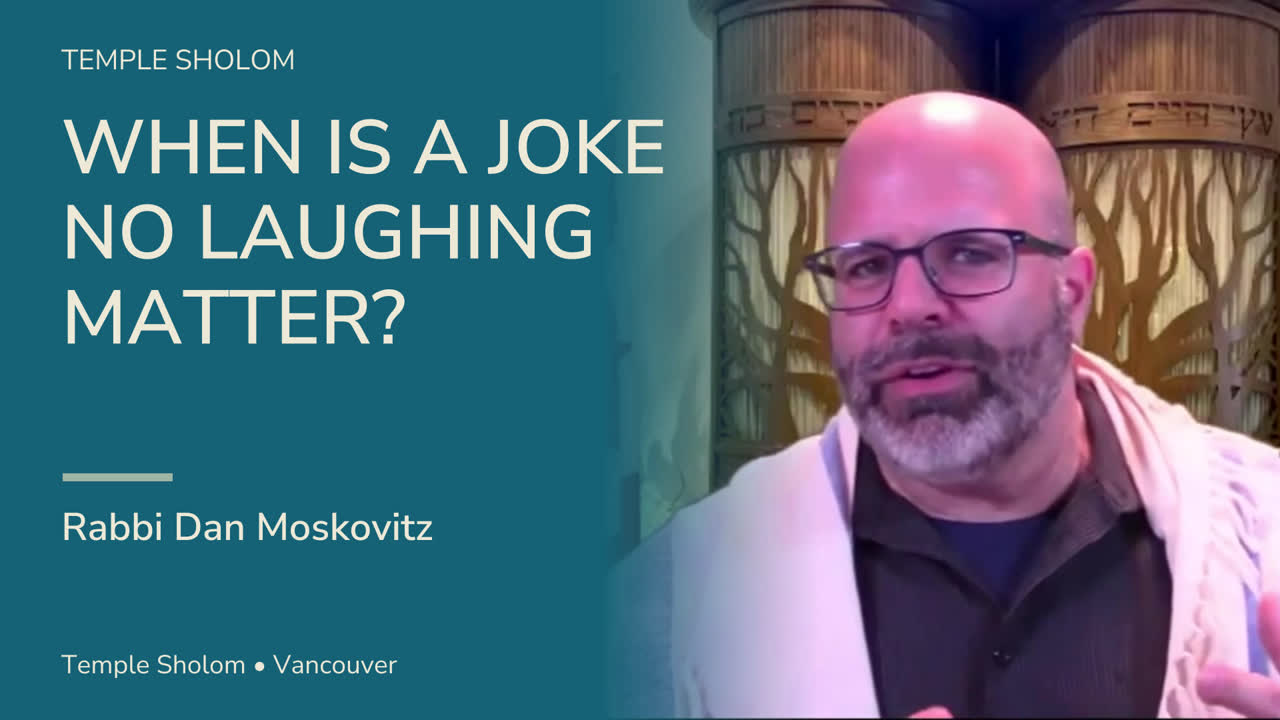
When is a Joke Not Funny
Rabbi Dan Moskovitz
Temple Sholom, Vancouver BC Canada
February 26, 2021
On this night after Purim, the holiday where we are commanded to tell jokes, laugh, and even get so
drunk that we cannot tell the difference between good and bad, many Jews are pondering a question
that goes to the heart of the humor this holiday is established to celebrate.
When does a joke stop being funny and become instead offensive and even dangerous?
Many in the Jewish community are debating this very question after a joke was told last week on
Saturday Night Live by comedian Michael Che during the Weekend Update segment of the world famous
and most watched show.
Che in his character as a new anchor reporting on current events challenged Israel's claim to success at
vaccinating 50% of Israelis against COVID-19.
“Israel is reporting that they vaccinated half of their population said Che the show's co-head writer. And
I'm going to guess it's the Jewish half.”
That was the joke. To the uniformed listener Che was implying falsely that Israel is only vaccinating Jews
against COVID-19 when in fact, all of Israel's citizens, Jews and Palestinians alike were vaccinated.
Jewish organizations angrily denounced the joke as anti-Semitic noting that Israel was in fact vaccinating
it's Arab as well as Jewish citizens, but others notice that the joke did point to a real problem. Israel's
failure to vaccinate Palestinians in the West bank who aren't Israeli citizens, but who are nevertheless
under Israel's occupation.
Still others raised the counterargument that jokes aren't meant to be literal and a people who are
known for our humor; indeed, some citing this very holiday of Purim as a prime example would do well
to laugh along with others. Why can’t the people who basically invented the joke, take a joke? Was the
rhetorical question asked by many in and outside of our community?
The incident raises serious questions; are we Jews being overly sensitive? Doesn’t our transition from
powerlessness to powerful require us to develop a thicker skin and to recognize that with attention will
come criticism, not to speak of biting jokes. More substantively, assuming that we're not treating
Palestinians, certainly on the West bank, the same way we treat Israeli Jews and Palestinians, do we
really have the right to be so outraged?
As my teacher Rabbi Donniel Hartman observed, “A joke which has a kernel of truth may hurt, but it is
the kernel, not the joke, which is the issue.”
Judaism has a long tradition of worrying about the danger of words. We never accepted the dichotomy
that sticks and stones are dangerous and words are not. Rather in Judaism we acknowledge that words
can do great harm, words can kill. The Torah and later rabbinic writings make clear that the sin of l’shon
hara – of gossip and speaking ill of another person are sins worse than murder in the eyes of some 2
Talmudic scholars. Because where physical violence has a definitive end; the sin of gossip, lies and
hurtful speech can go on hurting and reoccurring again and again.
In Judaism words matter, it was through words that God created the heavens and the earth, “beresheit
bara Elohim, at the beginning God spoke” and it is through words that human beings can crush a spirit,
mortally wound a soul.
And still there is a part of our tradition which says jokes are sacred. So much so that many Jewish jokes
are so well known we simply refer to them by number, or with the shorthand of the punchlines like, “it
might lead to dancing” or “A priest, a minister and a rabbi walk into a bar” In Judaism you don't censor
jokes. That's deep in Jewish culture, Jewish humor is irreverent. Last night we quite literally laughed in
the face of our own death; and then we ate cookies shaped like our tormentor’s hat. That’s funny; that’s
dark, that’s cathartic, that’s Jewish humor. Indeed, it’s the very example of gallows humor.
BUT maybe this joke crossed the line? Maybe when it is as this was a political joke told on the most
important political satire show in America, a show that shaped the culture of a whole generation and
when this joke portrays Jews as racists and comes out during a coordinated and global campaign to
portray the Jewish state as an apartheid state and when the joke is based on an outright lie that Israel
distinguishes between its Jewish citizens that its Arab citizens. Then what we are really dealing with is
more the warning of Jewish tradition to be mindful of your words, to watch your speech. Words can kill.
When is a joke not funny? Perhaps it is when your most basic legitimacy as a people or a race or a nation
is being challenged. Let me be clear, when you talk about the Jews, let alone joke about Jews there's a
lot of baggage and landmines. When you accuse Jews or the Jewish state of discriminating against
others, or of pushing to the head of the line, or of hoarding lifesaving medicine, there are associations
here that touch a deep Jewish nerve of blood libels, dual loyalties and anti-Semitic tropes; our Jewish
antenna go up.
And while we as Jews may be especially attuned to this kind of mischaracterization every race or culture
or nation; has its redlines. I won’t repeat the litany of offensive and over the line jokes that have been
made about marginalized people or the outright lies told about free and democratic nations, but they
are well known to us and we also know well never to repeat them.
The danger in Che’s joke, which wasn’t even very sophisticated in its attempt at humor is that it
perpetuates and already rapidly spreading narrative that Israel is white supremacist. That Israel is racist.
That Israel is apartheid. And the more these lies are repeated the more they become accepted as truth.
We know that when something becomes a conceptual given in a society, it's not clear, how to effectively
combat it, especially if you're on the defensive from the beginning. So, we draw hard lines, we say do
not cross here, because once you let them over that line, they are within the gates.
In fact, Judaism speaks directly to Che’s actions, in Proverbs 26:17-19 we are taught.
“Someone who passes by and gets involved in a conflict that is not their own is like one who grabs a dog
by the ears, like a madman who casts, firebrands, arrows, and death. That's the person who deceives
their neighbor and says, but I'm just joking to me.”
What Che did in articulating this joke based on an outright lie and fallacy was to cut into a conflict that
was not his own, clearly knows nothing about and cause undeserved pain, like grabbing a dog by it’s 3
ears. He opened up a hornet's nest and then like the text shirks any responsibility by saying, “but I was
only joking.”
That said, let’s be rational not hysterical not every person who makes a joke about Jews is an enemy or
an anti-Semite; Michael Che is not part of some larger cabal against the Jewish people, but his joke fed a
lie and targeted a long persecuted people and that was wrong.
There's no doubt that Che's argument is factually incorrect. 20% of Israeli citizens are Palestinian-Arabs.
All Israeli citizens are members of the national health plan and everybody has access to the vaccine and
is being vaccinated. BUT the joke may be a little painful because it's pointing to something that we could
have done, should have done; as Rabbi Hartman pointed out, it’s not the joke it’s the kernel of truth
within the joke that touches a nerve.
The critique of Israel in relation to COVID and the Palestinians is based on two aspects. One is the legal
one is the moral.
The legal has very little weight. The Oslo Accords granted full autonomy to the Palestinians on health
matters. The Palestinian authority in the past, made it clear to Israel that they did not want Israeli
intervention or help in their public health system.
The moral argument begins with the first moral responsibility that any state has is to its own citizens;
and Israel is still in the process of fulfilling its moral responsibility to vaccinate its own citizens, Jews and
non-Jews alike.
But at 70% Israel is approaching the point where they’re about to fulfill that moral responsibility. Then
what? What is the moral responsibility in a global pandemic to those living in lands occupied by Israel?
In Judaism as I practice it and teach it the legal does not excuse me from moral responsibility. Even in
strict orthodoxy we are commanded to have empathy for others; to live by the words of Torah, B’hai
B’hem; not to let them be the end of us. The moral takes precedent.
It is moral and legal for Israel to first care for its own citizens, Jew and non-Jew alike and without
distinction. Israel is doing that. But it is also moral that Israel; when it can; and that time appears to be
soon at hand turn its resources to those that it also has a moral responsibility for, those who live under
Israeli occupation.
Israel is now vaccinating the youngest adult populations; it could have; under the moral question for
example decided to offer vaccine and resources to acquire vaccine to the Palestinians once Israel
vaccinated those over age 60; knowing that those in the younger cohort are less likely to experience
hospitalization and death. It could have said to the Palestinians, now here if you haven’t already started
vaccinating those over 60 in your population then please take from us these shots and resources, and
then worked back and forth down the age group ladder.
Part of Israel’s role as a global leader and exemplar of a social democracy is a willingness to be judged by
the highest moral standards amongst the community of nations. And as a Jewish State we accept that
the Jewish Nation just like the Jewish people is held to and answers to a higher authority and standard.4
Che’s joke was factually wrong AND Israel is in the unique position now to do more for the Palestinians
than it has done thus far. I would prefer that the Jewish people went beyond the legal and set a new
standard of moral ethical behavior for all nations and all people. I think that’s our calling as an Or
Lagoyim, to be a light unto the nations. People laugh at Canadians for being too nice. Imagine a world
where they laugh at the Jewish people and the Jewish State for being too moral, to empathic, to
generous. For me that’s no joke; that’s an aspiration.
SERMONS & WRITING · 2021
When is a Joke Not Funny
February 26, 2021