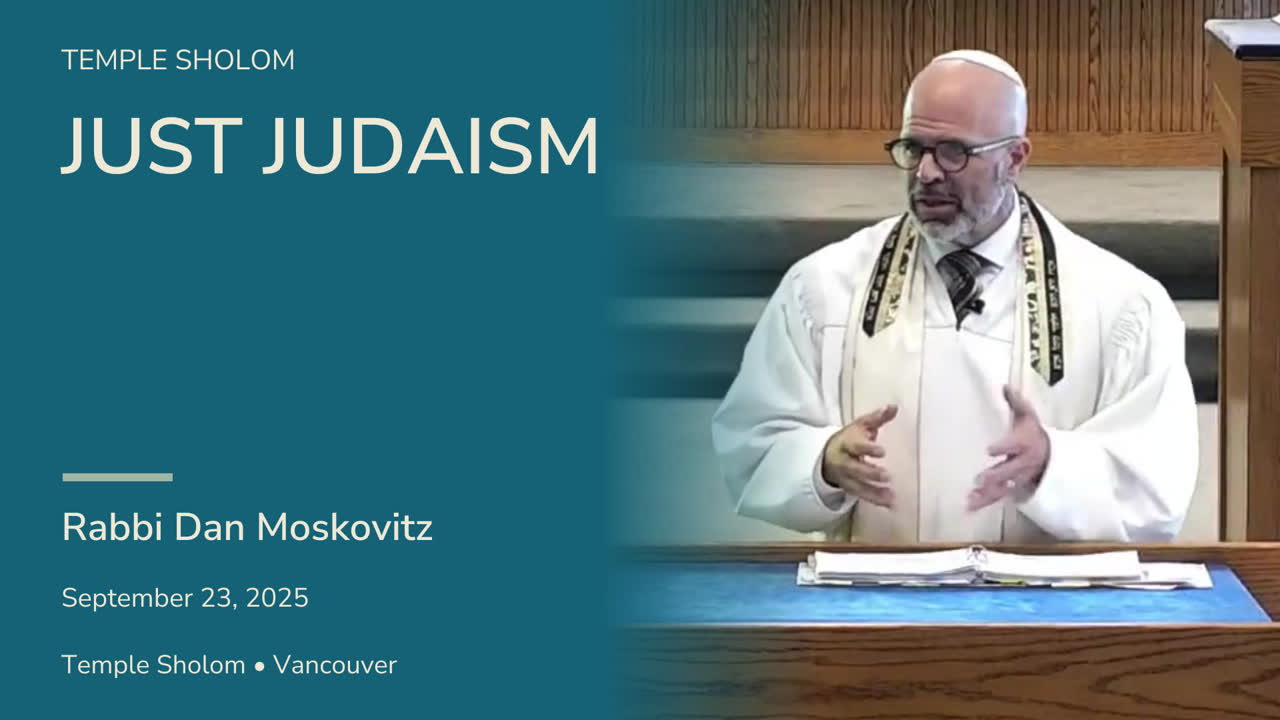
“Just Judaism”
The Essence of Who We Are
Rabbi Dan Moskovitz
Temple Sholom, Vancouver BC Canada
Rosh Hashanah Day 5786
Video Link:
https://youtu.be/UfG7VMu2b0U?si=0pjA1d_O9MLX-IkX
INTRODUCTORY SONG: I am Perfect and I am Broken by Dan Nichols
The Jewish people are extraordinary —
here and in Israel,
now and throughout history.
A people filled with love,
with purpose,
with holiness.
Hold strong to that truth, no matter what voices say.
And we are broken.
Wounded,
grieving,
questioning.
Carry that truth gently, even when your spirit feels heavy.
Both are true.
Both are in this room.
Both are in us.
Two years after October 7, the wound is still open. Time has not healed. It has revealed — how deep the pain goes. How relentless the hate. How much we seem to be living through the darkest moments of our history all over again.
Leonard Cohen sang, the cracks are how the light gets in - and that light has revealed so much; how much we need one another. How strong this community is. How resilient our people remain.
In the darkness [pause] we are shining.
And still we are hurting, not only collectively but personally. Our fractures run deeper than headlines. They are at our tables, in our friendships, community, in our own souls.
The Torah records that when our biblical ancestors watched Jerusalem burn for the first time 2500 years ago the prophet Isaiah prayed to God: Nachamu, nachamu ami — Comfort, oh comfort My people.
How many times in the 2,000 years since the second exile has that prayer cried from the heart and soul of the Jewish people? How many times in the past 2 years have we cried those words ? How many times have I cried?
Too many to count.
Nachamu, nachamu ami — Comfort, oh comfort My people.
How can I comfort you? How can we piece back together our broken hearts and wounded souls?
Another sermon about what Israel should or shouldn’t do? That won’t heal our brokenness — those debates matter, but they can’t be the whole of Jewish life.
Another sermon about who is to blame in Gaza? That won't save the innocent — Hamas’s cruelty is clear, the suffering of civilians is real and the hostages are still, hostage to it all.
Another litany of statistics about antisemitism in Canada or on campus? We know the danger is real, the policies ineffective, but fear and grievance cannot be the center of our Judaism.
Nachamu, nachamu ami — Comfort, oh comfort My people.
What does comfort actually look like? Not more arguments, not more statistics, not more blame—comfort must come from deeper sources.
Comfort is right here in this synagogue, in this community, with all of you. In Just Judaism itself.
In just Judaism — prayer and practice.
In just Judaism — memory and possibility.
In just Judaism — unapologetic and alive.
JUST as in essential: the core practices and values that ground who we are as a people.
And JUST as in justice: a Judaism measured not only in ritual but in righteousness.
A Judaism that carries the fulfillment of the two-thousand-year dream of return to our ancestral home.
A Judaism that holds Zionism as its founders envisioned it: the realization of prayers spoken for centuries, since the time of Isaiah — L’shanah haba’ah b’Yerushalayim, ‘Next year in Jerusalem,’
and
the 77 year promise of Israel’s Declaration of Independence, that the State of Israel ‘be based on freedom, justice and peace as envisaged by the prophets.’ for all who dwell there.
The Judaism I speak of is not a Judaism that leaves parts of us behind. It is a Judaism that gathers the whole story together: the covenant at Sinai, the yearning and trauma of exile, the rebirth of a sovereign people in our ancestral homeland, and the call to live out our values even in the hardest of times and most challenging of places.
That’s not revolutionary, it's nothing new, in fact it's very old, it's both ancient and urgent. It’s Just Judaism.
Just Judaism insists that our prayers and our actions, our memory and our moral conscience, are inseparable.
Both dimensions — the essential and the just — are not optional. They are what make Judaism whole and allow our people to embody our promise: to shine as an Or L’Goyim, a light to the nations, and to kindle that light within Am Yisrael itself.
For when Judaism is fully lived — through prayer, study, peace, and the pursuit of justice — it repairs individuals, elevates communities, and inspires the world.
Both the essential and the just are necessary, we cannot confuse our tradition of debate with endless quarreling; one builds us up, the other tears down.
So how do we navigate this moment in Jewish life, not Jewish history but the Jewish present. The world we are living in as Jews today?
Sadly it’s not so different, if different at all from our parent’s and grandparent’s.
Our tradition points to God, Torah, and Israel as the tools that sustained them and our people for thousands of years.
Today I want to offer a reframing, not to replace that classic rubric but to bring it closer to us in this moment. Think of them as three tools from our millenia old Jewish toolbox refurbished to the present day and situation. The old, essential tools are prayer, study and peace.
Prayer reaches toward God, a power greater than ourselves, however we understand and define it.
Study connects us to Torah, our story and our wisdom.
Peace is what binds us to Israel, Am and Eretz, the people and the land, in every place we live. Bakeish shalom v’rodfeihu, seek peace and pursue it the psalmist declares. (Psalm 34:15)
Taken together, prayer, study and peace are the core of Jewish life and they are Just Judaism. These tools are what got us to this moment as a people, a people that by all accounts, past and present should have disappeared like the Aztecs, Canaanites and the Hittites. And they are just what we need right now.
Three tools, three ways to find comfort and wholeness, meaning and purpose in this new year.
Let’s take them out of the tool box, dust them off, and remember or learn for the first time how to use them.
1. Prayer
Prayer isn’t magic. It's not a spiritual vending machine that dispenses blessings in exchange for correct words. Prayer is a way of re-calibrating the heart.
Years ago I was sitting by the bedside of a congregant in the hospital. Machines beeping, tubes everywhere, the fear of what might come next hanging heavy in the air.
You might think I always know what to say in that moment, I don’t and I didn’t then, and neither did they. Finally, she whispered, “Rabbi, will you share a prayer with me?” Not, fix this or explain this — just, be here with me, in prayer.
We didn’t recite the whole liturgy. We said the Shema. Slowly. Quietly. Together.
SHEMA YISRAEL ADONAI ELOHEYNU, ADONAI ECHAD
The words were a container. We filled them with all the fear, hope, and longing that neither of us could put into sentences.
That’s what prayer is. The words are ancient, but what they carry is always new because they hold the complexity of our lives. Prayer doesn’t change God, it changes us. Prayer is not a tool for explaining life, it’s a tool for holding us steady in it.
How do you use prayer as a tool in this complicated and painful time?
Choose one prayer and let it anchor you. It doesn’t have to be long or in Hebrew. Express gratitude when you wake up. Or whisper the Shema before bed. Or pause for Motzi before eating. One prayer, one line, one breath.
The words are a container, you pour in your soul. Do it every day, and see how it changes you.
It’s Just Judaism, pray every day.
2. Study
The rabbis teach: “The study of Torah is equal to all of the commandments in the Torah.”
Why? Because study is not only information. It is formation.
Study makes us into the kind of people who can live wisely.
Study trains us to think with nuance. To argue with humility. To listen and question with curiosity. It helps us resist propaganda and simplification. And do we ever need that!
In a world of weaponized slogans, study is our defense and our nourishment.
I think often of the Jews who carried a single book through exile, who whispered verses in camps, who recited psalms in secret. Study in Judaism has never been a luxury; it has always been a lifeline.
The Mishnah teaches when two people sit together and study Torah the shechina the divine presence of God studies with them.
You want holiness in your life, meaning beyond absurdity? You want to make sense of the moral complexity of this moment?
Study with us, your klay kodesh. Study a sacred text with a friend over coffee. Study with your child at the dinner table. Every time we learn, the Shechinah sits beside us. And we all need companionship. We all need wisdom.
Every time we learn, we uncover a path toward becoming the person and the people we are meant to be.
It’s Just Judaism, study it.
3. Making peace
Since many of us were children, if we knew one Hebrew word it was Shalom. We know it means hello, goodbye and peace, but it has a fourth meaning that encompasses them all, Shalom means wholeness.
To make peace is to stitch together what has been torn — in the world, and in our own families.
The rabbis teach: one of the greatest mitzvot is making peace where there is strife.
And yes, there is strife in our world. But the strife that wounds us most is closest to home — at the dinner table, in family group chats, in lost friendships, in silences that stretch for years.
Leave the troubles of the world behind for a moment, let this sanctuary truly be a sanctuary, focus on what’s right in front of you or the person sitting beside you, within arms reach.
We're not going to solve Israel, Gaza, Antisemitism here, but I’ll tell you this, whatever lies between you and those you love, Judaism gives us tools to repair that. Shalom is a verb, to make the broken whole.
The Midrash says: after the Golden Calf, God was so angry with what some fearful and fanatical Jews had done to distort Judaism that Moses had to talk God down from destroying the whole of the Israelite people. And if we’re honest, we can understand the impulse.
But God backs down, God’s anger subsides, God seeks resolution not retribution.
Hear the lesson: If God can revoke an angry vow. If God can learn that the person is more important than the principle. Then so can we, and so should we.
And I’ll confess another thing, in 25 years of being a rabbi I can’t recall ever using the word, “should” in a sermon. I’m using it now.
We all make vows in anger. We say “never again” about someone in our lives.
Sometimes that’s necessary for our safety or dignity. But often it’s just hardened pain.
Not every rift can be healed. Not between us and not between Israelis and Palestinians; but every rift SHOULD be met with empathy.
The High Holy Days remind us: judgment begins with compassion. First God listens. Then God weighs. Then God acts.
We are created in God’s image and so the same can be true for us. We can listen. We can release bitterness. We can refuse to let anger be the only story and we can act with Godliness.
Sometimes the most peaceful act is release. To say, “I can still be whole even if this relationship is never whole.”
Forgiveness is a homecoming, a return. It is teshuvah. Not a mountain to climb, but a step to take.
This is hard. And holy. And desperately needed.
So here is how to use this tool: Between now and Yom Kippur, choose one relationship. Not all of them — just one. Call. Write, simply say, ‘I’m listening.’ That is how peace begins. Let’s model in our lives what we find missing in the world.
That’s the essence of teshuvah, of this holy day, of shalom.
It’s Just Judaism, we SHOULD seek peace.
-=-=-=-
This past summer marked my 25th year in the rabbinate and began my 13th year, my Bar Mitzvah year, as your rabbi. Like every bar mitzvah, it’s a time to look back with gratitude and to look forward with hope and responsibility.
I am grateful — for every one of those years with you.
There is a lot I don’t know, but I do know this: what we need more than anything to navigate this moment is a Judaism that is both simple and profound, personal and public: a Judaism that shapes us, and a Judaism that bends the moral arc of humanity toward justice.
The world tells us: Jews, you are alone. You are hated. You will not endure.
Judaism says NO: We are a people. We are loved. We are eternal.
I am proud to be a Jew. Not only because we have survived, but because we have something worth surviving for.
Because in the chaos of the present day our tradition still teaches us and the world how to live — with integrity, intention, and joy. Because we are obligated to seek justice and pursue it.
So let me be clear about what I’m asking of each of us this year — myself included, because this is not only the sermon you need to hear, I need it too:
* In this New Year: Pray give your soul a voice. Even if it’s just one word, even it’s a cry of pain.
* In this New Year: Study, don’t just scroll, go deep. Let Torah shape you.
* In this New Year: we SHOULD seek peace where we can. Take one step toward reconciliation. Or one act of release.
These are not small things. These are the things that make us who we are.
These are the things that sustain us.
They are… Just Judaism.
The words Paloma sang are still true. We are beautiful and a little broken too.
And it is also true that through prayer, study and peace — through Just Judaism — we will do as our people have done for 3,000 years: we will take brokenness and make it whole and holy, our lives and our world.
The time for being defined by who and what threatens us is over.
It is time to rise, to remember who and what we are; to embrace the fullness of our tradition.
To restore the hope of two thousand years.
To uphold the justice at the heart of our Judaism.
To renew the spirit of our people.
We are not only a people who survive. We are a people who live, who thrive.
Let the sound of the shofar call us to that life:
A life of prayer. A life of peace. A life of study. A life of justice. That’s Just Judaism, that’s who we are and that’s just what we need in this New Year.
Shanah Tovah
SERMON ANTHEM: Am Yisrael Chai by Beth Shafer (new version)