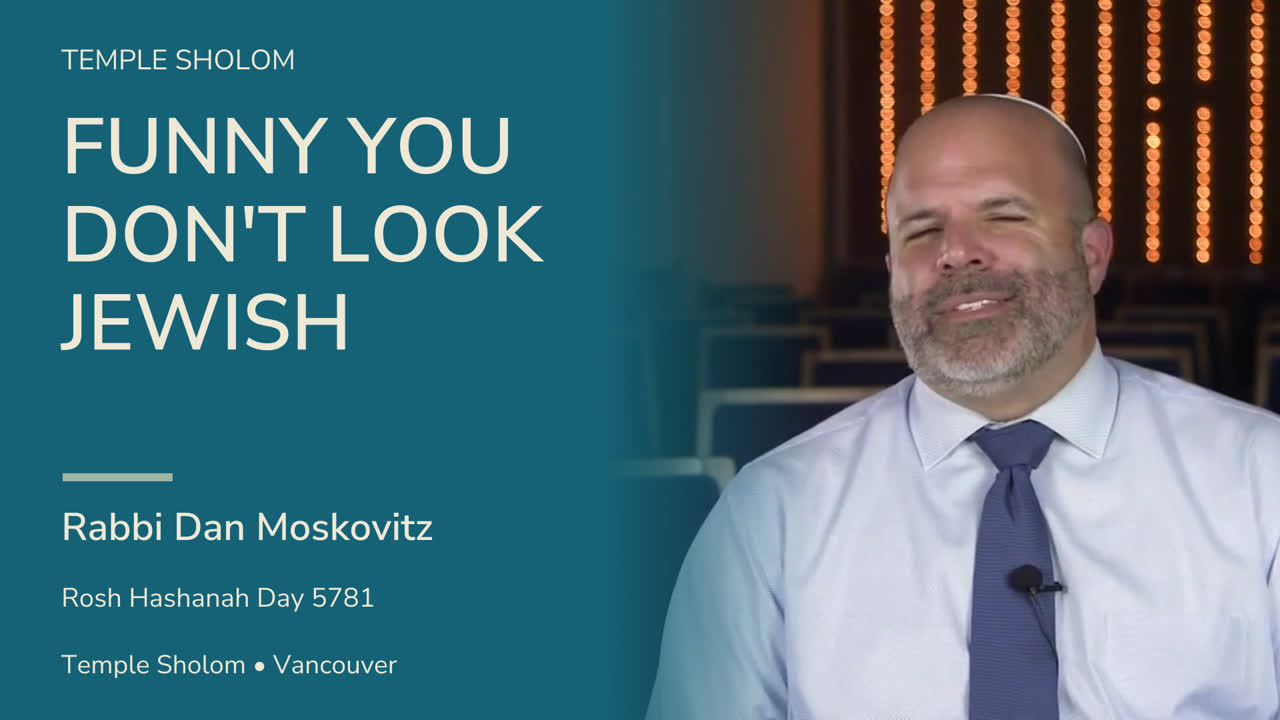
FUNNY YOU DON’T LOOK JEWISH
Rabbi Dan Moskovitz
Temple Sholom, Vancouver BC Canada
Rosh Hashanah 5781
This sermon was pre-recorded and produced like an extended television news segment,
including on camera interviews and archival footage. The script is below but it was really written
for the screen. That video is here: https://www.youtube.com/watch?v=VVsbCvWYUN4
IMAGE WORDS
Rabbi Dan - Have you ever heard the phrase, “Funny, you don’t look Jewish”?
Have you ever said it?
Video
Lower Third:
Vanessa Hidary,
“The Hebrew
Mamita”
“I meet a guy at a bar that’s cute.
He wears LL Bean Duck Boots and guards my bar stool when I
have to go pee.
He asks me out for dinner for the following Tuesday I decline;
Tuesday’s Yom Kippur I will be fasting.
You’re Jewish? Wow!
You don’t look Jewish.
You don’t act Jewish.
And he says it in this tone that sounds like he is complimenting
me,
And I say, and I say
Nothing!”
Rabbi Dan - That poem by Vanessa Hidary, the Hebrew Mamita has over half a
million views on YouTube. Clearly it touched on something deep
within the Jewish experience.
Since the late 20th century, there has been a general assumption that
Jewish means white and of Eastern European descent. So if you’re
black, asian, hispanic or any other Jew of color, you may have been
told that you don’t look Jewish. Or perhaps worse.
Take as just one example what happened to Rivka Campbell, when
she sat down in a Toronto synagogue on Kol Nidrei.
Rivka Campbell
(1:26 - 2:45)
Rivka Campbell
Toronto, ON
“I love Kol Nidrei. I think of all the services on during the high
holidays, Kol Nidrei, I love so when I go Kol Nidrei, I am focused. I am
centered. I am deeply involved in the service. And what had
happened was, we are sitting in our seats.
Re-enactment
closeup of a tap
on a shoulder,
And then during the service, when I am, you know, in my spot, there’s
a tap on my shoulder. Rivka Campbell
(1:26 - 2:45)
So I turn around and I’m like, yes. And the person
says to me, Oh, I’ve never seen you here before, blah, blah, blah,
blah, blah. I looked at them and I said, that’s interesting because I
come every Shabbat and I’ve never seen you here before. And I
turned it around because just the way they asked the question, it was
that that feeling of, you know, they wanted to say more is a
completely inappropriate question to ask, not just merely for the fact
that I’m there and it’s Kol Nidrei and you with your entitlement, tap me
on the shoulder to ask me this question; what does it matter to you?
Um, I hope you’re tapping everybody who you’ve never seen before
and asking them the same question, but somehow I doubt it.
Rabbi Dan - Rivka was born and raised in Toronto to Jamaican Jewish parents,
whose matrilineal Jewish lines start with the Jewish expulsion from
Spain to Jamaica. She is a Jew of color and she is not alone.
Rabbi Dan - Last year the UJA conducted a study on Jews of Color in North
America. That alone was significant because in the last 20 years only
41% of Jewish community studies even included any questions about
race and ethnicity in the first place.
”12-15% of North
American Jews
are Jews of
color.”
The UJA study found that ”at least 12-15% of North American Jews
are Jews of color.
Rabbi Dan That means 1 out of 7 Jews in North America is a Jew of Color and
yet, when we meet one, in one way or another, we say the words:
Rabbi Dan
Put words on as
I say them
Funny, you don’t look Jewish.
Rabbi Dan - It may sound innocent...
but it’s racist.
I am ashamed to admit that I’ve said it.
It was Purim, days before the COVID lockdown, we were rehearsing
the Purim spiel, I was trying to be funny, I wasn’t even really thinking;
but the pain I caused was real, I apologized, it was accepted and still
the shame weighs on my conscience.
Uncomfortable Truths, Al heyt shechatani - forgive me; I am guilty of
this sin.Definition card Racism not only means that one believes in the superiority of a race.
It also means racial prejudice. Assuming that “Jewish” means “white” -
that’s racist.
Rabbi Dan - Darren Parris is a Temple Sholom member, new father and a Jew by
choice.
Darren Parris
33:47
Lower Third:
“Darren Parris -
Vancouver BC”
“Ever since converting, I've had some interesting moments that
people are either shocked that I've suffered racism or they've said to
me, racism doesn't exist. It doesn't happen often, but it has, or
someone's told me that I haven't experienced racism and, and they
were all Jews, all those interactions were from Jews and it blew my
mind.
Rabbi Dan - Though in our community, discrimination is not only based on looks. It
can also be based on culture.
Rabbi Dan -
Definition card
on screen
“You don’t look Jewish” has an equally hurtful and cancelling
counterpart,
“That’s not Jewish”
Where the word “racism” means to hold a racial prejudice, another
word -Ashkenormativity- is used to describe the
dominance of Eastern European Jewish culture, heritage, and
experiences in representing what many believe to be “normal”
Judaism.
Rabbi Dan -
Images flash on
screen:
Herring, Kugel,
Lox & Bagels,
In the askenormative worldview: Herring, kugel and bagels are
“Jewish.”
Rabbi Dan -
Images flash on
screen:
Lachmagine,
kubbeh and
Khachapuri
Lahmjoons, kubbeh and Khachapuri – traditional Sephardic foods –
are not.
Rabbi Dan -
Video from
fiddler
Tevye dancing
(4:21)
Fiddler on the Roof, klezmer music - that’s Jewish. Rabbi Dan -
Video of
yeminite
wedding
Music from the Mediterranean basin played with the Oud, qanún,
tambourines and other percussion instruments and sung in an Arabic
melodic mode - that’s not Jewish.
“Ashkenormativity” can be just as powerful a force in ‘othering’ and
marginalizing members of our community as racism.
Rabbi Dan - The rabbis of the Talmud argued that this human weakness, to judge
people by how they look or to make assumptions based on dress or
culture rather than their values, goes back to the story of creation.
Rabbi Dan -
Talmud page
with pull quote
According to the Talmud, Adam and Eve were created alone, without
a sibling, so that one person wouldn’t say to another, “My father was
greater than your father”
Rabbi Dan -
Heschel and
MLK photo
The great theologian and civil rights activist Abraham Joshua
Heschel, gave a similar answer when he was asked about the root
cause of racism in one of his final interviews only a few weeks before
he died.
Video
Heschel interview:
“racism is eye
disease” @
(10:54 - 11:20)
“As a person committed to biblical faith I would say what keeps
humanity alive is the certainty that we have a father. But then I
supposed I have to remember that God is either the father of all men
or no men. And the idea of judging a person in terms of black, or
brown or white is an eye disease.”
Rabbi Dan - Whether our community discriminates based on race, food, music or
traditions in general, the consequences of what Heschel called an
“eye disease” and we might call “inherent bias” or “systemic racism”
are the same: our community weakens and divisions between human
beings grow deeper.
Rivka Campbell
(13:15)
“”My children mentioned it to me. They said, you know what, mom,
people are asking if we’re Jewish and you know, how are we doing?
And they had never asked that before… When they saw me as a
black mother, it flipped their thinking.
Rabbi Dan - Experiences like those of Rivka’s children are not uncommon Bema
Sermon
amongst young Jews of color, a disconnect that stems entirely from
how the Jewish community “sees them” – Heschel’s eye disease; not
how they see or practice Judaism.
Rivka Campbell
(15:07 - 15:20)
And it's sad. It's sad because they're members of this family and they
should feel, they should feel comfortable in going into a Jewish space
and not having the questions, not having the looks, not having
anything, just being just existing.
Rabbi Dan
v1
Annamie Paul recently ran for the leadership of the Green Party of
Canada. She is the first black woman to run for a federal party
leadership since 1975, and had she been elected she would have
been the first Jewish party leader since David Lewis of the NDP in
1971.
V2 (18 seconds) Annamie Paul is the newly elected leader of the Green Party of
Canada. She is the first black woman to be elected to federal party
leadership since 1975, the first Jewish leader of a Canadian political
party since David Lewis led the NDP in 1971.
Annamie Paul
(6:09 - 6:24)
Annamie Paul
Toronto, Canada
“I think the other day someone said to me, ‘You know, this is
remarkable. I really had to speak to you because you are already a
black woman in this world. And then you just thought, I'm just going to
add Judaism on top of that. Like, you didn't have enough problems.’”
Rabbi Dan - Being Jewish and a person of colour in 2020 where both anti-semtism
and anti-black racism are rising provides an important perspective on
this moment of social conflict
Darren Parris
(11:06 - 11:35)
Interview2
Being a black person and Jewish, I feel even more compelled to fight
the stereotypes and negative stereotypes that are portrayed for both
cultures. And there's definitely parallels that run between them. And,
uh, and the great thing about Judaism. It not only gives me the tools
to do that, but it actually helps me, with the reason why.
Rabbi Dan
Images: Anti
Israel protest
signs from BLM
marches
Images of the St
Louis and the
book cover
Images from
sites of attacks
on Jews images
The Passover Haggadah reminds us that in every generation they rise up to
destroy us. We know who THEY are, every era has its Pharaohs but how we
define US is our question on this holy day of questioning and examining our
souls.
The rallying cry "Black Lives Matter" has divided communities, and Jews are
no exception. Some in our community are unable to separate a unifying
slogan from subgroups within the movement that promote an anti-Israel
agenda. of memorials to
George and
breonna
Others have shown instinctive discomfort with the fact that the slogan
focuses on the lives of a single ethno-racial group.
I understand the concerns but we cannot let valid concerns become invalid
excuses.
The Jewish people, more than perhaps any other group, should understand
the demand of Black Lives Matter. We need only look to our own historical
experience of distinctive discrimination, violence and oppression,
specifically due to our ethno-religious identities. At this moment US is all of
us.
We of all people should be able to relate to this powerful three-word
statement for what it is: an echo of our own outrage and disbelief when the
world and Canada in particular said, “None is too many.” Did we not scream
“Jewish Lives Matter” as the world closed its borders to us?!
Yes US is all of us
Black people and Jews have vital commonalities in our history; it is more
than some Black folks are Jewish or that many Jews were active in the
civil rights movement. If we truly look more than skin-deep our communal
experience of being considered "other" over many centuries remains a
searing and defining collective experience that feels ever-present.
The fact that the White Supremacists in Charlottesville were chanting
"Jews will not replace us" is a pretty powerful reminder that when it
comes to targets of hate groups Jews and Blacks are bound together.
My colleague Rabbi Jeff Salkin observed:
Rabbi Dan
Put quote on
screen in 2
slides
“Jews experience the wave of violence against Jews – Pittsburgh, Poway,
Jersey City, Monsey – as the continuation of the darkest moments of Jewish
history. As one long pogrom.
Black Americans experience the wave of violence against them – George
Floyd, Breonna Taylor, Jacob Blake – as the continuation of the darkest
moments of American history. As one long lynching.
Rabbi Dan We have an opportunity as Jews that a lot of people don't have, to go from
our own history of being beaten, murdered, targeted and systematically discriminated against and enter with empathy into what blacks, indigenous
and people of colour are experiencing everyday.
There is no doubt systemic racism is a huge and complicated problem - one
sermon will not solve it; Martin Luther King’s dream is not yet reality; but
we are not powerless either. Our torah reminds us, לֹא עָלֶיc הַמְּלָכאָה לִגְמֹר,
וְלֹא אַתָּה בֶן רוֹחִןי לִבָּטֵל מִמֶּנָּה it is not upon you to finish the task but neither
are you free to neglect it.
There is so much we can do and must do to address the experience of Jews
of Colour in our community and the systemic racism experienced by people
of color in Canada; the people I spoke with suggested these three important
actions we can take right now, especially now.
Rabbi Dan (1) Assume every person that walks in the shul belongs there, knows
why they are there and has a reason to be there. Open arms; not
closed minds.
Darren Parris
Bullet Point #1
18:47 interview2
I want people to realize when I walk through those doors, I want to be there.
And that's what you should take from that. And, and thus greet me with the
same, hopefully enthusiasm
Rabbi Dan - (2) Empathy - this moment is not about us as Jews, it’s about us as
Canadians and human beings. But while its not about us there is
a very specific Jewish response. As Jews, our generational
experience of discrimination and suffering compells us to be
allies to this movement; Black Lives need to matter to us!
Rivka Campbell
31:29
Bullet point #2
People should be better at not othering others, regardless of whether it's
about race, about gender, sexual orientation, whatever it may be about. We
as Jews have an obligation to not other others.
Rabbi Dan - (3) Its not enough to not be racist, we have to be anti-racist - to
actively and proactively disassemble structural racism and racist
policies and implement policy and elect leadership that furthers
those goals. We cannot sit idly by.
Annamie Paul
18:45
Bullet point #3
Given the, the, the hundreds of years of, of racism in this country, whether
it's anti indigenous or anti black racism, or, you know, other communities as
well, that suffer from racism, if you're not proactively seeking ways to be an
ally seeking ways to use your talents, uh, uh, for instance, uh, against,
against actively fighting against that racism and working towards the kind
of systemic change that is going to bring true equality, then, uh, you know,
you really couldn't consider yourself to be anti-racist either.Rabbi Dan Ellie Wiesel powerfully observed that the greatest threat to humankind is
not hatred but indifference.
Elie Wiesel
Video
(0:08 - 0:50)
“I came to a conclusion that the peril threatening humankind today is
indifference, even more than hatred. There are more people who are
indifferent than there are people who hate. Hate is an action. Hate takes
time. Hate takes energy. And even it demands sacrifices. Indifference is
nothing, but indifference to hatred is encouraging hatred, and is justifying
hatred. So what we must do — I mean your peers and mine – is fight
indifference.”
Rabbi Dan
Lower third:
“The opposite of a
racist is; not, not a
racist. The opposite
of a racist is to be
anti-racist.”
Lower third:
Tzedek, tzedek
tirdof the Torah
urges “justice,
justice you shall
pursue.” (Deut. 21)
To be aware of the injustice and indignity experienced by people of color in
our society and in our shuls and to respond, “All lives matter,” or to state
defensively, “I am not a racist” is to deny the complicity of indifference. The
opposite of a racist is not, not a racist. To be the opposite of racist is to be
anti-racist.
Judaism demands this of us. It’s a commandment, not a suggestion.
“Tzedek, tzedek tirdof,” the Torah urges “justice, justice you shall pursue.”
The word is repeated because it’s not enough to only be just, we must
pursue and fight injustice, we have to go looking for it and eradicate it;
anything less is indifference. Anything less is to answer by saying it’s about
them not us, not me.
We of all people who have felt the pain of indifference, who have been
told and shown that our lives don’t matter; we cannot, we must not allow
that to happen to anyone, any people, ever again; never again.
Good Material that I am leaving out:
(27:14) Balarama Holeness on What we can do
So what could we do? Well, it's conversations around the dinner table, ensuring that people in
our immediate environment are aware of these issues, the way that you treat people in the
streets, the way that you treat people in the workplace, the way that you treat people throughout
your environment, simply showing respect is the first step to solving systemic racism and
systemic discrimination. We do not want as a society for people to be treated equally, but before
we can ask a judge to treat everyone equal before under the law will us in our everyday lives
and our everyday social lives, we have to treat everyone equally. And that is the first, most
simple step to tackling systemic discrimination. And to end on that point is that there is not going
to be one hero. That's going to come up with one policy or one action or one organization that's
going to complete eradicate systemic racism. We're going to have to make connections and
collaborations across Canada, across religions, across gender, across race. And we have to
ensure that everyone from synagogues to mosques, to churches, or regardless of your religion,
or regardless of your background, that we all come together to collaborate, to tackle this issue, to ensure that there is more just this here in Canada.
(33:10) Rivka on George Floyd & Discovering that her white Jewish friends were racist
Sure. Yeah. George Floyd, that's still a really difficult thing for me to speak about as a black
person take away even the Jewish part, even though you really can't, but let's put that aside for
now as a black person, I have almost become desensitized to all the stuff that happens to us as
a people. I have, you know, when I hear in the news, Oh, this person was shot by police broken
into the house, whatever it may be in my mind, I'm like they got another one, they got another
one of us and nothing's going to happen. George Floyd was different for me. George Floyd was
different. And I'll tell you how I got to this part. When I heard the news of George, George Floyd,
I did think they got another one of us and another one of us use that sentence. I can't breathe,
but I still didn't really process it.
Other than to think that I didn't even watch the video for a couple of days, because why, but as
a momentum was building up on, you know, social media and so on, I said, okay, let me at least
see the video. So I went and I watched the video and it wasn't even, I'll tell you what did it for
me? Wasn't George Floyd. It was the police officer. And the, if you'd seen the police officer, if
you didn't see, mr. Floyd had just saw from, you know, let's say waist up, even you would have
thought that man was waiting for a bus. And I don't think any of us had, had seen something like
that before the, I like to say it is, um, there's a term that they used the Holocaust during the
Nuremberg trials. And it was a coin that a, um, a woman, I think I cannot remember her name,
but nonetheless, she coined the term banality of evil. And that's all I can think of when I looked
at that police officer and his expression of nothing, actually, nothing, nothing. And I think that's
what made me break. That's what actually hurts my heart was that here you are crushing a
human being to death and you have no expression. Your hand is in your pocket. Your hand is in
your pocket. Like you're waiting for a bus and it broke me. And I, I cried for a day. I'm sorry.
Cause it hurt my heart. It hurt my heart. And so I started posting about it and I don't normally
post about those topics on Facebook is Facebook supposed to be my happy place. And I
started posting about it. And what hurt me even more was the reaction of my community was
my Jewish community. And the reaction, you know, we had the support. There's no doubt. I
think it was the obvious racism being spewed on my page that was like, wow, wow. Um, things
like, well, you know, those people, if they weren't in that position, then you wouldn't have a
problem. And um, you know, look at his record. Uh, and I would say so because of things in his
past, he deserved to die. We have a concept of tshuva and he had was making that and you've
discounted that. And really, and truly, it doesn't even matter.
We are not judged. We're not police judge, jury and executioner, but they didn't care. And I kept
seeing these posts. And let me tell you, I lost real friends. I was fine to Facebook friends
because you know what I saw them for the first time in years, I saw them. I saw exactly who
they were and I did not want them in my world because no matter how many times I explained it
and I would like even do, I would even do comparisons to us as Jewish people and what we
went through. And how would it feel if somebody said, well, we deserve to die because we did
this, that and the other, we would lose our minds. We would lose our minds or even, um, when
somebody were bright, black lives matter and somebody would say, well, this and that. And I
said, well, how would you feel if the authorities, if the authorities, the government decided to kill
Jews and Jews started saying Jewish lives matter and somebody said, yeah, but all lives
matter. How would you feel? Nobody's saying only black lives matter. Nobody would have been saying only Jewish lives matter, but you think how that would feel if you were in a position where
the government were killing Jews because they were Jews and you said help us because
Jewish lives matter and somebody countered it with all lives matter.
(41:02): Rivka - there is hope
Out of all of this, I do believe there is hope. There is hope for us. I've noticed I've been doing
this for years now, years. And normally when I do this, I feel like I'm sometimes feel like I'm
talking to myself. Sometimes I feel like I'm talking to people are smiling and nodding, but not
really hearing the words that are coming out of my mouth. For some reason, it's like everything
came into place and people in my community, my family are listening. I am getting people who,
cause there'd been other incidences like this, but now I got, I got calls straight away from people
who've said, Rivka, are you okay?
Are you okay? I'm the president of my synagogue called me. Are you okay? I don't know what to
say, but I'm here. And, and the other piece is not only are people listening, they are, they are, I
have this thing. It's called not about us without us. And the community is doing that. They are
saying Rivka. We would like to make some lasting change, but we recognize that we can't do it
without you. We can't do it without you because for two reasons, first of all, it's not my job to fix
fix. The problem is not my job to fix the racism. It's not the victim's job to fix it. However, I know
how it feels. And I know what the microaggressions are. I know what I would like to see as a, as
a person of color. And it's an, it's a unique view and it is refreshing and hopeful to me and to us
that you want to hear from us, what would make things better, as opposed to saying, look, we've
decided to put up this sign. I hope that makes you happy.
Because if you had asked me, I'd probably say, nevermind, the sign, nevermind the sign. Don't
even do a statement. I'm more interested in the walk that you will walk. I am more interested in
the fact that you're going to involve me in this conversation because you cannot do it without
me. I am more interested in the fact that you're recognizing it's not a sprint. It is a marathon. And
that putting up a sign, um, is not enough and that you need to make some lasting changes. And
that will take time. That will take time. And I saw, for example, somebody said, you know, in
good intentions that said, okay, you know, we're going to look to find, see if we can shake up
our board and get some people of color. And it's like, Whoa, no, that is performative. And what
you are actually doing is you're setting us up to fail. And it's a process. It's a process. Plunking
me on a board of directors is just performative. Look at, look bigger than that. Look at your
policies. Look at the ways that you can encourage people like me to come in and participate.
And then maybe one day we'll take that other step and say, Hey, I'd like to be on the board of
directors. Don't start here. Start here. Don't start here. Start here. Because the thing is, it took a
lot of years to get where you are. It's going to take quite a bit of time to get things the way it
should be. So be kind, also be kind to yourself, but never have the conversation without us.
SERMONS & WRITING
Funny You Don’T Look Jewish
Rosh Hashanah 5781