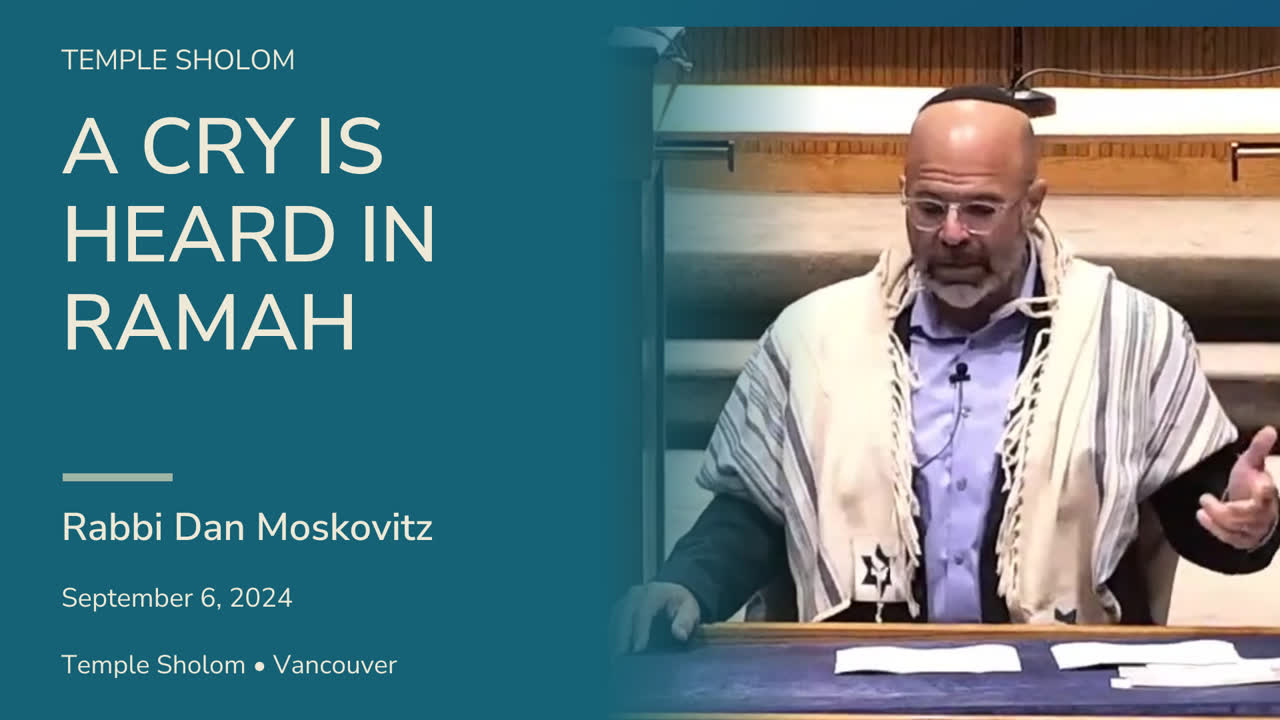
A Cry is Heard in Ramah
Rabbi Dan Moskovitz
Temple Sholom, Vancouver BC
September 6, 2024
Thus said GOD: A cry is heard in Ramah—Wailing, bitter weeping—Rachel weeping for her children.She refuses to be comforted. For her children, who are gone. (Jeremiah 31:15)
That verse from the prophet Jeremiah was written 2,600 years ago, and was written again 10 days ago when Rachel Goldberg-Polin, mother of Hersh cried out his name into a microphone on the Gaza border.
Pleading, praying, beseeching that her voice, which had penetrated even the most stone cold of hearts, would penetrate the stone and sand of the vast Hamas tunnel complex that held her son and nearly 100 other innocent women, men, children, elderly and wounded Israeli civilians captive.
“Rachel [is] weeping for her children.” These lines became a parable of Jewish loss, displacement, and despair. So loud did Rachel’s sobbing seem that it rolled across the Samarian mountains, and so intense was her sorrow that “she refuses to be comforted for her children who are gone” (Jeremiah 31:15).
Again that was 2600 years ago, but it was also six days ago.
Not every Jew knows these lines, but every Jew knows Rachel’s cry. We hear it from afar, even if it is whispered, and that is what we heard when we watched Rachel Goldberg-Polin’s cry at the gates of Gaza, and then six days ago when we heard her cry and saw her strength and courage again at the funeral of her only son. Murdered with five other fellow hostages.
Rachel’s weakness before the world, her dignity, her composure, her location of Olam Habah was so impactful. She brought everyone to shiva. Here I’m not distinguishing between the biblical Rachel and the Rachel of present tense. They are one and the same, they are mothers, Jewish mothers crying over the murder of their baby boy. That cry knows no time, no place, no religion, no nationality. A mother’s weeping is universally recognized and understood.
Thanks to this mother, we are all sitting shiva for Hersh Goldberg-Polin
If there is one thing I’ve learned from Rachel, it is the importance of channeling that inner Rachel in the face of challenges and adversity.
Listening to her tell Hersh’s story on the news, at the UN, at the Democratic Convention, to world leaders, in the face of antisemites made me a better father. She inspired me to tell my children multiple times a day how much I love them. She reminded me to never let fear or embarrassment or work stand in the way of expressing that love.
The reason so many felt so connected to Hersh is not because his life is valued more than the other precious souls trapped in Gaza; it’s because, for 330 days, Hersh felt like a brother, son, and friend we knew ourselves. And that’s because of his mother and father’s tireless advocacy for his freedom.
“They range in age from 10 months to 85 years, and they are from nations all around the globe,” she told the UN. “They are Christian, Jews, Muslims, Hindus, and Buddhists,” she went on, thus universalizing the hostages’ plight while imploring the diplomats she faced: “Look at their photos, read their names, and then replace their names with the name of your own daughter, son, father, mother, brother, sister, spouse, grandparent.”
As she has repeated many times, “in a competition of pain there is never a winner.”
Jews, however, saw in the same tears something additional. They saw, and heard, what Jeremiah saw and heard when he looked from Jerusalem northward, to Samaria’s deserted mountains: “Rachel weeping for her children.”
AMOTZ ASA-EL a fellow at the Sholom Hartman Institute where Rabbi Brown is studying points out that, “The Bible is full of people crying – Esau when he loses his birthright, Joseph when he meets his estranged brothers, and Job’s friends when they see him devastated, to mention but a few – but no crying in Jewish heritage is as powerful, lasting, or resounding as Rachel’s.
Watching from the kingdom of Judah the destroyed kingdom of Israel, where Rachel’s descendants once prospered, the biblical matriarch’s voice came in Jeremiah’s ears, “wailing, bitter weeping,” a mourning mother’s bereavement of her son.
I learned from Rachel’s tears, also learned from her humility.
In her eulogy of Hersh she says to him:
“At this time I ask [for] your forgiveness. If ever I was impatient or insensitive to you during your life, or neglectful in some way, I deeply and sincerely request your forgiveness. If there was something we could have done to save you and we didn’t think of it, I beg your forgiveness. We tried so very hard. So deeply and desperately. I’m sorry.”
Rabbi Jonathan Muskat teaches that Rachel, “does not declare victory in effort or pride in how much she did; instead, she still seeks forgiveness for what might have been left undone. This profound humility—this sense of responsibility, even when we are blameless—is at the core of what it means to be Jewish.
This theme of humble responsibility resonates strongly as we approach the season of teshuva.”
In about 3 weeks we will read Parshat Ki Tavo. There Moses instructs the people of Israel to fulfill the mitzvah of bikkurim of giving of your first fruits as Tzedakah and an offering to G-d.
Then we make a declaration called a vidui maasrot. The Torah instructs us to say, “Asiti k’chol asher tzivitani,”—”I have done approximately all that You commanded me.”
Why “approximately”? Why the qualifier?
Rabbi Joseph Soloveitchik, a 20th century Jewish scholar and philosopher points out that we do not say we did everything that G-d commanded. We acknowledge that even when we strive to fulfill God’s will, there is always more to do.
The word k’chol—approximately all—expresses the humility that drives us to never be complacent, to always push ourselves to do more.
Rabbi Muskat connects it with Rachel and this month of Elul that we entered only a few days ago. He teaches that this message challenges each of us. Teshuva isn’t just about repenting for the wrongs we know we committed; it’s about reflecting on where we fell short—not out of malice, but because we simply didn’t do enough.
I would maintain that Rachel Goldberg-Polin did everything possible to save her son, but in humility she teaches us that we can always do more. That’s a hard lesson to learn, it’s unsatisfying and guilt ridden, but it’s also true. We focus on sins of commission, but what about sins of omission? What about when we stopped short? When we could have asked for help but didn’t? Could have admitted our failings or errors so as to learn and grow and try a different approach? Rachel has nothing to apologize for, but we do. I do. I could have done more. The world could have done more.
Lastly, and it’s related, I learned from Rachel's vulnerability. She said something in her eulogy that I don’t remember ever hearing before in all the eulogies I have heard given over decades. She asked for help.
“And I want to say now the sincerest and most heartfelt thank you to the countless people in our extended community who have held us, cared for us, prayed for us, cooked for us, and carried us when we could not stand up.
I’m so thankful to you, and I apologize deeply, but we will need continued help to get through this sickening new chapter too. I am so sorry to ask, because we have given you nothing, and you have already given so profoundly and completely. But I beg of you all, please don’t leave us now.”
It’s what every grieving family feels and it’s what almost none of them say. We hold back our tears, we put on a courageous face, we say we got this; but we don’t. We either lie to them or deceive ourselves. Rachel reminds us why we need a minyan, why we need a community to visit and say Kaddish with us. She brought the whole world to shiva and helped us weep, reminded us of our humility and our need for each other.
As author Joelle Spinner wrote:
“Rachel, We prayed with you,
We hoped with you,
We cried with you,
Today we tear our shirts with you.”