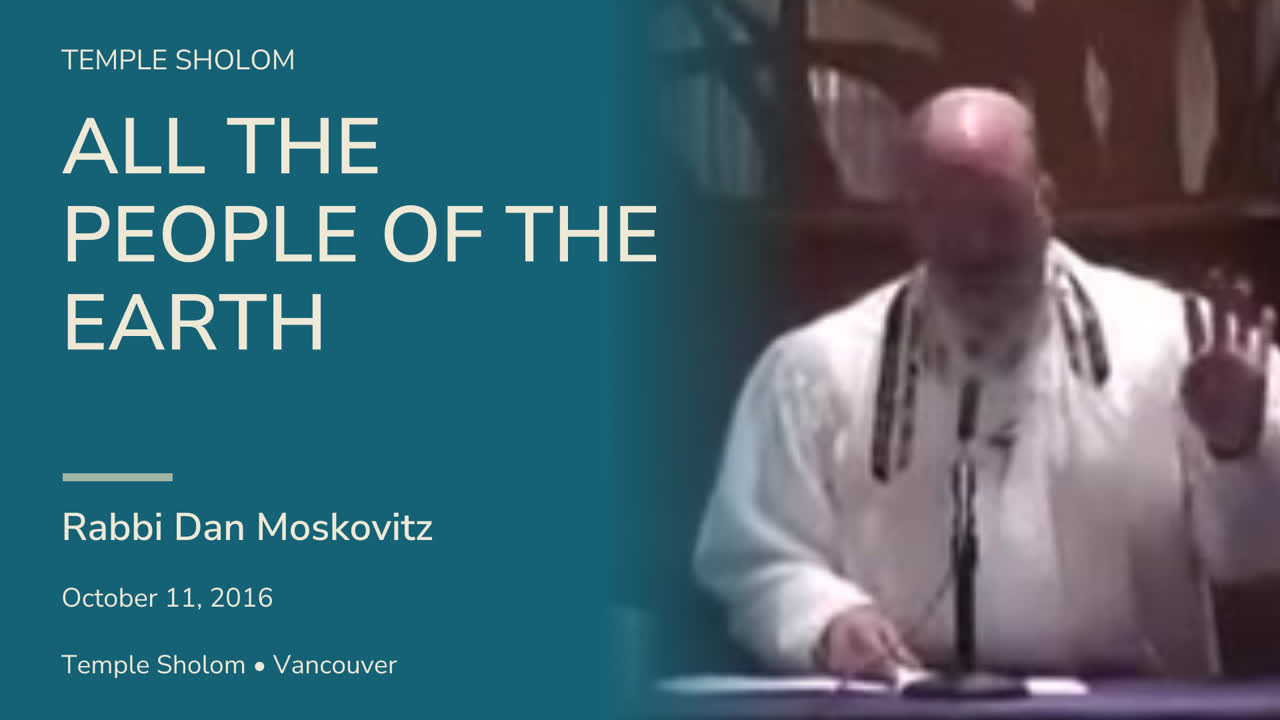
All The People of the Earth
Yom Kippur 5777
Temple Sholom, Vancouver BC
Rabbi Dan Moskovitz
A video of this sermon as delivered is available here:
https://www.youtube.com/watch?v=CjXK-HfusFM
“We are the product of ignorant people, who have been taught an ignorant thing.
Which is, that there are four or five different races.
There are not four or five different races. There is only one race on the face of the earth!
And we're all members of that race - the human race! But we have separated people into
races, so that some of us can see ourselves as superior to others. We thought, it would
work. It hasn't worked!”
This past summer in the midst of the scourge of race violence in the United States, and
xenophobia that is sweeping the globe, anti-racism activist and educator Jane Elliott
blew up the internet when her 1-minute clip on a cable news show articulated those
words in answering the question, “Why is there racism?”
What a question. And what an answer!
A lot of things are called racism, including our own experience of anti-Semitism but
fundamentally, racism, in its many guises, is about exclusion. It’s about saying we are
different and I am better than you.
I have no idea what it is like to be a black man in the United States or a First Nations
teen raised on a reservation in the shadow of Canadian residential schools.
I have no idea what it is like to be a Palestinian living in the territories or a Mexican
immigrant or Syrian refugee struggling to climb over a fence that some have already
built in their hearts if not along their borders.
I can’t even begin to imagine what my life would be like if I had been born in Eritrea or
Sudan, or India, or Somalia, or Afghanistan, and not born white, and male, and in
North America.
I don’t know what it feels like to be a transgendered teen struggling with my identity in
a school locker room; and I don’t have any clue what it’s like to do the same job as a 2
man but be paid 30% less for it because I am a woman, or be told I’m now too old for a
job I have been doing all of my adult life, replaced by a computer or outsourced to a call
centre.
What does it feel like to be one of “those” people, judged and excluded by others out of
ignorance, held captive by bigotry and racism?
I have no idea, but I should. Our Judaism, the very cornerstone of our tradition is to see
the world with empathetic eyes. To image ourselves in their shoes.
“My father was a wandering Aramean, and we were once strangers in the land.” The
haggadah reminds us every year, those were our shoes.
But we forget, the lash of slavery, the pain and isolation of otherness. We were once
‘those people’.
My goodness! Who in this whole world should better understand being victims of
ignorance, and being held captive by racism better than us?
We are commanded, “Pidyon Shvuyim / שְׁיוּבִםי פִּדְןוֹי Redeem the captive!” Not only
those held physically hostage, we must redeem those held captive by racial prejudice.
Those our Torah describes broadly as the widow, the orphan, the stranger and we know
today as those judged by their nation, their station, their color, their gender, their creed.
Why are we commanded to care about them? To care about others when we have our
own problems?
Because Judaism is built upon the value of holding complexity. It implores us to be
conscious of both privilege and suffering. That is the work of empathy - imagining
myself into someone else’s narrative, and imagining their narrative as my own.
Judaism reminds us daily that ALL lives matter, BUT the lives of those in peril, trapped
by circumstance, sentenced by intolerance, surrounded by bigotry, tortured by racism --
those lives matter MORE right now. They need our special attention because they have
no power, no voice - we have the power and the voice.
We are commanded, “Pidyon Shvuyim / שְׁיוּבִםי פִּדְןוֹי Redeem the captive!”3
At Yad Vashem, the Israeli Holocaust museum, there is an avenue lined with trees. If
you've ever visited this awesome place you know how humbling it is. In a world of
total moral collapse there was a small minority who mustered extraordinary courage to
uphold human values, to redeem the captives in an unredeemed world.
These were the Righteous Among the Nations and they are memorialized at Yad
Vashem. These rescuers regarded Jews as fellow human beings who came within the
bounds of their universe of obligation. They didn’t say, ‘Not my people, not my
problem’ but rather they said – we are all people – racism, intolerance and bigotry that
is all of our problem and I must not remain indifferent.
Maimonides says the greatest mitzvah in the whole Torah is the one performed by the
Righteous Among the Nations - Pidyon Shvuyim / שְׁיוּבִםי פִּדְןוֹי Redeeming the captive.
Why is this the greatest mitzvah? Because it saves two lives, theirs and ours. How can
we live freely in a world when some are not free? How can we sleep at night knowing
others are living a nightmare?
The Talmud puts the point on it precisely, “Whoever destroys a soul, it is considered as
if he destroyed an entire world. And whoever saves a life, it is considered as if he saved
an entire world.”1
To honour such courageous individuals Yad Vashem began planting a tree for each
rescuer that saved the life of another, they planted 2,000 trees over time, then they ran
out of room. The list now exceeds 27,000.
Will we live lives worthy of a tree?
When they build a museum to honour those who stood up to the xenophobia and racial
injustice of the early 21st century will they plant a tree for me? …Will they plant one for
you?
Our fellow human beings are imprisoned by the color of their skin, their gender, their
faith, orientation, ethnicity.
1 Mishnah Sanhedrin 4:54
By the ignorant view that I was born better than you.
To fight racism and bigotry in every incarnation is to save the entire world from
destruction at the hands of our own ignorance.
Some have called Anti-Semitism the oldest hatred in the world, and while we could
debate its age, we have no doubt of its paternity – it is just one of the multitude of
bastard children born of racism and bigotry. Its lineage can be traced all the way back to
the time of Noah and sinat henam, the senseless hatred that flooded the earth long before
God washed away the sin and the sinners.
Like a weed, the sin of racism and senseless hatred keeps coming back. It’s always
there, just below the surface, it’s just below the surface in others and if we are honest
with ourselves, and on Kol Nidrei of all nights we must be honest with ourselves as we
stand before God in judgement,
it is just below the surface in us as well. Indeed, sometimes, in the heat of an argument,
the impatience of waiting in line, or behind a driver of a certain age, race or ethnicity, it
comes bubbling out.
To quote Princeton and Kate Monster in the Broadway Musical Avenue Q:
“Everyone's a little bit racist
Sometimes.
Doesn't mean we go
Around committing hate crimes.
Look around and you will find
No one's really color blind.
Maybe it's a fact
We all should face
Everyone makes judgments
Based on race.”
Yes, admirably here in Canada our Prime Minister is working to bring people together,
our cabinet is multicultural and multi-gendered. He accepted the findings of the Truth
and Reconciliation Commission. He walked in every Pride parade from coast to coast
and welcomed refugees at Pearson airport with open arms and warm coats.
Nationally the unity around the Tragically Hip concert brought our nation together to
sing and cry as opposed to the division and hatred we read about south of the border. 5
Reminding us, perhaps with a bit of nostalgia, that Canada is not about the pursuit of
individual happiness it’s about how we work together to make our country better, even
sacrificing a bit of ourselves for the betterment of all.
But there is no denying there’s a portion of the population even here in Canada that
feels threatened by unrelenting change — immigration, globalization, terrorism,
multiculturalism, foreign real estate buyers — they want someone to build a wall
around their cultural heritage, (if not their West Side Neighborhood). Many conflate
slowing or stopping the pace of change with preserving their heritage, their privilege.
A year ago I stood on this bema and challenged us to do something great, to sponsor a
Syrian refugee family and you opened your hearts and your wallets.
We are sponsoring two families and we learned just this week that they are in the final
stages of screening and expect a final decision before the end of the year for our refugee
families. I am so proud of our efforts and leadership, and that of our country, but not
everyone is.
I got hate mail, some threatened to leave the congregation, a man at the JCC gym spat
on me and called me an Arab Lover.
Even here there is a backlash, anti-immigrant sentiment, a closing of hearts if not
borders.
This summer Sharon and I led a Temple mission to Central and Eastern Europe, we saw
the “anti-liberalism” that is once again driving nationalism and extremism in Europe. In
every country they pointed out their own version of Donald Trump, and not with pride,
but wary knowledge that, “we have been here before.”
Donald Trump alone is frightening enough, but oh how much more horror lies with the
realization that 40% of American adults seem to agree with his racist leanings… 100
million Americans think he’s pretty much right!
In many ways the man is a mirror. He is a reflection of — indeed a revealing of — the
ugliness that people can harbor. Trump is an unfiltered primal scream of the fragility
and fear consuming white male Americans and their global equivalents everywhere.
The Talmud addresses exclusion of others in this way:6
Our rabbis ask why God began with only one human, Adam, and tradition answers, 'So that not
one of his descendants should be able to say: my father is better than your father' (Sanhedrin
37a). No race can say that it is better than others.
So, how do we end racism in others? How do we unlearn this ignorant thing in
ourselves?
It begins with seeing our similarities first instead of our differences.
So much depends upon our similarities. Unless we all worked the same way, all designs
would fail, medicine would be ineffective, and human society would become
impossible.
Yet we also affirm that each individual is unique. No two people look, think or act
exactly alike.
Both human sameness and difference are profoundly true.
The Rabbis compared faces to minted coins. A king of flesh and blood, they said,
stamps coins and they all look alike. The Divine stamps us and each is different. We are
all still faces, but none is a copy.
When we see a throng of people (like tonight in this sanctuary) and from a distance
everyone looks alike, remember that each is different. That is why our listening
campaign and conversations are so important for our community. As the Talmud puts
it, “when you see a crowd of Israelites, bless God who knows each person.”
This is the binocular vision of being a Jew and particularly a Reform Jew.
It is the gift of our sameness that enables us to have empathy and create community.
And it is the gift of our uniqueness that permits every human being to learn from one
another.
What a blessing it is to be a human being, and what a challenge it is to live like one.
Let's rise to the challenge, and rise above our inclinations, however slight.
We can start by changing four words. 7
There are a growing number of congregations around the world and particularly
amongst progressive congregations in Israel in which the last line of the Kaddish prayer
has been amended. Traditionally, we ask God who makes peace in His high places to
make peace for us and for all Israel — “aleinu v’al kol yisrael.”
Tonight I am asking that our congregation adopt the practice, modeled by the children
of Shimon Peres (z’l) at his funeral last week of adding four additional words: “v’al kol
yoshvei tevel, and on all the earth’s inhabitants” to the last line of the mourner’s kaddish.
What I am asking of us is consciousness in our prayers.
Consciousness of the pain of people who society considers, including Jews - as other.
Consciousness of privilege and injustice.
Consciousness of how we are implicated in that systemic privilege and injustice, and
how to bring tikkun, genuine healing, to a world that is both terrible and beautiful.
I believe that it starts with adding these four words to our most personal prayer.
Rabbi David Teutsch explains: “Adding the rabbinic phrase v’al kawl yoshvei tevel (and
for all who dwell on earth) logically completes the concentric circles of our aspirations –
our care starts with our minyan, extends to the entire Jewish people, and radiates
outward from there to all who share our planet.”
I ask that we do this to remind us both of our uniqueness as Jews and our sameness as
human beings.
To remind us that we all come from the same parent, that every life and tragically every
death has profound meaning, not just the life and death of those like us – because every
human being is “like us”, we all come from the same parent, we are all part of the
Human Race.
We are commanded, “Pidyon Shvuyim / פִּדְןוֹי שְׁיוּבִםי Redeem the captive!” Racism and
bigotry are a prison of thought, let’s open our minds, expand our thinking.
“We are the product of ignorant people, who have been taught an ignorant thing.” It is
hard to unlearn a falsehood, but we must try, we can start by being more inclusive not
exclusive in our prayers; our actions must follow our prayers, and others, I pray - will
follow us.8
Oseh shalom b’mromav, hu ya-aseh shalom aleynu, v’al kol yisrael, v’al kol yoshvei tevel, v’mru
Amen
May the one who makes peace in the Heavens, make peace for us, and for all Israel, and
for the people of the earth and let us all say AMEN!
SERMONS & WRITING
All The People of the Earth
Yom Kippur 5777