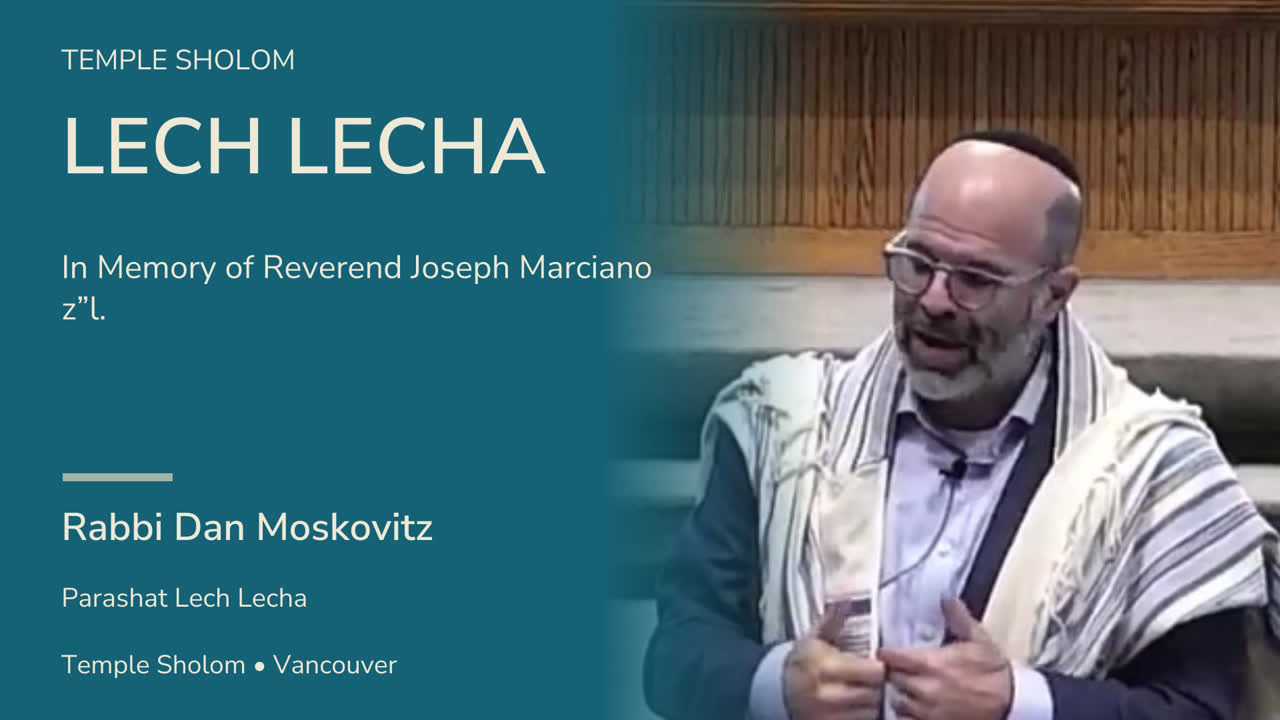
D’var Torah — Parashat Lech Lecha
In Memory of Yosef (Joseph) Marchiano z”l
Rabbi Dan Moskovitz
Temple Sholom, Vancouver BC Canada
November 1, 2025
Video of this drash:
https://youtu.be/Oh4awvGU5E8?si=_-Pgkx5Uum_04HJm
There is a moment early in this week’s Torah portion that changes everything — not only for Abraham, but for all who would come after him. God says, “Lech lecha mei’artzecha, go forth from your land, from your birthplace, and from your father’s house, to the land that I will show you.” It is not merely a command to wander; it is a call to faith — to move through the world guided by trust, devotion, and love. Abraham steps forward not knowing where he is going, believing that holiness will be found in the journey itself.
This week, we lost someone whose entire life was an act of lech lecha — a man who walked with faith, who lived for others, who quietly and steadily sanctified the world around him: our funeral director, teacher and my dear friend, Rev. Yosef Marchiano, of blessed memory.
Abraham teaches us that faith is not proven by the size of one’s miracles, but by the constancy of one’s steps. Yosef lived that kind of faith — not spectacular, but steady. Like Abraham, he answered God’s call not through words, but through a lifetime of walking toward others in kindness.
When Yosef retired this past June, I had the honour of helping him write his remarks for that evening at Schara Tzedeck. An honour, I later learned from Rabbi Bregman, that he too had shared for many years before I arrived. It appears I took over the congregation and the very honoured and sacred mitzvah of helping Yosef write speeches when he needed them.
Yosef began his remarks that evening characteristically, with gratitude to God that he was even able to stand there, as he had been in the hospital that very morning and, under doctor’s orders, would return there later that night
He recited Shehecheyanu, and then quoted a verse from the Talmud, Berachot 17a: “One who devotes themselves faithfully to the needs of the community carries the merit of the entire community upon them.”
He explained that this verse had guided him throughout his life — that to serve a community with integrity and devotion is to become part of the foundation that holds others up, especially in moments of grief and uncertainty. And then, with his typical humility, he said, “If the merit of the community rests on those who serve it faithfully, then any merit I have belongs to all of you — because you let me be of service.”
That was Yosef. Gratitude wrapped in grace. He had carried the merit of this community — all of it — for forty years. Reform, Conservative, Orthodox, secular; it didn’t matter. He showed up for everyone. He saw a single Jewish people.
His life was a masterclass in chesed shel emet — true kindness that cannot be repaid. He guided families through heartbreak and ritual, helping them honour life in the shadow of death. He taught hundreds of Bar and Bat Mitzvah students. He ran the Hevra Kadisha, visited every shiva house, offered comfort to every mourner, and blew the shofar so powerfully, David his son said, that “it shook the sanctuary and the heavens.”
During COVID, when no one could gather indoors, Yosef sat outside in a tent in the Schara Tzedeck parking lot, in the freezing cold, so that Torah could still be read. When it was sweltering hot, walked across the city to another synagogue, simply because someone there needed Torah to be heard.. David said, “My father truly did it all, and he always did it for others, never for himself.”
His faith was as deep as Abraham’s. David spoke of it so beautifully: “Hashem told Abraham he would have children, and he believed Him with full faith. My father had emunah as well.” When Yosef retired and decided to move to Teaneck, NJ to be near his children and grandchildren, he did so with that same trust in life, in God, and in family. Within days of leaving the hospital, he made it happen. And it was everything he hoped it would be.
“He was so happy,” David said. “Going to minyan and Chevra and JCC, and having his children come for dinner or on Shabbat morning. His eyes would light up when his family came through the door. He truly felt like the luckiest man in the world.”
I once saw Yosef at Rogers Arena during a Canucks game. When the “Kiss Cam” landed on him and Simone, I could see him laugh under his touque which I might have been the only one in the arena that knew was covering over his black velvet kippah. I also knew, and I don’t think anyone else looking at this couple on the giant screen knew, that there was no way he was going to kiss Simone in public. But then they both smiled right into the camera and waved. He knew how to laugh at the absurdity of life while honouring its sacredness.
That was Yosef: grounded, human, holy. He knew that the Divine hides in the everyday — that the same hands that carry a Torah scroll can carry a casket; that holiness isn’t just in prayer, but in presence.
Through all of this, the centre of Yosef’s world was Simone. David told us, “He loved my mother more than anything in the world. Even a few days before he died, he told us to take care of her if something happened to him.” When they were newly married and Simone’s father passed away, Yosef welcomed her mother to live with them — not for a few months, but for more than thirty years. David said, “That mitzvah, along with the countless others — the people he helped in life and in death — will stand with him and take him to the highest places in heaven.”
Though Yosef was deeply observant, he found holiness everywhere. He was as comfortable in Schara Tzedeck as he was in Temple Sholom, as present at Beth Israel as at VTT. I remember one funeral when I was terribly sick, barely able to stand. Yosef told me to sit down and said, “I’ll take it from here.” And he led the rest of the graveside service, chanting El Malei Rachamim for our Reform community without hesitation.
Once, because of a scheduling mix-up, two funerals were happening in our community at the same time. He drove the hearse with the casket to Temple Sholom and then took my car to drive to the BI cemetery. A licensed Funeral Director must be present at the time of burial.
Before he left the temple he told me, “If I don’t make it back in time, Rabbi, you drive the hearse and I’ll drive your car to the Temple Sholom Cemetery and meet you there for the burial.” And when I came down the stairs and saw he wasn’t there, I got behind the wheel and led the procession to White Rock. When I saw him later at the cemetery, I told him it was the first tiem i had ever driven a hearse, that I was the envy of so many of my colleagues. He then asked with a sweet smile, “Rabbi, I hope you drove in the carpool lane?”
He called me often when he encountered a family that needed a bit more flexibility than perhaps other congregations could provide: “Rabbi, there’s a family that needs you, and I know you’ll take care of them.” He never tried to make them conform to his way of Judaism. He never asked what kind of Jew someone was. He just showed up. Met them in their grief and helped them find comfort as they walked in the valley of the shadow of death. His life was a bridge — between observance and openness, between tradition and compassion, between the letter and the spirit of Torah.
Abraham’s journey begins with a single, unseen act of courage — and so too the world continues because of unseen acts of righteousness. Our tradition calls such people the Lamed-Vav Tzadikim, the thirty-six hidden souls whose goodness sustains creation.
There is a mystical teaching that at all times there are thirty-six righteous souls — Lamed-Vav Tzadikim — whose quiet goodness sustains the world. They are hidden saints, ordinary people whose decency and love keep creation from collapsing. They never think of themselves as righteous. They simply do what needs to be done, with humility and devotion.
Yosef was one of them.
He would have denied it with a shy smile and said, “No, no, I’m just doing what I can.” But we knew. We saw it every day — in his steadiness, in his compassion, in his faithfulness. His righteousness wasn’t grand or public. It was daily, gentle, and real. He was a man who made you believe that goodness still exists, that holiness is not confined to prayer or study, but lives in the way we care for one another.
In our parasha, when Abraham heard God’s call, he left everything familiar behind, trusting that he would find blessing along the way. Yosef lived that same call in his final months. He left the community he had served so faithfully in Vancouver to journey to the land that God showed him — the land of his children and grandchildren, and then, finally, the land of his ancestors.
“Lech lecha” was God’s first call to Abraham, and it became God’s last call to Yosef: Go forth, faithful one. You have done what I asked of you. You have carried My people, comforted My mourners, and sanctified My name. Now go to the land that I will show you.
He went forth surrounded by love — by Simone, by his children and grandchildren, by friends and colleagues, and by over forty people from Vancouver who travelled to Israel to lay him to rest. David said, “I am confident that the countless mitzvot my father performed, and the countless people he helped in life and in death, will stand with him and take him to the highest places in heaven.”
I believe that too.
The Talmud teaches that when a tzadik departs the world, their presence still sustains it — perhaps even more than when they were alive. Yosef’s presence will remain with us — in every act of compassion, in every kind word, in every moment of quiet service that no one sees but God. His legacy will live in every bridge that connects one Jew to another, and in every human being made a little less lonely because he cared.
We are blessed to have known him. Blessed to have been served, taught, and comforted by him. Blessed to have called him our friend.
May his memory be for a blessing, and may we each, in our own way, continue the sacred work that he began — to walk humbly, to serve faithfully, and to help hold the world steady through love.
Y’hi zichro baruch — may the memory of Yosef Marchiano be for a blessing.