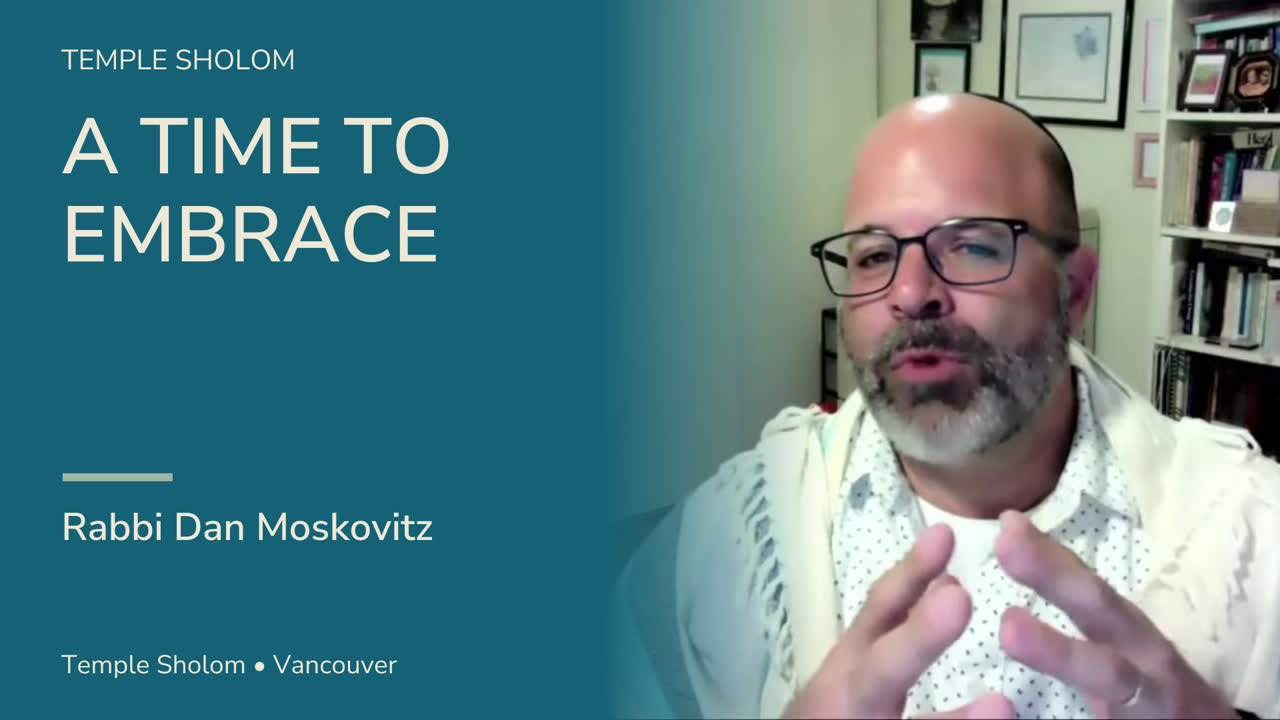
A TIME TO EMBRACE
RABBI DAN MOSKOVITZ
TEMPLE SHOLOM, VANCOUVER BC
July 9, 2021
I hugged my parents for the first time today in 19 months.
We have driven down to California after dropping our children at Jewish summer camp in
Washington State. One of the many advantages of now being dual citizens is that we can drive
across the US border on our US Passports and return to Canada in a few weeks on our Canadian
passports.
My parents live in the SF Bay Area, Sharon’s in Los Angeles, we will see them G-d willing next
shabbes.
I have known for weeks that my sermon tonight, delivered as it is from my parent’s guest
bedroom would be about that first hug; I have thought of nothing else for nearly a month.
What I didn’t know was how it would feel and what I would say about it after it happened.
These are those thoughts
King Solomon, the wisest of all men, long ago taught us in the book of Ecclesiastes (The Birds
set to music in the 1960s) that there is “A time to embrace and a time to cease from
embracing” (Ecclesiastes 3:5). The sequence is significant. There may be good cause at times to
cease from embracing. Surely a plague is one of them. But we must never forget that human
contact is an ideal – an ideal which for many has tragically been all too often unattainable
during the past year and half during this pandemic.
Among the many images that will stay with me probably the rest of my life as I reflect and
eventually retell the story of this pandemic to the next generation will be those of grandparents
waving to their children and grandchildren from behind glass windows in long term care
facilities or through patio doors. They each desperately want to hold each other, to wrap them
in their arms and let the other know they love, they care, it will be ok. But they cannot, glass
separates them, a virus endangers them, so they wave, or talk – but painfully they cannot touch
and something profound is unable to be fully expressed without it.
No matter how often I saw my parents on zoom nothing can replace the physical connection of
a hug.
Rabbi Yosef Jacobson is a world-renowned scholar of Kabbalah or Jewish Mysticism and I
turned to his writings this week to try to understand why a hug is more powerful than words, or
a kiss or a longing look into the eyes of another. In teaching about the spirituality of a hug he explains that there are four universally accepted
forms of expressing love to another human being.
The first is, through words of affection. The three simple words "I love you," when uttered
sincerely, may have a transforming impact on people’s lives. Words have always served as the
basic tools for expressing our inner emotive experiences.
A second, more powerful expression of love is a kiss. A genuine kiss contains an extraordinary
energy and serves as the medium for communicating a deeply intense feeling that may not be
grasped in words. Words can state, "I love you," while a kiss declares, "I love you more then I
will ever be able to tell you how much I love you."
A third, perhaps even more powerful expression of love comes in the form of a gaze. Two
people in love can gaze at each other for long periods of time without uttering a sound. To
reference another 60’s folk bank, Simon & Garfunkel, the sound of a silence when accompanied
with a gaze is sometimes louder than all the “I Love You’s” shouted from rooftops.
Eyes carry within themselves deep secrets of the soul (that is why most people feel
uncomfortable when somebody stares them in the eyes for more than a few seconds.) There is
something of your soul that you can communicate to another human being exclusively through
your eyes. I think however that this is lost or greatly diminished via zoom, physical proximity is
also a key component of this “love communication”.
A fourth universally accepted method of expressing love is by means of an embrace. A hug
demonstrates a solid and profound bond existing between the two people embracing each
other.
Which of these four forms of love do children cherish most?
Children enjoy being spoken to (to, not at). They certainly take pleasure from being kissed and
being looked upon with tender affection. Yet, more than anything, most children, especially
infants, and in my experience most adults as well cherish being hugged. It supersedes the
previous three, a words, a kiss or a longing gaze.
What is the secret of the hug? What is its power?
It may surprise you but our rabbis have though and written deeply about the power of a hug.
Rabbi Isaac Luria, also known as the Ari, one of the great scholars of Kabbalah from mid 16th
century Tzafat explains how the physical mechanics of a hug set it apart from all other forms of
"love communication”.
Part of kabbalah is finding hidden meaning in words and constructs that are right in front of us.
This teaching from that spiritual lens.Look at your arm for a moment or look at mine. It is of course with our arms and then our
whole bodies that we embrace another person.
For The Ari there are three dimensions of an arm's embrace, and each encompass three distinct
parts of the body being embraced. When you embrace another person, the highest part of the
arm (between the shoulder and the elbow) encompasses the entire side of the one being
embraced. The middle part of the person's arm, the forearm, expands over the entire width of
the embraced person’s back. Finally, the palm and the fingers extend even further and cover a
small part of the face of the embraced one, a handbreadth of the face.
Lastly, and this is my own hiddush to his teaching, the body comes into the mis to complete the
embrace, to fully encircle the other and when done in coordination with the intended recipient
of your hug, two bodies combine in what philosopher Martin Buber would describe as an I-Thou
moment, when two separate entities become something new, and whole and even holy, when
they become one being.
My hug with my parents was like that. Something that has not existed from 19 months was
created in that moment. It wasn’t the same as hugs pre-pandemic, it carried with it nearly two
years of yearning and angst and worry and trauma and unrequited affection. It was filled with
tears and joy and pain and overflowing with love.
I am painfully aware that I’m among the lucky ones, for many even after 19 months that hug is
still some time and distance away. For some, more than we can imagine that hug will never
come; they lost loved ones to this virus or having lost their parents before COVID emerged they
had to go through it without them. Still others; alone, lonely and isolated because of the
pandemic or in spite of the pandemic have no one to hug or hug them back. My heartbreaks for
all who have not or will not experience what I was so fortunate to finally feel this morning as
my parents held me in their arms and I held them in mine. I understand that pain now better
than I did the last 19 months when I felt it myself.
There is a time for every experience under heaven, a time to be born a time to die, a time to
laugh and a time to cry, a time to embrace and a time to refrain from embracing. Thank G-d the
deaths from this virus are declining, there were no COVID related deaths in BC today. We have
shed many tears for all that we have been through these many months, and we have, as Jews
have done with resilience from generations found moments of laughter and joy in the midst of
the OY and sorry. The time to embrace is here or it is coming soon. Embrace it! Give extra hugs
to those who surround you, embrace this powerful and much-needed communication with our
loved ones. Hold on to it, hold on to them – like your life depends on it; because as I learned
today, in so many ways it does.
SERMONS & WRITING · 2021
A Time To Embrace
July 9, 2021