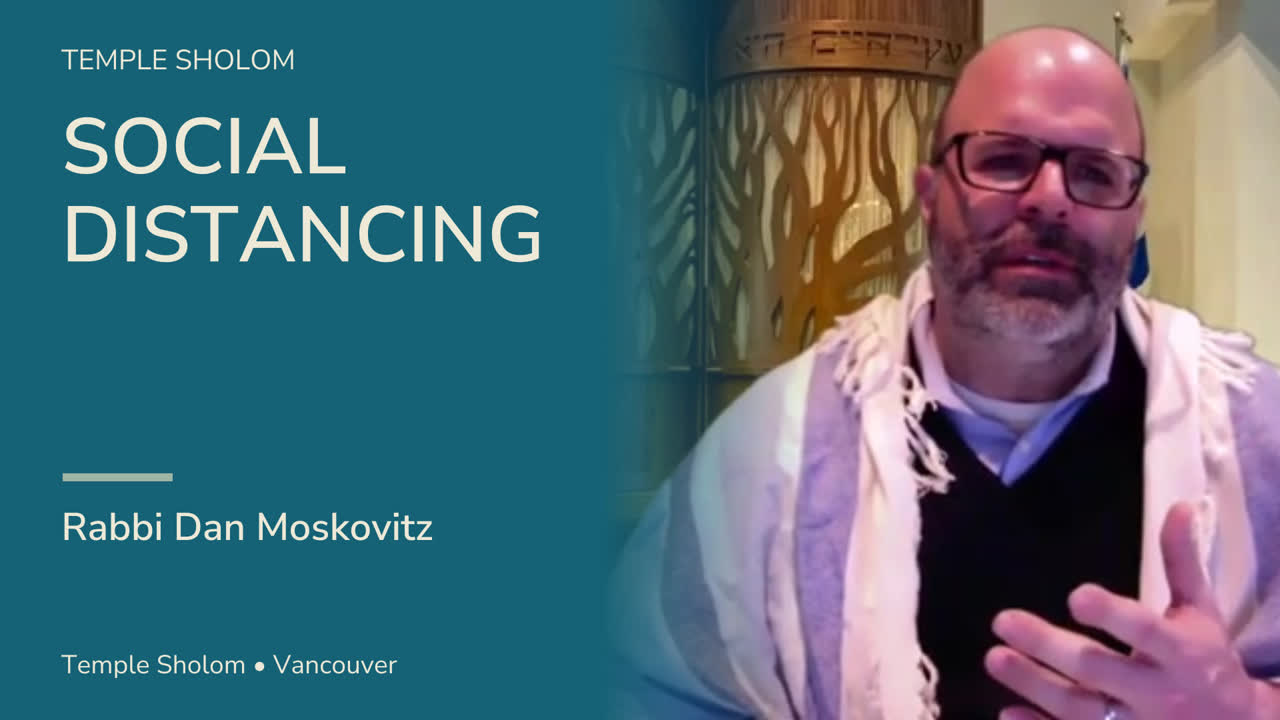
SOCIAL DISTANCING
Rabbi Dan Moskovitz
Temple Sholom – Vancouver BC
March 20, 2020
I go to bed every night and I wake each morning with the same thoughts, thoughts only of the
virus, the pandemic, or exponential numbers, of my family sleeping peacefully in our home, an
unseen threat looming like the angel of death on surfaces, did I touch my eyes, my nose, my
mouth, did I wash my hands enough? Did they?
I go to bed and wake with worry about my family in California. Last December we celebrated
my parent’s 80th birthdays; my in-laws came up from LA, we were all together. It seemed at the
time like such a milestone, 80 years old; now it’s an extra worry, a demographic cohort that is
far too statistically significant in this pandemic.
You, my congregation, our community you are on my mind constantly. I don’t know if I will ever
be able to fully describe how much joy and meaning I find in our congregation when we are all
together for shabbat.
This past year as our numbers grew beyond all expectations, our shabbes community and
school community grew as well. Weekends are hard for rabbis, for everyone else it’s a day of
rest, for your klay kodesh it’s a time of intense work. But it started to feel less and less like work
as we would sit and linger over shabbat lunch after services or kibbitz with parents during
religious school. Truthfully, there were many days I didn’t want to leave. Now, we can’t even go
in.
My children – fight over who gets to go to shul with daddy – never in my life did I imagine I
would have children that would rather be at synagogue than home watching cartoons or
Netflix, but it has been true almost every weekend. They want to see their friends, some
generations older than they are. Sit with you in the sanctuary, act like judges on a cooking show
as they evaluate the oneg dessert.
We have lost so much in just these few days, of social isolation – I guess I miss lots of things, but
right now as we gather virtually for this surreal shabbat via video conferencing, I miss all of us
being together more than anything right now.
They call what we are doing right now, Social Distancing – we can add this to the long list of
examples of one of those delightful and often poignant turns of a phrase the English language,
an oxymoron. The bringing together of two seemingly incompatible and opposite terms; like “Sweet Sorrow”,
“Recorded Live”, “Act Naturally”, “Good Grief”, “Passive Aggressive”, and though not kosher
still illustrative “Jumbo Shrimp”.
I have always enjoyed how language can construct through the use of this literary device biting
commentary on the incongruity of frequently paired things.
But it is that commentary, that moment of silence that hovers over a room when we
contemplate the meaning of an oxymoron, when we dwell on the underlining message of Social
Distancing that such a term is so powerful. The oxymoron challenges us to see compatibility,
even harmony in seemingly incompatible things.
So now and for the foreseeable future, human beings the most social animals in the universe
must stay away from each other so that one day we can, God willing all be together again.
How can we be together when we are physically so far apart?
One answer I guess is this, technology.
To quote my teacher Rabbi Jeff Salkin, and as I mentioned earlier, “Judaism is now in the cloud”
— which, let the record note, is a biblical euphemism for God.
Is this where I want it to be, is there where I think Judaism belongs? No, I think of Judaism as
the anti-tech of our day. The sabbath is the great moderator of screen-time, carrying more
weight and authority than any parent could ever muster.
But and here is the brutal truth of the thing – if we are not here, if we do not make this work till
we can return to our sacred places, our communal tables, classrooms and gatherings we will
lose too much, and we may never come back.
Judaism dies in isolation. Our community needs community. It is not a Jewish thing to go off
into the woods by yourself or to find god in solitary moments on a mountain top all alone. Yes,
God dwells there too but, God dwells more between us, than in any one of us.
Martin Buber taught us this. In his transformative lens of I-Thou relationships. Buber explained
that God is the hyphen between me and you, between I and thou. God is the bridge. When we
act to help each other, we make God present.
As many have said, Social Distancing does not mean Social Isolation – we can be apart, but we
need not, dare not be alone.Melissa Raphael is an author, she wrote a powerful book called, “The Female Face of God in
Aushwitz” In it she says that what died in the Shoah was the masculine presence of God the
Kadosh Baruch. The heroic, manly God, superhero God, that would always be there to save you,
save us; but what remained was the Shehinah the motherly presence of God, that provided
comfort and became present in acts of helping each other.
God did not rescue Judaism and the Jewish people from the Shoah, people recused people.
Where was God in Aushwitz? God was in the acts of kindness, of hesed, of compassion that in
spite of everything and all attempts to destroy our humanity still remained.
How do you survive the unimaginable? A Global Pandemic? Its not with Toilet Paper, its with
hesed.
The Talmud declares Tzedakah teyzil m’mavet/Tzedakkah saves from death. Why, because of
the hyphen, because the dash between me and you IS godliness. Hesed/Tzedakah gets us out of
ourselves, our own worries and gets us into giving to others.
I pray every day and every night for a miracle cure. I imagine with great dreams that an Israeli
scientist will discover the cure, and then not only will the world be saved form this pandemic,
but Israeli will get the credit and for once our people will be accepted and appreciated. Both
are grand dreams I know, and yet somehow the first, the finding of a cure seems more plausible
than the second, which I guess gives me some measure of hope.
But until humanity finds a cure, what will save us from loneliness, despair and fear is each
other; the acts of hesed, of kindness that we are seeing across this country every day.
The people that are shopping for their elderly neighbors. Donating medical supplies to front line
health care workers. In my neighborhood families put paper hearts on their doors and fence
post so that neighborhood kids could walk the sidewalks on a solitary scavenger hunt finds
these sweet totems of connection.
A cure will be found, I have infinite faith in humanity and our collective resolve and ingenuity,
and a cure for our worry already exists – its each of us, doing and caring and looking after each
other. That means the errands and the sharing of supplies but it also means staying away from
each other, gathering here online instead of in our community spaces so that we can flatten the
curve and one day again, hopefully soon be together again.
SERMONS & WRITING · 2020
Social Distancing
March 20, 2020