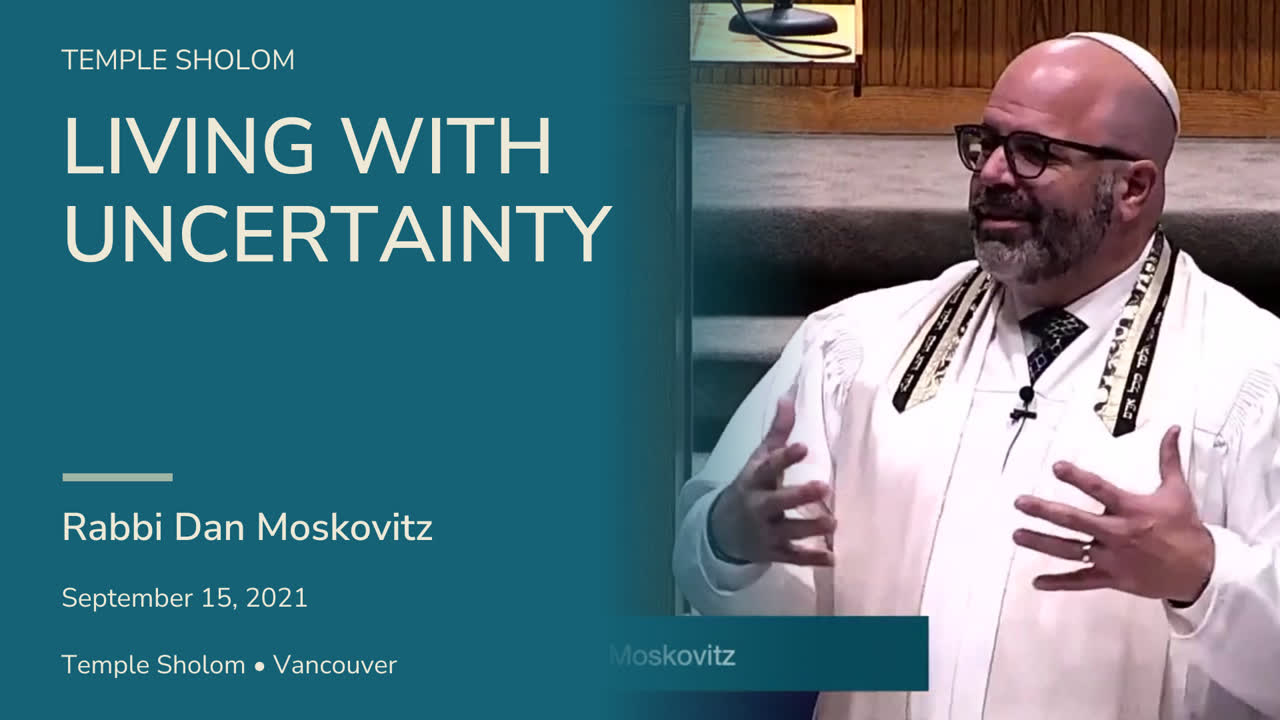
LIVING WITH UNCERTAINTY
RABBI DAN MOSKOVITZ
KOL NIDREI 5782
TEMPLE SHOLOM, VANCOUVER BC
SEPTEMBER 15, 2021
A member of our congregation who was anxious after undergoing tests for some strange symptoms, recently said to me: “Rabbi, I’m stuck in the middle! On one hand, if I knew that I was OK, I’d breathe easy. On the other hand, if I could only receive a diagnosis, and could know what my course of treatment was, I’d also feel some relief – I’d at least know what to expect! But not knowing, not knowing anything, feeling powerless and in the dark, that’s the hardest part.”
During this past year like no other, not knowing, the uncertainty of it all - we all know what this person means. The not knowing, that is the hardest part.
We are drawn to knowing, to being certain. It’s a characteristic of our time – we live in the Information Age; we base our lives on the latest technology, the latest studies, the latest reports. Knowing gives us at least an impression of control. And so not knowing presents us with a difficult spiritual challenge. It is why emunah, the Hebrew word for faith, is so essential to living with uncertainty.
Rabbi Arthur Lelyveld, a well known rabbi from the last century, wrote in his book "The Steadfast Stream," that the definition of emunah, of faith for Jews, is not necessarily doctrinal belief; rather faith for Jews means "persistence." That was the emunah, the "faith" of the prophets -- to keep on speaking, keep on working, despite the obstacles and uncertainty.
Faith is keeping on through relentless, tireless, unwavering struggle.
Faith is struggling with an unknown future, with fraught relationships and against the human proclivity for violence and injustice. Emunah, Jewish faith is the kind of faith that guarantees nothing in this life or the next, and whose greatest reward is the resolve that comes with faith itself; not giving up, not giving in to despair.
This crisis we are all living through is the kind of crisis that can cause us to lose faith – in ourselves, in our leaders, in society, in humanity.
In these past 20 months, with sadness and despair I have witnessed this crisis destroy faith, and with awe and wonder I have seen it restore faith – to generate a wellspring of resilience and fortitude I didn’t know I had or that we had collectively.
Despair and resilience - sometimes in the same day, sometimes in the same thought.
In truth this past year was not just one crisis. It wasn't just COVID. It was many crises all at once. It was the pandemic, yes. It was an economic crisis. It is a climate crisis. It is a civil rights movement. It is a rise in anti-semitism. It was a violent Israeli-Palestinian conflict.
A crisis like this, like all of these at once, it changes you, it changes the world. It tests you, it tests your emunah, your faith - not necessarily in God, it tests your faith in yourself and our faith in each other. Can we persist, day after day, through the struggle?
What have we learned from all of this faith testing and crisis compounding?
We have learned that we control nothing.
That's the message of Yom Kippur, it’s the lesson of the pandemic. It's more than “people plan and G-d laughs' ' - it's that too but it's more.
I keep thinking back to Unetaneh Tokef, that haunting poem the cantor chanted on Rosh Hashanah. Who shall live and who shall die, who by fire, who by water, who by hunger, who by thirst…never thought we would actually have to address, “who by plague” - but here we are.
We just never ever know - no matter how much we try to control things - that we are NOT in control. We live in uncertainty every day. The illusion is that we think we don't. And the message, to me, the message of these compounding crises, the message of Kol Nidrei, of Yom Kippur is: It’s not about control or certainty - but how we navigate through it. That is the quintessential Jewish ideal, navigating, living with uncertainty, persisting through it.
It's Moses leading the Israelites through the wilderness, a journey that should have taken 3 weeks and took 40 years. Because when you are in the wilderness, when you are navigating uncertainty, it's never a straight line; as we’ve learned you can glance down but a convoluted path of surprises, gifts, and afflictions awaits you.
That, how we navigate uncertainty - that is in our control. The choices we make, those are ours.
When I meet with couples before their wedding, one of the things we discuss is their ketubah, the Jewish marriage contract. Traditionally it lays out in great detail each person's responsibilities in the marriage, who will do what, how often and under what circumstances. There is even a whole section on what should happen if one of the parties doesn’t fulfill their obligations to the other. The ketubah tries to address uncertainty; but it can’t, because the very nature of uncertainty is you don’t know what is going to happen.
I explain this limitation to the couple, that the ketubah, through words and letters written on the document, can only speak about what is known or anticipated, but we never know everything, we can never plan for everything. Marriage, as they will come to discover, as so many in this room and watching online have learned, is lived and experienced in the unknown stuff, the things you never thought of, didn’t plan for, the white space between the words and letters; the uncertainty.
I then suggest that it’s actually in these spaces in between the words and letters, where the marriage really lives. This contract is a promise to each other that you will have faith, emunah, persistence to deal with the unanticipated, the unknown.
We don’t know what is going to happen, or how, or when, and in that very uncertainty is the space of hope. Not only in our marriages, but in all of life.
Author Rebecca Solnit writes, “When you recognize uncertainty, you recognize that you may be able to influence the outcomes—you alone or you in concert with a few dozen or several million others.”
If there is one thing we can draw from where we are now in the midst of all these crises and where we were last year at this time or when it all began a year and a half ago, it is that in times of uncertainty, when our world is changed beyond our control, we also have a chance not only to persist through it, we have a chance, through how we respond, to make things better. In fact the greatest changes for good throughout modern history have come on the heels of and often the result of the greatest calamities. We cannot do this alone, we don’t have all the answers.
As the New Year comes and we look around us at an uncertain present and unpredictable future, we may feel daunted by the scale of the task humanity faces. The number of overlapping problems can feel overwhelming. Where do we start, which way do we turn?
We have endured so much, which speaks to our strength and resilience; our emunah, our faithful persistence.
Yom Kippur, the start of the New Year, is a time to glean wisdom from our challenges in order to understand who we are in the communal narrative of this moment, and how together we get out of this wilderness of uncertainty.
So again, as I did on Erev Rosh Hashanah, I invite you to take part in our initiative, Sholom Bamidbar - Together in the Wilderness.
It's a gift we are giving each other, it's what we need, to bridge the white spaces, the gaps between the words and letters of what we think we know and that which we never even imagined we’d encounter.
Sign up for one of the dozens of small group sessions we are holding via zoom beginning this weekend. Consider the questions we will ask each other:
* What challenges have you faced over the past year?
* What helped you get through the year?
* What have you learned, or what are you learning, about yourself that you want to carry forward?
* What can the synagogue do to support you as you move forward?
I am reminded of a Hasidic story retold by the Nobel Prize winning Israeli writer S. Y. Agnon in his precious anthology ‘Days of Awe’ (Schocken, 1948/1965).
It’s a parable attributed to the 19th century master, Rabbi Hayyim of Zans:
A man had been wandering about in a forest for several days, not knowing which was the right way out. Suddenly he saw a person approaching him. His heart was filled with joy. “Now I shall certainly find out which is the right way,“ he thought to himself. When they came nearer to one another, he asked them: “Brother, tell me which is the right way. I have been wandering about in this forest for several days.” Said the other to him, “Brother, I do not know the way out either. For I too have been wandering about here for many, many days. But this I can tell you: do not take the way I have been taking, for that will lead you astray. And now let us look for a new way out together.”
And Agnon concludes this simple tale with the following comment from Reb Hayyim, he wrote 200 years ago, but he could just as well be speaking to us today in the midst of our cascade of crises and uncertainty:
“So it is with us. One thing I can tell you: the way we have been following thus far we ought follow no further, for that way leads you astray. But now let us look for a new way.”
The importance of community, of recognizing the value of companionship, of realizing we are not alone in feeling lost, is at the heart of Reb Hayyim’s tale; it’s the essential lesson of COVID and it’s coupled with controlling our response and emunah - persistent faith. Community is how we live with and overcome uncertainty.
We can learn from each other.
We can help each other.
We need each other.
Of that I am certain.