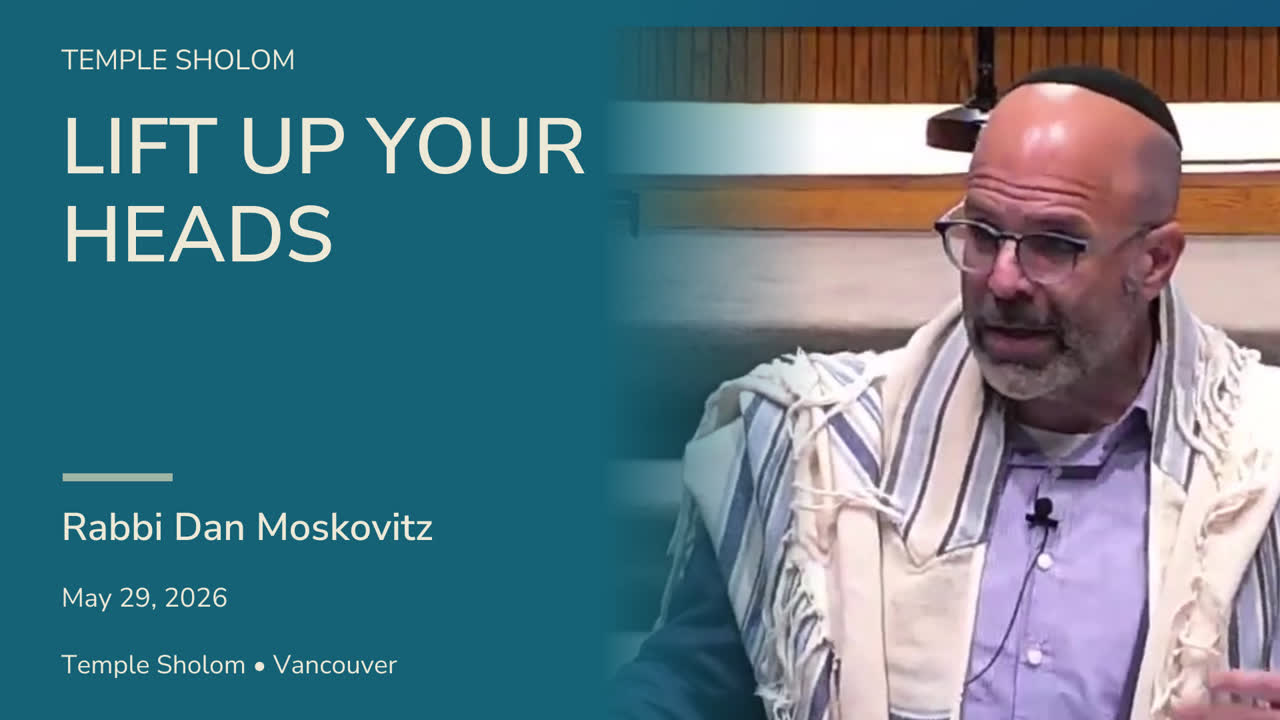
Naso: Lift Up Your Heads
Rabbi Dan Moskovitz
Temple Sholom, Vancouver BC Canada
May 29, 2026
Video of this sermon as delivered
This week we read Parashat Naso, the longest Torah portion in the entire Torah. Come early tomorrow. Vincent is going to read every word. Right, Vincent?
You would think, with that much ink, the Torah might give us one grand theme, one clear message, one tidy sermon already wrapped up for the rabbi.
You would think.
But no. Or should I say, Nah-so. It does not work like that.
Naso is not tidy. It is long, complicated, and wanders like our ancestors in the desert from census lists to camp organization, from the suspected adulteress to the Nazir, from ritual offerings to the dedication of the Tabernacle.
It is a Torah portion filled with details, repetition, anxiety, structure, and order.
Then, suddenly, in the middle of all of it, there is this exquisite blessing:
Y’varechecha Adonai v’yishmerecha.
May God bless you and keep you.
Ya’er Adonai panav eilecha vichuneka.
May God’s face shine upon you and be gracious to you.
Yisa Adonai panav eilecha v’yasem l’cha shalom.
May God lift up God’s face toward you and grant you peace.
Three verses. Fifteen Hebrew words.
A blessing so ancient it was found engraved on silver amulets from the First Temple period.
A blessing still spoken by parents over children on Friday nights, by rabbis and cantors from the bimah, under chuppot, at baby namings, at bedsides, at moments when words fail us and all we can do is reach backward into the deepest well of Jewish memory and pull up these words.
Yesterday I said it four times, at two conversions, a wedding, and a hospital visit.
I am reading Rachel Goldberg-Polin’s heartbreaking book about her beloved Hersh, z’l. Again and again she returns to the blessing, and each time it undoes me.
May you be blessed.
May you be kept safe.
May you be seen.
May you be held in grace.
May you know shalom.
It is striking that this blessing appears in the Book of Numbers, in the wilderness. The Israelites are not settled. They are not safe. They are not home. They are still figuring out how to travel together, how to organize themselves, how to carry fear without letting fear become their only identity.
They are where Jews are right now in Canada and in the world. We are in the wilderness. It is bleak and desolate, and also redemptive. The moment then and the moment now are challenging in ways that can make you stronger, if they do not destroy you in the process.
I want to share one of those moments with you.
This past week, I had the honor of being in Victoria for the first public celebration of Jewish Heritage Month in our provincial capital. I was there with Temple Sholom members, Jewish communal leaders, elected officials, music, food, and, thank God, some Jewish joy.
With all humility, I was there because together with the incredible Nina Krieger, CIJA, and Jewish Federation, we pushed the province to celebrate the Jewish people, not only to gather with us in moments of Jewish mourning and fear.
The key word in that sentence is celebration.
So much of our communal and national energy since October 7 has been focused, necessarily, on antisemitism, security, Holocaust remembrance, the safety of our children, the safety of our synagogues, the safety of Jewish institutions, the safety of Jews walking down the street in Canada wearing a kippah or a Magen David.
Those fears are real. The silence, indifference, and sometimes complicity of people in power is real. Raising the issue of Jewish vulnerability in Canada matters deeply.
The security guards outside our buildings are not decoration. The worry parents feel when their children go to school or university is not paranoia. Our indignation is righteous. There are moments when anger is a moral obligation, when quiet would be a betrayal of our people and our history.
But we have to be careful.
Fear can protect a community, but fear cannot nourish a soul.
Security can guard a building, but it cannot make that building holy.
Indignation can wake us up, but it cannot be the only thing that gets us to our feet.
Standing in the capital building, I challenged our elected officials. I taught them about the devastating title of Dara Horn’s book, People Love Dead Jews.
I told them that the world often finds it easier to mourn Jewish deaths than to celebrate Jewish life.
That is why we went to Victoria. That is why we insisted on public acknowledgement of Jewish Canadian culture and heritage.
In 2018, Parliament unanimously passed the Canadian Jewish Heritage Month Act, recognizing the contributions Jewish Canadians have made to Canada’s social, economic, political, and cultural life. And yet until this year, there had never been a formal public celebration of Jewish Heritage Month in our provincial capital.
For thirteen years I have stood solemnly in that august chamber as we gathered with heads bowed low for Yom HaShoah and International Holocaust Remembrance Day. Since October 7, our leaders have gathered with us to mourn and condemn and remember.
All of that is necessary.
But it does not define us, though Jews and non-Jews sometimes think that it does. That is a shanda, a tragedy, an embarrassment, and it is shameful.
Naso means “lift up.”
At the beginning of the portion, the Israelites are counted, tribe by tribe, family by family. But the Hebrew does not simply say “count.” It says Naso, lift up the heads. Count them by lifting them. See them. Recognize them. Let each person know they matter.
And that is what we are commanded to do for each other. It is also what Jews have done in Canada.
We have lifted up this country. We have made Canada count.
The Jewish people are tiny. About fifteen million Jews in the world. Fewer than four hundred thousand in Canada. Barely one percent of this country. And yet for more than 3,500 years of history, and through every chapter of Canadian history, the Jewish people have contributed ideas and values far greater than our numbers would suggest.
The Hebrew Bible and the prophetic call for justice and human dignity. That’s Jewish.
The revolutionary idea of a weekly day of rest, a sacred rhythm that helped inspire labour protections. That’s Jewish.
A deep commitment to education, debate, charity, community responsibility, and tikkun olam, repairing the world. That’s Jewish.
Across centuries and continents, Jews have contributed profoundly to medicine, science, law, music, literature, civil rights, democratic thought, humour, food, and art.
David Oppenheimer, Vancouver’s second mayor, helped transform a frontier town into a modern city.
Leonard Cohen, one of Canada’s most beloved poets and songwriters, brought Jewish spirituality, biblical imagination, brokenness, longing, and profound humanity into music and literature that touched millions around the world.
Cornelia Hahn Oberlander, a founding member of Temple Sholom, helped shape some of Canada’s most iconic public spaces and changed the way Canadians experience the relationship between nature and civic life.
But the story of Jewish contribution to Canada cannot only be told through famous names.
It is also the story of Jewish immigrants who arrived here with almost nothing, fleeing pogroms, poverty, antisemitism, and closed doors in Europe. Many became peddlers, shopkeepers, tailors, factory workers, and garment workers. They worked long hours in hard conditions, and many brought with them a fierce commitment to labour rights, education, mutual aid, and human dignity.
Their children became us. Or our parents. Or our grandparents. They surpassed every expectation and every station assigned to them.
And here in Vancouver, after the Second World War, Jewish women helped welcome forty-seven children orphaned by the Holocaust when they arrived in 1948. These women were not famous people trying to make history. They were members of the National Council of Jewish Women. They saw children who had lost everything and said: we will help. We will receive them. We will make room. We will be family where family has been destroyed.
That is Jewish heritage too.
Ordinary people doing extraordinary things because Jewish tradition taught them that when someone is hungry, you feed them. When someone is vulnerable, you protect them. When someone is alone, you draw them close. When the world breaks, you do what you can to repair it.
That is what Jews have brought to Canada.
And that is why the hatred of Jews is such a moral and intellectual failure.
Anyone who argues that the world needs fewer Jews, less Judaism, less Jewish visibility, less Jewish confidence, less Jewish life, is simply a bigot. They are intentionally blind to the blessings and gifts Jews have given to the world. They are blinded by hate, brainwashed by antisemitism, and I honestly feel sorry for them, because to hate the Jewish people is to cut yourself off from one of humanity’s great sources of moral imagination.
We are not perfect. There is no such thing as a saint in Judaism. The closest you can get is to be a mensch, a good person. And some Jews are still working on that, and some have lost their way entirely, and to be honest, they embarrass me. But the vast majority of Jews inspire me, and they should inspire the world.
To hate Jews is to despise a people who gave the world the Sabbath, and with it the radical idea that human beings are more than what they produce.
To hate Jews is to despise a people who taught that every human being is created b’tzelem Elohim, in the image of God.
To hate Jews is to despise a people who insisted that kings are accountable, that the poor cannot be forgotten, that the stranger must be protected, that memory must become responsibility, and that hope is a discipline.
How sad to be so consumed by hatred that you cannot recognize blessing when it is standing right in front of you.
How tragic to become so certain of Jewish evil that you can no longer see Jewish goodness.
How diminished a soul must become to look at a people who have carried Torah, learning, justice, humour, music, medicine, literature, civil rights, philanthropy, courage, resilience, and repair into the world, and see only a target.
For more than 3,000 years, the world has tried to rip these gifts from us, body and soul. Yet we are still standing. Still carrying them. Still holding them high.
Parashat Naso says: lift up their heads.
So Canadian Jews, lift up your heads.
Hold your heads high with pride in who we are, what we do, and what we stand for.
Hold your heads high because Jewish life is a blessing to Canada.
Hold your heads high because Judaism has something urgent and beautiful to teach a world that is angry, lonely, divided, and morally confused.
The answer to antisemitism is more Jewish life.
More Shabbat tables. More Jewish learning. More children singing Hebrew songs. More teenagers going to camp and BBYO and Israel. More tzedakah. More courage. More kindness. More Torah. More Jewish joy.
Y’varechecha Adonai v’yishmerecha.
May God bless you and keep you.
Ya’er Adonai panav eilecha vichuneka.
May God’s face shine upon you and be gracious to you.
Yisa Adonai panav eilecha v’yasem l’cha shalom.
May God lift up God’s face toward you and grant you peace.