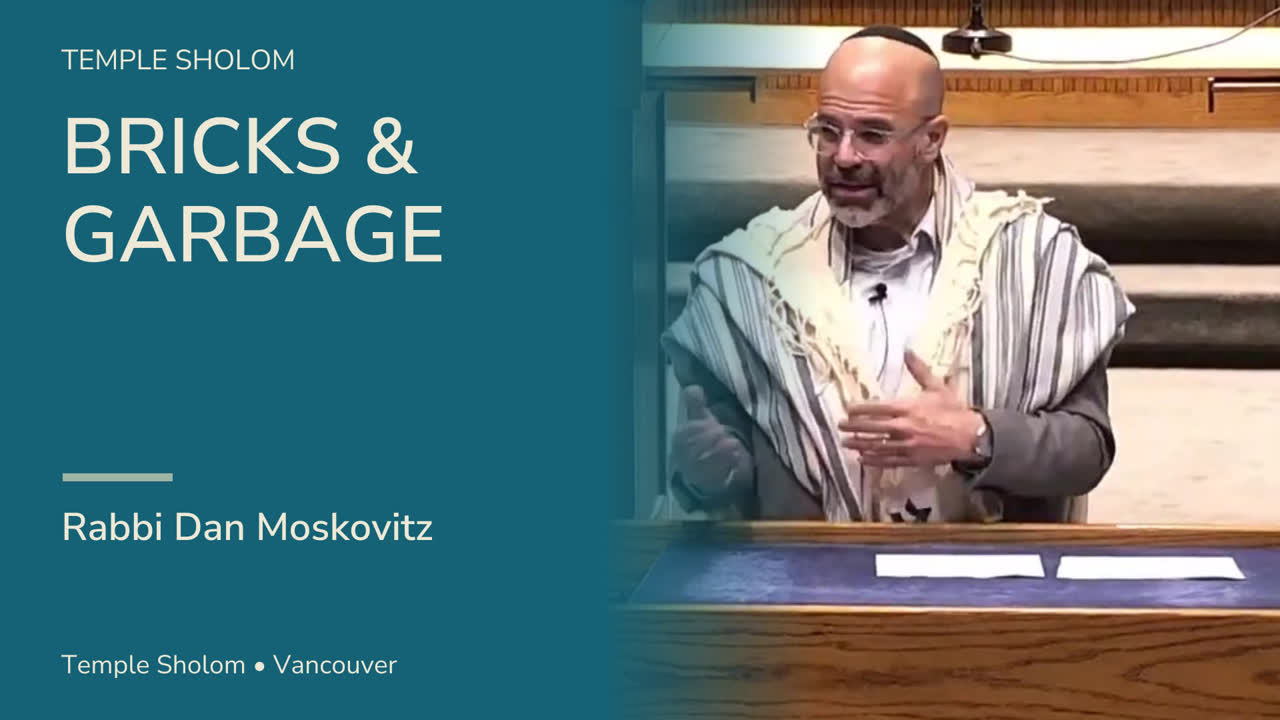
BRICKS & GARBAGE
Rabbi Dan Moskovitz
Temple Sholom - Vancouver BC Canada
November 1, 2024
Parshat Noah, the second portion in the book of Genesis and my Bar Mitzvah Portion is perhaps the most universally known and at least by children; most adored in all the Torah. In part no doubt this is because it has not one, not two, but every animal and they come in pairs. So beloved and recognizable is this Torah portion that we tend to forget that there is more to it than the animals coming on the ark two by two, the dove, the rainbow and our ancient ship builder Noah.
Tucked in at the end of the portion that bears his name is a small and poignant story. We are told that the descendants of Noah built a great city in the land of Shinar. They built a tower “with its top in the heavens” to “make a name” for themselves. God was offended by the hubris of humanity and said:
“Look, they are one people, and they have all one language; and this is only the beginning of what they will do; nothing that they propose to do will now be impossible for them. Come, let us go down, and confuse their language there, so that they will not understand one another’s speech.” (Gen. 11:1-4).
A favorite midrash explains: Many, many years passed in building the tower. It reached so great a height that it took a year to mount to the top. A brick was, therefore, more precious in the sight of the builders than a human being. If a man fell
down, and met his death, none took notice of it, but if a brick dropped, they wept, because it would take a year to replace it. So intent were they upon accomplishing their purpose that they would not permit a pregnant woman to interrupt herself in her work of brick-making when she went into labor. Molding bricks she gave birth to her child, and, tying it round her body in a sheet, she went on molding bricks.
(Yashar Noah)
When you’re a rabbi or really anyone that has studied Jewish texts intensely you can’t help but see the world through the lens of Torah. You hear something in the news and it triggers a connection to a lesson or story from our tradition that often puts the current event in a much larger and at times biblical context.
So when this week a comedian stood on a stage at Madison Square Garden, a venue that has its own historical context for Jews dating back to the pre-WWII Bundist American Nazi rally that was held there in times of similar deep social turmoil.
When I heard a comedian refer to other human beings as garbage, among many similarly dehumanizing and degrading remarks made by other speakers at the rally I thought of that midrash about how bricks were more valuable than human beings, disposable in the same way that garbage is used up and tossed aside.
I’m not singling out one party or one candidate in this context. This is not a sermon about Trump or Kamala, its not even a sermon about the US election per say. It’s a sermon about us, the human beings wandering amid the ruins of our own tower of humbris and selfishness, unable to communicate with each other, experiencing different realities, condemned as we are to mutual incomprehension and unprecedented distrust.
What happens when you see bricks as more valuable than human beings and your heart becomes numb to the suffering of others is that you discount and dismiss anything that stands in the way of you gathering more bricks, building your tower.
When grievance, power, and retribution overshadow the inherent worth of every person we lose sight of our shared humanity and see fellow human beings as garbage, disposable, deplorable and irredeemable.
The builders of the tower believed that their worth was determined by how high they could climb, how lasting a legacy they could etch into the heavens. They believed they could insulate themselves from vulnerability and dependence on others by reaching godlike heights, and if they had to step over and on top of their neighbors to do it, so what. They grew indifferent to the people around them, indifferent even to life itself. The society they built became one where a brick was worth more than a human life, where human suffering was simply an afterthought or maybe something to make fun of, make jokes about.
Today, in our world, we see reflections of this mindset. How often do we, too, get swept up in the structures we build—our jobs, our reputations, our possessions, or as we see across the political spectrum and beyond borders, we get swept up our ideologies and affiliations?
How often do we become so focused on these “towers” that we lose sight of the human beings right in front of us, reducing others to mere obstacles or, as was said this week, to “garbage”?
The Torah is calling us to dismantle these towers and to see the divine spark in each other. It is urging us to break down the walls of isolation and the hierarchy of worth that the world would have us believe in. Our tradition teaches us that every person is created b’tzelem Elohim, in the image of God, infinitely valuable, deserving of respect and compassion.
This Shabbat, take a moment to consider the towers we build in our own lives and that we are building in our society. Are they monuments to the best and most sacred versions of ourselves and the human project or, perhaps, barriers to real connection and understanding? Are we laying brick upon brick, seeking to rise higher no matter the human cost, or are we reaching out our hands, lowering the walls, and inviting each other to climb up with us?
From the moment the tower was finally destroyed, and the text implies that God seeing human hubris brought it all tumbling down. From that moment to today we have never again experienced the shared collective human effort to create something as unified and grand as the Tower of Babel. That ancient project, misguided as it was, represented humanity’s last attempt at a singular, collective endeavor, one where all people worked with one language, one purpose, and one vision—however flawed it may have been.
Since then, our languages, cultures, and societies have splintered, and while diversity is a beautiful testament to human creativity, it has also made it more challenging for us to unite with a common goal. The text suggests that perhaps God intended this division to curb our tendency toward pride and unchecked ambition. But in our fragmented state, we also find it harder to come together, to bridge divides, and to work toward universal goals like peace, justice, and compassion.
Today, we live in a world where global challenges, like climate change, social inequality, and violence, demand a response as unified and collective as that ancient tower-building effort. But instead of working together, we often find ourselves building individual towers, focused on personal success and divided by ideology, nationality, and belief. We devalue our fellow, see those that disagree as obstacles, or worse as garbage, when we need to see them as partners and fellow travelers on this shared journey. In our rush to build higher, we forget that our strength lies not in our individual towers but in the bridges between us. We need each other to tackle the immense issues facing us; no single person, community, or nation can solve them alone. When we reduce others to obstacles or dismiss their humanity, we weaken the very foundation of our shared world. No tower can ever be built on a weak and cracked foundation, every bridge needs solid points of connection.
The story of Babel is a reminder that we are meant to build together—not structures of stone that separate us, but communities rooted in compassion, understanding, and respect that connect us. If we can view those who differ from us as essential pieces of the human mosaic, as people with insights and gifts we may lack, then we can start to bridge the divides that Babel left behind. In unity—not uniformity—there is the power to meet our shared challenges and build a future worthy of all humanity. In doing so, we can transform the legacy of Babel from one of division to one of intentional, compassionate connection. And perhaps, in this way, we bring a little piece of heaven down to earth.
Any movement, any political rally or ideology less than that endeavor, well that truly is garbage.