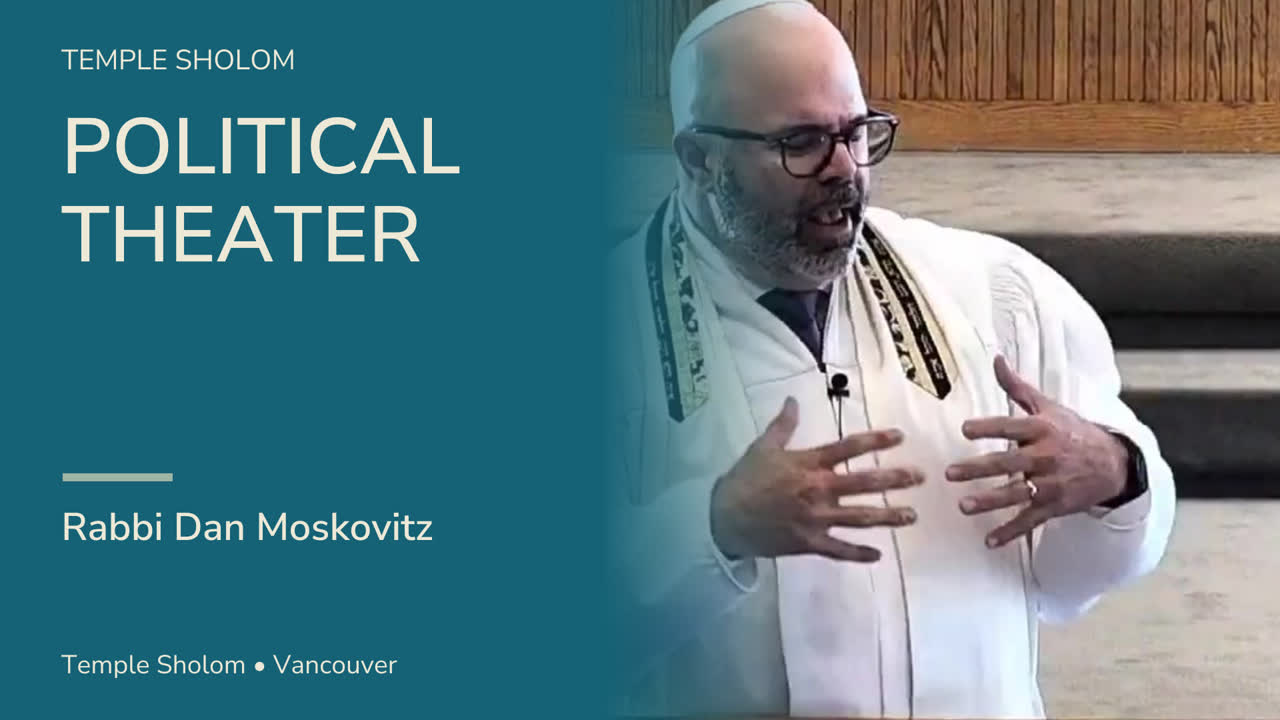
Political Theater
Rosh Hashanah Day 5783
Rabbi Dan Moskovitz
September 26, 2022
Video Link: https://youtu.be/G-pdGFXv04I
You may have heard that a few weeks ago there was an incident here at Temple, right here in
this sanctuary.
We were hosting a mayoral debate, the top five leading candidates were all sitting here on the
bema.
Sofie Lu from Global TV was the moderator, she sat over there.
Media, Journalists and TV Cameras were stacked in the center of the room.
The questions had been prepared in advance by CIJA, there was to be no participation from the
audience.
About half way in to the debate the topic turned to the rise in hate crimes in Vancouver,
particularly the rise in anti-Jewish and anti-Asian Hate.
One of the candidates was answering the question and spoke of their intention to pass the
International Holocaust Remembrance Alliance’s working definition of Anti-Semitism.
The moment they referenced the framework, a protester stood up, right over there where ____
is sitting and unfurled a sign.
I won’t repeat what was written on their banner but it used the words “aparthied”, “zionism” and
“racism”. I was sitting a few rows behind, over there by the yahrtzeit board. I caught it out of the
corner of my eye and I guess you could say instinct took over; I lept to my feet, went up to the
protester and quietly but firmly told them to sit down or leave.
As I was admonishing them that our sanctuary was not the place for such a protest, and by the
rules of the debate the audience was not to interrupt or participate, as I was quietly explaining
this two or three more protesters stood up and unfurled similar banners and messages.
Using a voice not even my kids have heard I bellowed, “Not in my house. You want to put up
signs you do it in your house, not in mine, not here.” I repeated it a few times, the
moderator/Sophie Liu called for security and the protesters were escorted out.
The room erupted in applause, I apologized to the candidates for the disruption and the debate
continued.
I have been thinking about that incident a lot these last few weeks, it's emblematic of the world
we live in today.
I want to be clear, I am all for political debate. In fact we were hosting a debate engaging in
an exchange of ideas at the very moment they stood up and unfurled their signs. But that
act was not political dialogue, that was political theater.
What the sign holders did was political theater and so was my response.2
Neither their actions nor mine were helpful to their concern about Palestinian Human Rights,
which I care about too, or my concern about Jew Hatred on the left hiding behind criticism of
Israel. And because it was theater, from both of us, they don’t know the depth of my concern for
the issue they raise and I don’t know theirs for mine.
● Theater isn’t dialogue.
● Theater isn’t debate.
● Theater solves nothing,
Theater is dramatic, it's provocative; we often need theater to alert us to a problem, but
today… theater IS the problem.
We want to address and to redress our differences … What we need is honest dialogue, not
theater..
What took place in our sanctuary is really a metaphor for what is happening not only between
left and right, but within the left and within the right, as well as within universities, companies,
professional associations, museums, congregations and even families.
Everyone has his or her or their own narrative, which excludes all others. We are fractured,
splintered, broken, divided into our different camps and tribes …more and more opposing
groups. The more we try to purify the groups we identify with, the more we split our society.
Social media does this inherently. That in itself is bad but what has made our current social
discourse so destructive is that there is no incentive to understand where the other is coming
from. There is nothing to encourage anyone to compromise or to strive to reach consensus, just
the opposite.
In the social media fueled, hyper-polarized, ‘who can shout the loudest and be the most
provocative’ world that we have created for ourselves our politics have become our religion,
so changing your mind becomes heresy. Even listening to the other side gets you
labeled a heretic; grounds for excommunication, banishment from your own side.
We have come to believe that dialoguing with those we disagree with, watching their
news, reading their opinions is a sin; it’s not a sin - it’s a Mitzvah!
Being familiar with, conversant with the “other side of the debate” is … a commandment.
And it is our obligation! Debate and difference of opinion are not the enemy, they are
how we arrive at the truth.
The Hebrew word for truth, EMET makes this point all by itself. The word is composed of three
letters, ALEPH-MEM-TAV, the first, middle and last letters of the Hebrew Alphabet. Thus we
arrive at truth ONLY when we incorporate all ends of the spectrum. Left. Right. And middle.
The Jewish tradition of engaging with so many texts, which are contradictory, has created a
Jewish way of thinking that is perfectly suited to address the widening and deepening divide
between us and between groups of us.
There is a story in the Talmud about the passionate and often heated debates between Rabbi
Yohanan and his brother-in-law Reish Lakish. Back and forth they argued. It was during one of
their passionate and sharp-tongued debates that Yohanan upset Reish Lakish for the last time. 3
Yohanan was hurt and Lakish too was hurt. That wasn’t unusual. But this time, Before they
could make up, Lakish dies.
Yohanan is inconsolable at the loss of his study partner. So his students decide to send him a
new study partner, an accommodating scholar, known for his calming manner. The name of
this replacement partner was Elazar.
The Talmud tells us, “no matter what Yohanan said about a passage - Elazar would agree with
every word.” This goes on for the better part of a week. With Elazar agreeing with every single
thing Yohanan says.
Finally, Yohanan can’t take it anymore and he lashes out “Elazar, You are certainly no Lakish!
Lakish would respond to me with twenty-four difficulties to each word I said, to which I would
give twenty-four answers, which produced a fuller comprehension of the law - for both of us!!.
But to everything I say, you say, ‘I agree. I agree.’
Elazar,,,I already know that what I say is right. I need a friend who is wise enough to explain to
me why I’m wrong.”
Then Yohanan ripped his garments and wept. And he cried until he died. Some say he went
mad first.
We don’t need more friends who agree with us. We don’t need more likes on our Facebook
posts, we need to test our views in the marketplace of conflicting facts and opinions. We need to
surround ourselves with people like Lakish, not a fan club of Elazars.
19th Century British Philosopher John Stuart Mill wrote, “In all of the great political and social
struggles of our time each side is correct in what they assert but wrong in what they deny, if
each could recognize the claims of the other there will be little left to have a complete picture.”
In the Talmud two great schools of thought, Beit Hillel and Beit Shammai model the importance
of how we can disagree with each other, even criticize each other, without tearing our society
apart in the process.
These two schools Hillel & Shammai were composed of thousands of students, in the whole
history of rabbinic debate they almost never agreed with each other.
The split between them was so deep that, according to the Talmud, "the Torah became like two
Torahs [when they would debate its meaning]".
But they followed two rules that we must learn as a society if we have any hope of stopping the
theater of grievance and bridging this divide.
FIRST: Even though they vehemently disagreed with each other on matters of Jewish law and
custom, the students of Beit Shammai and the students of Beit Hillel ate in each other’s homes
and married each other’s children. They did not let disputes in one area prevent not only
friendship, but even cooperation in other areas. 4
SECOND: When it came down to determining who was right on any particular subject matter we
learn that the law would generally follow Beit Hillel, not because they were more lenient (which
they generally were), but because the students of Beit Hillel would begin their argument by
teaching both their own position and that of Beit Shammai, in fact they would teach the opinion
of Beit Shammai first.
It takes great confidence in one's own views to be able to validate the views of others.
Of course you’ll get no argument to your position if you only permit or hear one side of the
argument. I know many who like the sound of their own voice but in a social media echo
chamber you’ll never learn what you don’t already know.
That is why Hillel needed Shammai and Yohanan needed Raish Lakeish. Because Judaism
does not only welcome diversity of opinion, it insists on it.
So how do we get out of this mess we have created, how do we stop playing to the crowd, like
those protesters did and like I did in response, which only further divides and enrages us.
We need to do three things:
ONE: We need to be conscious of what game we are playing when we confront those we
vehemently oppose and disagree with. Do we want to change their minds, defeat them, show off
how smart we are, or do we want to find a way to live together?
Those are foreign incompatible goals and many of us come in with this, “I’m right and justified in
my view, but your point of view is not only wrong, you have no right to have it”.
If we pursue those goals, we play that game, engage in that theater, we’re just gonna be angry
all the time; and people are so angry. Have you noticed that? How could you not?!
That’s the schools of Hillel & Shammai, they engaged in debate to seek truth, not to seek
destruction. And when the debate was over they danced at each other’s weddings.
TWO: We need to read each other’s opinions, follow each other’s news sources. Not to confirm
our biases, but to challenge them. Be curious. Be humble.
To effectively and respectfully make our case, we need to show that we are capable of entering
the mindset and worldview of the other side, seeing what they see through the prism of their
values and their experience. Walk a mile in their shoes, even if they rub us the wrong way and
give us blisters.
Ask questions, be curious because it turns out each group is actually right about a number of
things.
That’s Rabbi Yohanan and Reish Leikish, that's the verse right here on my tallit; “azeh hu
hacham, halomed m’kol adam / who is wise? The one who learns from all people.” The person
who thinks they have nothing to learn is a fool.
Here’s the homework: Go to a moral community that you disagree with and acknowledge
something that they're right about. 5
Don’t stand in their sanctuary and unfurl your banners proclaiming why everything they believe
is wrong. Sit, listen, learn. It might be hard, you might have to hear a lot you fundamentally
oppose, that offends you. So what! Listening is not agreeing, listening to views you disagree
with is learning, seeking knowledge. So listen, listen for values not policy. Find agreement,
reject confirmation bias, seek truth.
You can try this in a few minutes on your ride home or on the way to Rosh Hashanah lunch.
Turn on that news channel you never listen to, that you think is Fake News. Try to understand
their perspective, it may help you better understand your own.
THIRD: Ideas can be inflammatory and disagreement can be dangerous, things can boil over
and real conflict, violent conflict can result, we have already seen that. The problem of
maintaining peace in the face of ideological conflict is an existential challenge for every human
society: no society can long exist without managing it. The Torah says sinat hinam, senseless
hatred, unmanaged conflict is what destroyed the world in the time of Noah, the temples in
Jerusalem. That's why the Talmud was created, that’s why we refer to the School of Shammai,
the School of Hillel. The answer to ideological conflict is to build up institutions of authority,
universities, courts, houses of worship, formal/structured political debates like we were trying to
host here.
We must build up our institutions, not tear them down. Strong, moral institutions are the bedrock
of democratic success. Institutions are essential because they are set up to pit people against
each other in “Managed Conflict”, like the debates that fill the Talmud, or were on this stage.
Three steps we can take individually to collectively heal our fractured society.
● It's not a game, our inflammatory language and behavior is going to destroy us.
● Studying views you disagree with is not a sin, it’s a mitzvah. Seek EMET the whole truth,
left, right and center.
● Strong democratic institutions of authority make lasting communities, they manage
conflict and resolve disputes.
A rabbi once asked his students: “How do we know when the night has ended and the day has
begun?”
The students thought they grasped the importance of this question. There are, after all, prayers
and rites and rituals that can only be done at nighttime. And there are prayers and rites and
rituals that belong only to the day. It is important to know how we can tell when night has ended
and day has begun. It is important to get the rites and rituals correct.
So the first and brightest of the students offered an answer: “Rabbi, when I look out at the fields
and I can distinguish between my field and the field of my neighbor, that’s when the night has
ended and the day has begun.”
A second student offered his answer: “Rabbi, when I look from the fields and I see a house, and
I can tell that it’s my house and not the house of my neighbor, that’s when the night has ended
and the day has begun.”
A third student offered another answer: “Rabbi, when I see an animal in the distance, and I can
tell what kind of animal it is, whether a cow or a horse or a sheep, that’s when the night has
ended and the day has begun.”6
Then a fourth student offered yet another answer: “Rabbi, when I see a flower and I can make
out the colors of the flower, whether they are red or yellow or blue, that’s when night has ended
and day has begun.”
Each answer brought a sadder, more severe frown to the rabbi’s face. Until finally, he shouted,
“No! None of you understands!
“You only divide! You divide your house from the house of your neighbor, your field from your
neighbor’s field, you distinguish one kind of animal from another, you separate one color from all
the others. Is that all we can do – dividing, separating, splitting the world into pieces?
Isn’t the world broken enough? Isn’t the world split into enough fragments? Is that what
Torah is for?
No, my dear students, it’s not that way, not that way at all!”
The shocked students looked into the sad face of their rabbi. “Then, Rabbi, tell us: How do we
know that night has ended and day has begun?”
The Rabbi stared back into the faces of his students, and with a voice suddenly gentle and
imploring, he responded: “When you look into the face of the person who is beside you, and you
can see that person is your brother or your sister, then finally the night has ended and the day
has begun.”
We must stop dividing, we must stop the theater, and find what we agree on, accept our
differences, learn from each other, even if what we learn is that we see things differently, let us
at least understand why. Debate and difference of opinion are not the enemy, they are how
we arrive at the truth. It’s a Mitzvah!
Let me finish where I started.
If those protesters don’t stand up with their signs and banners, I don’t stand up and shout them
out of the room. If they do, I do, and regrettably, I would do it again. The same goes for anyone
who denies my existence, spews hatred, incites violence. We all have our limits and there are
places on both left and right where I will not go, but within civil limits.
But if instead they seek to understand me, and I seek to understand them, we meet across a
table in the marketplace of ideas instead of in the theater of the absurd; then maybe like Raish
Lakeish and R. Yohanan, our arguments make our own positions clearer, and maybe like the
schools of Hillel and Shammai we respect each other’s right to their own point of view. And then
maybe, as the rabbi taught his students, we will see that that person is our brother, our sister,
and then finally, this dark night where all we do is divide and divide will end, and a New Day, a
New Year will have truly begun.
END
SERMONS & WRITING · 2022
Political Theater
Rosh Hashanah Day 5783