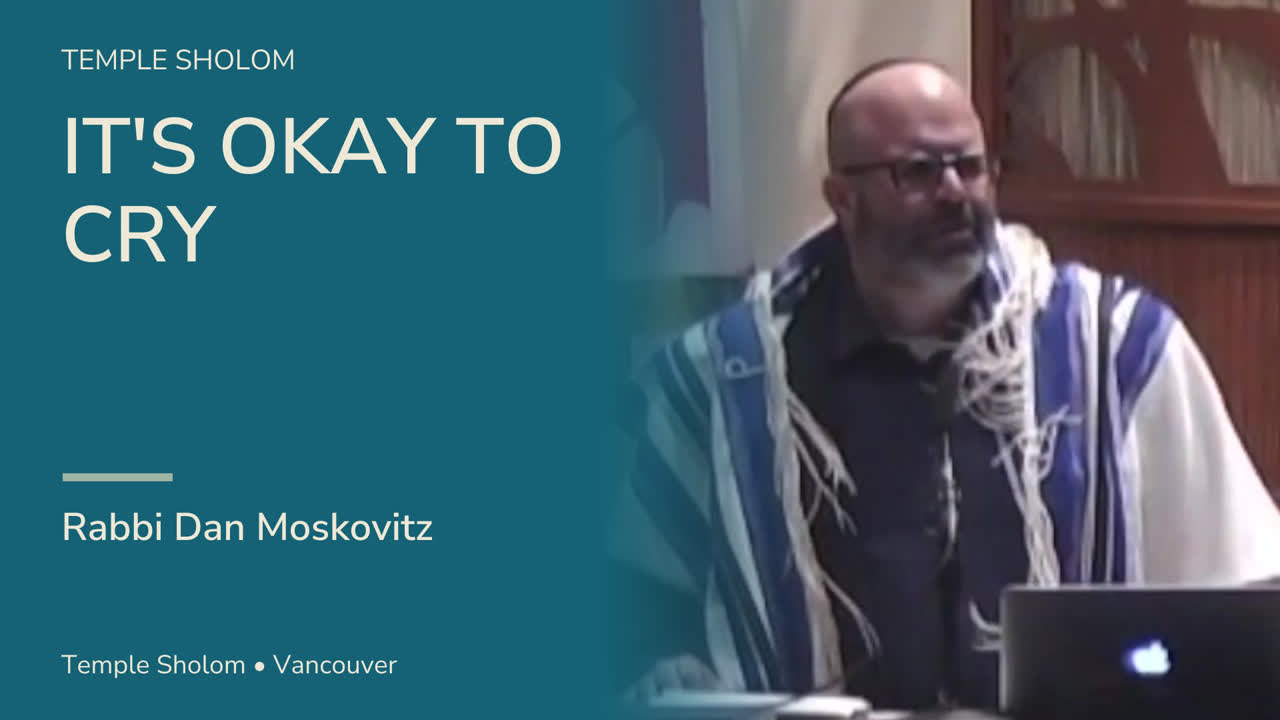
ITS OK TO CRY
RABBI DAN MOSKOVITZ
TEMPLE SHOLOM – VANCOUVER BC
MARCH 13, 2020
Yesterday I cried in my car.
You shouldn’t worry - I was parked at the time.
I share this not for sympathy or even empathy – I know that I have both and I feel your
support. I share this because, these are harrowing times, we all feel the tremendous
weight of worry:
• for ourselves, if we are relatively young, we know the vast majority of cases are
mild to moderate, but some aren’t.
o If we are older the danger increases with age, though interesting to me I
have found amongst many of our elders a rationalism and calm that if I
wasn’t freaking out so much worrying about them I would take comfort
in.
• for our aged parents, if we still have them and for some compounded worry that
they are beyond our reach in other cities or countries
• for our children – as normalcy evaporates. I told my children the other night as
we cancelled plans for our son’s birthday party at the movies that they will tell
their own children how they survived the Pandemic of 2020. And they will, the
vast, vast majority of all of us, even the aged will survive this – but we will be
forever changed by it – I hope for the better.
• for our city and country as it attempts to ‘flatten the curve’. I long for the days
when that phrase was most often rendered in my head as I looked in the mirror
at my belly or hips.
• I’d say that I worry for our world as this pandemic is truly global, but the sweep
of this virus is so vast that I can’t wrap my head around the whole world
experiencing this crisis all at once.
o If ever an example was given that there are no true borders that what
happens here effects people over there and visaversa – this is an
example.
§ Refugee Crises
§ Climate Change
§ Economic Disparity
§ And now a Pandemic – we are all connected. There are no
Chinese COVID-19 victims, or Italian, or Israeli, or Iranian or
American or Canadian – there are just people living in different
parts of the world all with the same fears, uncertainty, worry and
prayers for healing. Just people, just human beings – there is
NOTHING so different about any of us, except perhaps age, which is only a matter of time that it protects any of us more than the
rest of us.
That’s why I cried in my car, and I share it with you because I learned from that cathartic
cry that it is ok to be scared, its ok to cry. Not because I did it, and I don’t want to be the
only one crying in my car, where the kids can’t see me but because I felt a lot better
after – and you might too.
There was a cartoon that was being passed around on the internet, I guess we call that a
meme. It was of a couple looking at their computer and the caption was as the man
turned to his wife over her shoulder, “That’s funny all of my friends on Facebook, who
last month were constitutional law experts are now epidemiologists.”
I thought it was funny.
I know very little about the science of all of this – though I am trying to keep up, and Dr
Henry and our congregant Dr Patty Daly and their teams are incredible in their
competence and expertise. But I know almost nothing about science that is helpful here.
What I would like to offer, what I think might be of help is the power of prayer. Not to
change God, not to change the course of this virus. As I wrote in my letter to the
congregation, though this is a natural evil, I do not think it is punishment from God or
within God’s control. My faith doesn’t work like that.
I want to suggest and teach for a moment the power of prayer not to change God, but
to change each of us.
Sarah Hurwitz, writes in her book “Here All Along” – which I am sure many of you are
tired of hearing me praise and talk about. She describes a form of chassid prayer called
Hitbodedut. The word, which sounds a bit like the last name of one of the former
democratic candidates for president refers to a practice of self-secluded Jewish
meditation popularized by Rebbe Nachman of Breslov (1772-1810).
The practice as he taught is an unstructured, spontaneous and individualized form of
prayer and meditation through which each individual establishes a close, personal
relationship with God through a free flowing monologue. Where some people go out
into the woods and make a primal scream, Jews, at least Jews who are students of this
practice go out into the woods and kvetch.
Not only kvetch, but thank, and question and plead and wonder and acknowledge,
outload without stopping to think or formulate your thoughts. You just talk to God. It’s a
stream of consciousness practice that takes some practices, but like the cry in my car, it
can be incredibly cathartic and remarkably revealing of your inner thoughts and feelings.Its not unlike the famous Jewish folk story of the young uneducated shepherd who
comes to the synagogue to pray. Not knowing the prayers of the established liturgy, he
sits in the back row and sings the alphabet over and over again (maybe he was also
washing his hands?). The men of the synagogue confront him: “Why do you disturb our
prayers with your gibberish?”
The boy explains, “I don’t know the prayer. But I wish to thank God for my sheep and
the stream, for the warmth of the sun and the silver moon that keeps me company
when I sleep. I am the alphabet and surely God can put the letters in the correct order
to make the prayers.”
In this worrying and frightening time, give voice, actual voice to your thoughts and
feelings, your fears and your anxieties. Not to change God, not to stop the virus, but to
change yourself. To give you insight and courage, and patience and perspective and
confidence and hope and calm and gratitude. In doing so you might just find your
prayers, not those in this book (or on that screen) but the prayers that are deep in your
soul. Go out into the woods, they tell us the virus in not as communicable outside, and
talk to God.
Rabbi Abraham Joshua Heschel taught:
“Those who honestly search, those who yearn and fail, we did not presume to judge. Let
them pray to be able to pray, and if they do not succeed, if they have no tears to shed,
let them yearn for tears, let them try to discover their heart and let them take strength
from the certainty that this too is a high form of prayer.”
Talk to God, Cry to God, be silent with God, it’s all prayer, and it all helps. I know it is
helping me; I pray that it will help you.
SERMONS & WRITING · 2020
Its Ok To Cry
MARCH 13, 2020