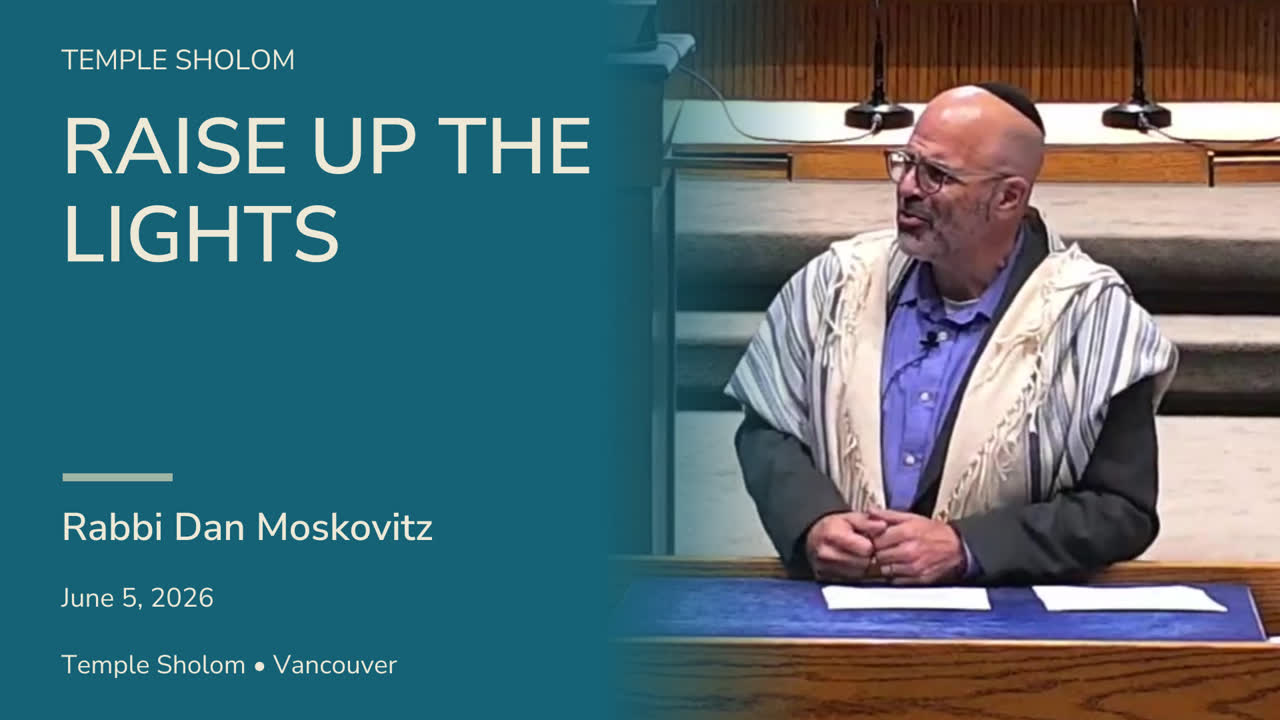
Tonight I want to begin with a simple confession.
I am tired.
And I know many of you are tired too.
Not only physically tired, though there is certainly plenty of that. We are emotionally tired. Spiritually tired. Tired from the alerts on our phones. Tired from the news, the tweets, I still call them that, from the posts and reels. I went off Facebook for a few months around the new year it was the best thing for my mental health. But the world didn’t stop spinning out of control I just stopped paying attention. Which is like ignoring a leak in your roof, one day you’re going to have a real problem.
I’m Tired from the meetings about security, maybe 30% of my time now. I’m tired from writing statements and OpEd and the briefings and meeting with politicians.
Tired from wondering what will happen next. Tired from explaining ourselves. Tired from defending things that should need no defense. Tired from having to say, again and again, that the way it’s being used antizionism IS antisemitism. Tired from having to constantly remind people that Jewish children should be safe in school, Jewish students should be safe on campus, Jewish families should be safe walking into synagogue, Jewish Canadians should be safe being Jewish in Canada.
And then, just when we think we have found a moment to breathe, another synagogue is attacked.
This morning, Temple Emanu-El-Beth Sholom in Montreal, the historic Reform congregation of that city, was firebombed. Thank God, no one was hurt. But let us not allow the absence of physical injury to diminish the severity of what happened. Cantor Cohen was just at that synagogue yesterday for a conference, she left Montreal this morning. Like us, they have a bat/bat mitzvah tomorrow and according to my friend and colleague Rabbi Lisa Grushcow the building still smells of smoke. A synagogue is not just a building. A synagogue is a house of prayer, learning, memory, mourning, celebration and hope. To attack a synagogue is to attack the sacred space where a community gathers to affirm life. They know that. The haters, that’s why they do it.
Here in Vancouver, we know this pain. Last year, Congregation Schara Tzedeck was attacked by fire. In 1985, our own Temple Sholom was firebombed and rendered unusable, and Rabbi Philip Bregman ran into the burning building to rescue those Torah scrolls, that menorah still shows the wounds from the fires of hate that engulfed it. These are not distant stories. They live in the memory of this congregation. They live in the body of Canadian Jewish life. They are part of the generational trauma that has yet to skip any generation of Jews.
And what makes this morning’s attack even more painful is that it came just days after the Prime Minister stood in a synagogue, Holy Blossom Temple In Toronto and spoke about antisemitism in Canada. He said clearly that Canada’s civic compact is failing Jewish Canadians. He spoke about covenant. He spoke about the promise of Canada. He spoke about the need for Jews in this country to be able to be visibly, fully, joyfully Jewish.
Those words mattered.
But this morning reminded us, painfully, that words alone cannot repair what has been broken.
A covenant is more than a speech, sympathy or thoughts and prayers. Just about anything is more than “thoughts and prayers” these days. A covenant has to be lived, enforced and protected. Or in the words of our tradition, shamor v’zachor, kept alive in our memory and guarded against violation. A covenant has to mean something.
This past week I officiated at two weddings, I have a third on Sunday. When I stood beneath the chuppah for those wedding couples last week and when I do again Sunday they will enter into a covenant with each other, a covenant of marriage, not unlike our covenant with Canada. If one says to another, “I will protect you but only when it's not too hard” or “only when it's in my own self interest” the broken glass will be nothing compared to the broken hearts and trust. Why marry someone who only cares about you when they need something from you?
That is the question many Canadian Jews are asking right now. Do you care about your Jews, have you ever really cared or is it all just for show?
And at the very same time, here is the strange and almost impossible truth: Jewish life continues.
That may be the most important sentence I can say tonight.
Jewish life continues.
In these same exhausting weeks, I have not only stood under chuppahs and watched couples begin their married lives. I have officiated at baby namings and watched parents place ancient Hebrew names upon new Jewish souls. I have stood with b’nai mitzvah students as they chanted Torah, taught our community, and stepped with pride into Jewish adulthood. Tomorrow, the Telio siblings will do that together, and many of them and their friends are here tonight. In these same infuriating weeks of unchecked hate directed at the Jewish people I have sat with families in mourning at funerals, visited hospital rooms, seen fear and sorrow, love and courage, all in the same day.
This is what it means to be a rabbi, but more deeply, this is what it means to be part of a Jewish community. We do not live one emotion at a time. We bury our dead and name our babies sometimes as with my Wednesday on the same day.
We march into government offices demand they stop dancing around the issues and then we dance at weddings. We sit beside hospital beds and then cheer for teenagers chanting Torah. We worry about the future and then watch the future grab hold of a Torah from their parents and recite the shema.
Last Sunday, our religious school ended its year with nearly two hundred students. We are the largest synagogue school in Canada. And the families did not want to leave the end-of-year barbecue.
Who ever heard of kids not wanting to leave Hebrew school?
And perhaps one of the most unexpected things happening right now is that almost every day, I hear from someone who wants to explore Judaism, someone who wants to talk about conversion, someone who is drawn toward this people, this tradition, this way of life.
What a bewildering time to be Jewish.
So many are out to get us. And many others are seeking to join us.
How do we hold both truths?
This week’s Torah portion, Beha’alotcha, begins with the lighting of the menorah in the Mishkan. God tells Moses to instruct Aaron to raise up the lamps. The Hebrew phrase is beautiful: be-ha’alotcha et ha-nerot. When you raise up the lights.
The rabbis notice that the Torah does not simply say, “when you light the lamps.” It says, “when you raise them up.” Rashi explains that the priest had to hold the fire to the lamp oil till each flame could rise on its own.
That is our work right now.
We are not only trying to survive the darkness. We are trying to raise up light strong enough to stand on its own, to erase the darkness..
Jewish continuity is not automatic. Jewish courage is not automatic. Jewish joy is not automatic. Someone has to kindle it. Someone has to protect it. Someone has to teach a child the Shema, invite a teenager into leadership, show up for a mourner, dance at a wedding, sit beside the sick, bring food to a family, celebrate a graduate, welcome a seeker, defend a synagogue, call an elected official, write the letter, make the donation, come to services, stay for kiddush, and refuse to let fear become the organizing principle of Jewish life.
That is how the flame rises.
Jewish joy right now is subversive, its counter cultural, is an act of spiritual resistance.
Our enemies want Jewish life to shrink. They want us anxious, hidden, guarded, suspicious and small. They want Jewish life to become only security meetings and police reports and trauma responses. And some weeks it feels like that is all I do. But that’s not all WE should be doing.
Yes, we must deal seriously with security, demand action from government. Yes, we must insist on enforcement, protection and accountability. The time for condolences without consequences has passed. And if they form one more committee to study rhe problem I’m gonna lose my mind. Which of course they did and I am.
But our answer cannot be fear or isolation alone.
The answer cannot be that we lower our heads, hide our kippot, tuck in our Magen Davids, tell our children not to mention Israel, or accept that Jewish life must now take place behind guards, locked doors and whispered caution.
A covenantal Canada must be a country where Jews can lift up our heads.
And a covenantal Jewish community must be a community that remembers how to lift up its own lights, and by our example the lights of others. That’s what it means to be an Or Lgoyim, a light unto the nations. We must meet darkness with light,
In our parasha Aaron was commanded to kindle light in the wilderness, when our people were not yet settled, not yet safe, not yet home. The menorah was not lit in a palace. It was lit in the desert. It was lit amid uncertainty. It was lit while the people were still afraid, still complaining, still wondering whether the journey would ever end.
And still, God said: raise up the lights. It was a beacon of hope, something to point to, to aspire to, to draw us near and keep us warm.
That is our command too. Dr. Martin Luther King Jr. taught:
“Darkness cannot drive out darkness; only light can do that. Hate cannot drive out hate; only love can do that.”
So tonight, even tired, even afraid, even heartbroken, we choose light and love.
We choose the light of this sanctuary, this Torah, this community. We choose the love of our people and our country, committed to see it through these hard times.
A synagogue in Montreal filled with smoke this morning.
But tonight, this sanctuary is filled with Jews at prayer and in song.
There was darkness and now there is light!
So we will demand action. We will protect our people. We will hold Canada to its covenant. And we will keep living Jewishly, visibly, fully, joyfully.
Because Jewish life continues.
Because the flame still rises.
Because Am Yisrael Chai.
Because here the light is not going out.