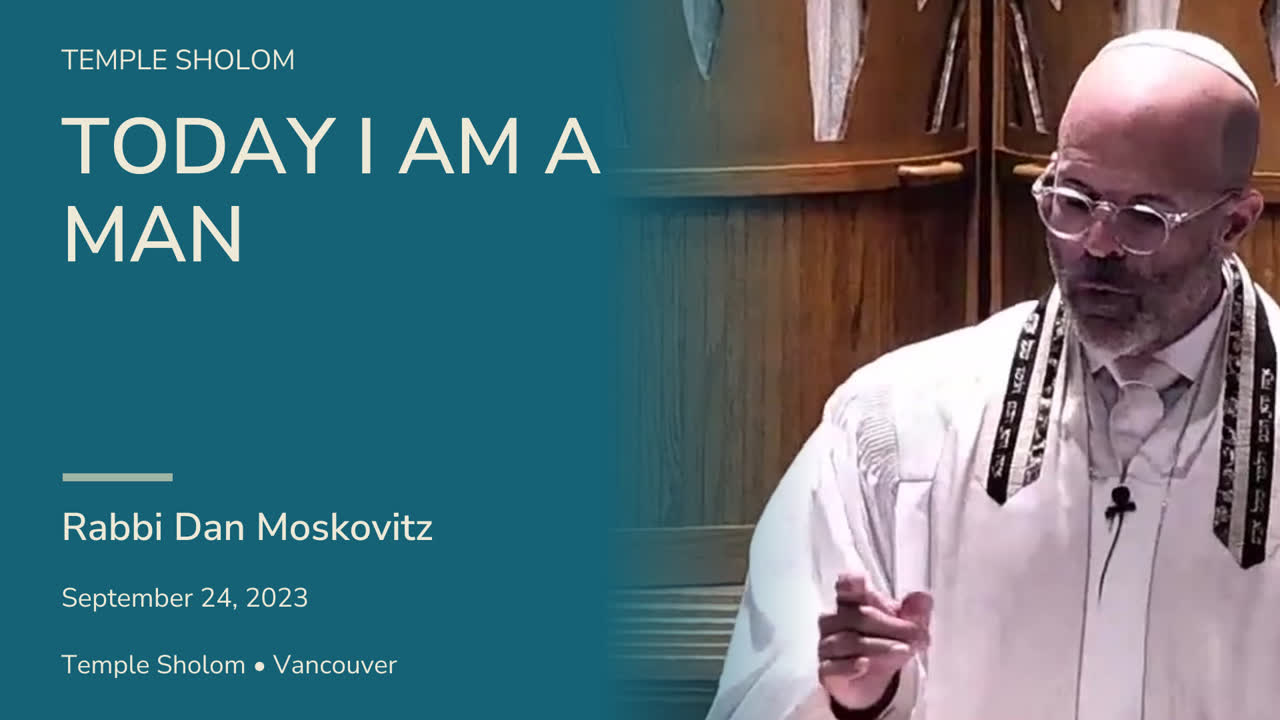
TODAY I AM A MAN
Rabbi Dan Moskovitz
Temple Sholom - Vancouver BC, Canada
Kol Nidrei 5784
September 24, 2023
A video of this sermon as delivered is available here
“Today I am a man!”
Declared the Bar Mitzvah Boy.
I know it's a cliche, but from time to time they really do say it.
“Today I am a man!”
Interestingly, in nearly 25 years as a rabbi I have absolutely no memory of a Bat Mitzvah Girl ever proclaiming, “today I am a woman”.
What do boys believe about the meaning of that moment that girls see differently?
“Today I am a Man!”
Molded from boys to men by superhero comics, war movies, and sports idols, for the longest time boys on the cusp of manhood understood that, like it or not, agree with it or not, and to be clear I, like many men, didn’t like it or agree with it, but like or not men until recently men have long understood that, “to be a man” meant:
* Repress your emotions - except for anger,
* Don’t show weakness or fear,
* Never let anyone get the better of you, always stand your ground,
* Demonstrate power and control,
* Be aggressive,
* Dominate,
* Be a protector,
* Be decisive,
* Make money,
* Be heterosexual,
* Don’t be “girly”, don’t be “gay”,
* Be tough, athletic, strong, fearless, don’t cry in baseball, hockey or anywhere else,
* Exhibit confidence no matter what,
* Don’t ask for help, or even directions, even if you’re lost.
“Today I am a Man!” - What does that even mean anymore?
________________
Anthropologist David Gilmore in his seminal work “Manhood in the Making” conducted a cross-cultural study of manliness around the world. He found that almost all societies had a concept of “real,” “true” or “adult” manhood that was seen as a valuable and indispensable ideal.
In the times of the Bible manhood had to be earned — and proved. You didn’t declare it on your Bar Mitzvah,
* you earned it by providing for your family and broader society,
* by protecting your tribe and others,
* and by procreating.
Today, all three of these goals seem less celebrated, to some they seem toxic and to most men they are out of reach; if worth striving for in the first place.
The lack of a clear path to manhood and a modern definition of manliness is messing men up.
That’s not good, not good for men, not good for those that care about them, not good for all of us who share this planet with them.
When I say men are lost and messed up I’m not just being euphemistic, men are truly broken and we are losing them.
I’m going to share some data with you now, but as with all statistics we must remember that each of these percentage points is a human being, a son, father, brother, friend, co-worker who is lost, broken and in crisis.
Try to think of the men in your life who are represented by these data points -
* personalize them,
* name them
We need to see the problem facing men as a problem facing all of us. Facing people we know and love.
Let’s start with education.
Men account for 41% of university enrollments, down from nearly 60% in 1970 the year I was born. If we talk about graduation rates, it gets even worse for men.
Since men drop out at a faster clip than women, if the current trend continues in the next five years there will be two female university graduates for every one male.
As we celebrate the remarkable achievement that this indicates for women, let’s not fail to notice that fewer men going to university means fewer men on pathways to economic prosperity; and that has implications for their prospects of forming meaningful relationships.
Roughly one-third of men are either unemployed or out of the workforce.
Already this has led to an epidemic of male loneliness and isolation.
Men have fewer social ties than they used to.
* 75% of men say they have less than six close friends
* 15% of men have no close friendships at all. Thirty years ago the opposite was true.
* For the first time in 130 years more young men ages 18 to 34 are living with their parents than with romantic partners.
* Men are twice as likely to overdose on drugs,
* three and a half times more likely to commit suicide or die from “Deaths of Dispair”
* nine times more likely to be incarcerated.
I'd joke and say maybe it’s because all of those things sound better than living in your childhood bedroom as a grownup of any gender identity, but it’s nothing to joke about and it’s sadly probably true.
In addition to data we are also going to need to learn some new vocabulary this evening. Not Hebrew or Aramaic, but the language of the manosphere; a collection of websites, blogs, and online forums promoting masculinity, misogyny, and opposition to feminism.
Among the most active participants in this virtual but all too real world are men who call themselves Incels, or “involuntary celibates.”
These are young, heterosexual men who blame women and society for their own inability to form romantic or sexual attachments. These men live their lives largely in online chat rooms where they immerse themselves in violent, misogynistic, pornographic fantasies that far too often result in real life violence against women and society in general.
It will surprise no one that recent studies reveal that more than 9 in 10 mass violent attackers were male, and more than two-thirds of them were men under the age of 35.
The most dangerous person in the world is a lost, aggrieved, broke and alone young male.[1] And we are seeing more and more of them every day.
To proclaim, “Today I am a man” should be heard by all of those who care about men and boys as a cry for help, some hear it as a threat.
CAVEAT/DISCLAIMER:
Now I want to say a couple of things before I say anything more on this subject:
1. I am well aware that when discussing any large group, we make certain generalizations that aren’t true of everyone in that group. Not all men are in crisis, angry, scared, lonely, violent or repressing their emotions. And still the data says that many truly are.
2. Second, I realize that in the fight for women’s equality we aren't done yet, that the gains for women are fragile; and if we focus on men we might forget about women, let alone the non-binary and trans community that is under assault and stigmatized at this very moment. It's a valid concern, AND it’s also not a zero sum game. I have three children, I can love and worry about each of them differently at the same time, in fact I have to.
3. Third, when we talk about marginalized groups, we usually mean groups that mainstream society treats as if they are less valuable and therefore are undeserving of the same rights and opportunities: women, People of Color, immigrants, LGBTQ+, and indigenous peoples. Part of the marginalization is to view members of these groups in a one-dimensional way based on unflattering cultural stereotypes.
It is true and accurate to say that boys and men aren’t discriminated against in the same way as these other groups are (unless they are also members of those groups).
And still a lot of young men feel that all masculinity is viewed as toxic, and the problem with men is really being framed as a problem of men.
What does it mean to be a man today? Is it a cry for help? Is it a threat? Is it a blessing?
* That Bar Mitzvah Boy who declares, “today I am a man!”
* The University student who wonders, “what does non-toxic masculinity look like today?”
* The father who is not the primary breadwinner nor the first nurturer of the children, and wonders “what is my purpose?”
* The lonely, angry, resentful incel who spends his nights and days raging against his loss of male privilege.
Each of them and all of us need specific answers to the question “what does it mean to be a man today?”
Richard Reeves, author of the bestselling book, “Of Men & Boys” agrees, “What is needed today is a positive vision of masculinity that is compatible with gender equality.” He says, “We must help men adapt to the dramatic changes of recent decades without asking them to stop being men. We need prosocial masculinity…and we need it now.”
THE JEWISH VIEW
What does that look like? It looks Jewish.
Judaism offers a model of masculinity that embraces imperfection, we are not a finished product on our Bar Mitzvah Day, nor the day we graduate from university, or stand beneath the chuppah nor even on the day of our death, and certainly not on this night of Kol Nidrei when we confess our sins and shortcomings. We are still becoming, improving, growing, learning, changing, repairing.
In Judaism, to be a man - means to always be working on yourself to be better in all the ways that we will pray and confess our shortcomings about this Yom Kippur.
Of course that’s also true about being a woman, or being trans or non-binary; we are all working on becoming the best version of ourselves.
But within the general category of human being, there are specific things that men, because of our inclinations, because of eons of conditioning as protector, provider, warrior, leader - there are specific weaknesses and susceptibilities that men need to pay particular attention to, just as their are specific things that other genders and identities need to be mindful of in their own lived experiences.
Where the left and the right offer men absolutes, “Be more like your sister.”, “Be more like your father.” Neither of which is particularly helpful, Judaism says to men, be more like our biblical role models, all broken and flawed, but striving to be better.
Be more like Jacob who wrestles with his own personal demons and moral failings, who literally and figuratively wrestles with God from which he claims his name and gives us ours, Yisrael, the man who struggles with God. Jacob who, in perhaps the greatest example of growth and self awareness in the whole Torah reconciles with his brother Esau, hugging and kissing him in a display of true humility and brotherly love.
Learn from the example of King David, who was as flawed and toxic a male example as you could find in torah, sleeping with other people’s wives, killing their husbands to cover up his actions, who uses force and power in the most egregious ways. Don’t do that, BUT when confronted with his sins David confesses just as we have done this evening, he says, Al cheyt shchatani l’fanecha, I have sinned before you Adonai.’
A model for men to avoid in his toxicity and to emulate in his accountability.
David doesn’t try to blame someone else or circumstance, he takes responsibility and then as an act of t’shuvah, of repair from his deathbed, he calls to his son Solomon and says, “ וְחָזַקְתָּ֖ וְהָיִ֥יתָֽ לְאִֽישׁ / v’hazaktah v’hayitah l’ish / strengthen yourself and become a man”
David tells Solomon:
I know that you are smart, but that won’t help you unless you can apply it to the way you act. Look at my life and how many mistakes I made, how much hurt I’ve caused. Don’t be like me.
v’hazaktah v’hayitah / ‘Strengthen yourself,’ become a man, an ‘ish,’ an emotionally well-developed person. Only then will your great wisdom be useful and serve you well. Follow the torah, let it be your guide not your wanton desires and crude impulses.
The rabbis of the talmud explain,
אֵיזֶהוּ גִבּוֹר, הַכּוֹבֵשׁ אֶת יִצְרוֹ /Ezeh who gibor,
"Who is a man? One who conquers his [evil] inclination” 'Better to be merciful than mighty, to have self-control than to conquer a city' [Prov 16:32]." (Avot 4:1)
Self-restraint in the view of the rabbis is constructed as a masculine activity, and an eternal struggle, self-restraint is what it means to be a man.
Consider the machzor, the prayer book you hold in your hands. Traditionally these prayers and confessions of sin were written to speak exclusively of male weaknesses and transgressions. Now we read them as universally applicable, and maybe they are, but they are also written for and about men and our “David like” inclinations, in Hebrew, our yetzer, they are so hardwired into the male psyche that our traditions says individually and collectively we to need to confess them year after year.
Al heicht shehatanu lfanecha, For these sins, our God, we ask forgiveness:
For the ways we have wronged You by giving in to our hostile impulses; and harm we have caused in Your world through inflexibility and stubbornness.
For the ways we have wronged You by losing self-control; and harm we have caused in Your world through consumption of food and drink.
For the ways we have wronged You through sexual immorality; and harm we have caused in Your world by hardening our hearts.
For the ways we have wronged You through greed and exploitation; and harm we have caused in Your world through dishonesty in business.
Certainly we can all be guilty of these sins but again in general, these are traits and transgressions that men must pay particular attention to.
Doing them, acting in these toxic ways doesn’t make you a man, mastery over them does, that is the Jewish measure of manliness.
But you can’t do it alone, men must break type, we must ask for directions.
SOLUTION
Throughout history boys have been ushered into manhood and masculinity by stories, examples and the mentoring of other men. Just as women have been ushered into womanhood by other women. We see this powerful example best in Anita Diament’s, The Red Tent. One of the most important Jewish Feminist texts of the 20th century.
The core idea of Diamant's novel is to give voice to the often-overlooked women of the Bible, particularly Dinah, the daughter of Jacob and Leah. The book reimagines the biblical story of Dinah and explores the lives, relationships, and experiences of the women in her family, focusing on their bonds, rituals, and the "red tent" where they gather during menstruation and childbirth. It is a celebration of female solidarity, resilience, and the power of women's stories in a patriarchal society.
Our Men’s Club does a wonderful job of programming and bringing men together for social and educational activities. Poker and Pastrami, Men’s Mingle - these are great programs, widely popular, Jewish men from other shuls come with a Temple Sholom member just to attend.
And still, this moment of male identity crisis requires more. Beyond the social, men must deal with the emotional.
In small, intimate (I just scared half the room, and it is the same half this sermon is focused on), in small, intimate circles of conversation and contemplation, our own “Red Tents”, Jewish men must come together to explore these questions. Our tents will be pitched in the sanctity of this holy space, or your living room or if necessary online via zoom, wherever men can gather, not for being, but for becoming.
Rabbi Nachman of Bratzlav taught, "Nothing is as whole as a broken heart." To be a man in full is to acknowledge the breaks. I invite men in our congregation to sign up for these self led groups. I’ll provide the resources, the conversation starters and you’ll bring your whole honest, vulnerable, work in progress selves.
For teen boys, and teen girls and those who identify as non-binary in addition to our inclusive and expanding youth group BBYO, Temple Sholom has also begun working with an organization called Moving Traditions that is helping us design a spring retreat and follow on programming to answer the question “What does it mean to be me?”
CONCLUSION:
“It is harder to be a man today, and in many ways, that is a good thing: Finally, men are being held to a higher standard. Even so, not all of the changes that have led us to this moment are unequivocally positive. Left unaddressed, the current confusion of men and boys will have destructive social outcomes, in the form of resentment and radicalization.” (Christine Emba) We are seeing that already, remember those statistics.
This sermon is about men but it’s a message for all of us.
Embracing our imperfection, becoming, not simply being that is the mitzvah of this most sacred and challenging day. That’s why we are here, fasting, confessing, reflecting, changing.
We are perfect as we are, and we are a little broken too. Being “perfectly imperfect” is what makes us human beings, in all our many forms and identities. We are works in progress, and it’s steady work.
Jacob reminds us it's a struggle, David reminds us it’s never too late to start, Solomon reminds us that we need to be both wise and moral, the rabbis remind us that we must practice self-restraint of our yetzer, our impulses, Yom Kippur teaches us the work never ends. Lest we forget.
I am a man, perfect as I am and a little broken too, so are you, so are we all. We need compassion for ourselves and for others, empathy and understanding that being a man, woman, human being in all our forms ain’t easy.
I am a man, I’m not defined by my flaws, neither are you, but by our willingness to embrace them, grow from them. We are works in progress and tomorrow, the work continues.
________________
[1] https://www.cnn.com/2022/04/19/opinions/masculinity-toxic-men-boys-education-galloway/index.html