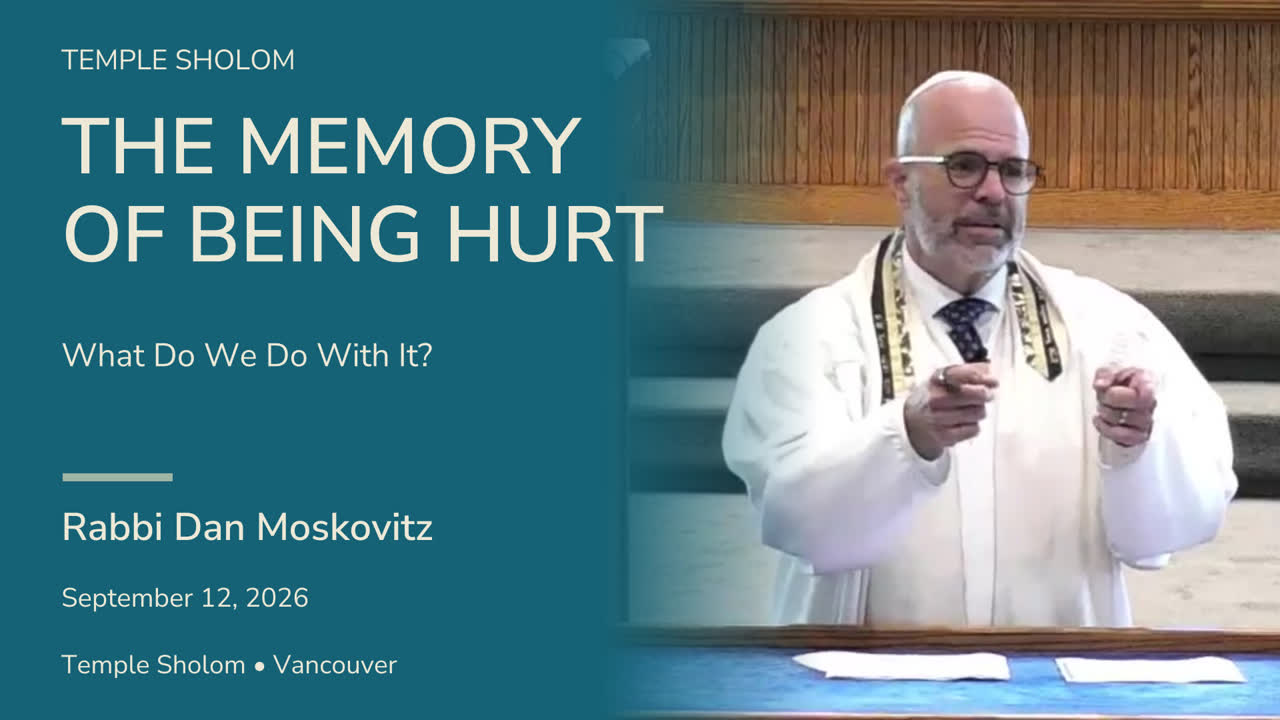
WHAT DO WE DO WITH THE MEMORY OF BEING HURT?
Rabbi Dan Moskovitz
Temple Sholom, Vancouver BC
Rosh Hashanah Day 5787 - September 12, 2026
A video of this sermon as delivered can be found here
What are we supposed to do with the memory of being hurt?
Judaism has been answering that question for more than three thousand years.
We were slaves in Egypt. We were oppressed. Our children were murdered. Pharaoh sought our destruction, finally, we were rescued.
And still they pursued us.
Salvation required a leader. A miracle. A parted sea. The enemy drowned.
Only then God gave us the Torah.
Think for a moment about what that Torah might have said. After all that had befallen us, after all the suffering, persecution, decades of harsh slavery.
“Remember what they did to you. Remember how they pursued you.”
Torah says that.
“Never allow yourself to become powerless again.”
Jewish Torah and history taught us that too.
Then we might think the next instruction would be vengeance, make them pay!
But no. Torah does something extraordinary with the memory of Egyptian bondage. It turns away from vengeance and toward values.
“You shall not oppress the stranger, for you know the soul of the stranger, because you were strangers in the land of Egypt.”
Torah says: “You know what it feels like. Therefore, you have an obligation. Don’t become them.”
Again and again, Judaism takes the memory of our suffering and directs it toward moral responsibility.
Arguably the most persecuted people in the history of the world is commanded: Tzedek, tzedek tirdof, justice, justice shall you pursue.
Judaism takes trauma and turns it into moral memory.
That’s extraordinary. That’s revolutionary.
Trauma does not naturally produce morality. So often just the opposite.
Trauma produces fear. And fear can become anger. Anger can become hatred. And eventually hatred can persuade us that because of what was done to us, because of our trauma, almost anything we do to “them” is justified.
You can hear the justifications echo throughout the history of human conflict:
Look what they did to us.
What choice did we have?
They deserve it.
Make them pay.
Time and again, throughout history and cultures, trauma becomes moral license.
But Torah demands something different of Jews.
On October 7, we saw what happens when grievance and hatred become permission to murder, rape, kidnap and terrorize Jews. The worst attack on the Jewish people in the history of the State of Israel.
Let me be clear: There is no equivalence between October 7 and the violence I am about to describe. Hamas carried out a planned, organized massacre on a massive scale, driven by an ideology committed to Israel’s destruction.
But refusing a false equivalence cannot become an excuse for refusing moral scrutiny.
So here it comes, painful as it is to say on Rosh Hashanah:
There are Jews living today in the West Bank, in Judea and Samaria, who are committing acts of violence against Palestinians. Who have turned our trauma and anger into a justification for doing to them what never should have been done to us or anyone ever.
Jews have attacked villages. Burned homes and cars. Destroyed property and uprooted trees. Beaten people. Some have murdered.
I need to call them what I believe they are.
They are Jewish terrorists.
I find those words almost unbearable to say.
But I am hardly alone in saying them. Some of Israel’s most decorated soldiers and former security chiefs use the same term.
Those are people who have spent their lives distinguishing necessary force from immorality and they see the difference and call it out, so can we, so must I.
Only days ago, Mike Huckabee, the United States ambassador to Israel, and no one’s idea of an enemy of the Jewish state, called such perpetrators “terrorists” and their conduct “an act of terror.” They are saying that what is happening in parts of the West Bank has crossed a line.
And I am saying it too.
I am ashamed that Jews are committing these acts. I am angry at them. Be they one, one hundred, or one thousand, it is a shanda l’yehudim, a disgrace to the Jewish people.
And still, they are part of us, so I am trying very hard to understand them.
I wish I could dismiss them as monsters. Monsters are easy. We condemn them and walk away.
But these are Jews Kol Yisrael arevim zeh b’zeh, all of Israel, the whole of the Jewish people is responsible for each other.
I try to emphasize, some have buried friends, survived terror attacks or watched October 7 and concluded that no one on the other side can ever be trusted. I get it, but still a Jew can’t do that.
Others have embraced an ideology of Jewish supremacy and territorial conquest that uses Torah to sanctify what it already wants. That’s a hijacking of Judaism I can’t tolerate.
And some think by fighting back and fighting dirty they will scare the Palestinians away from their homes and land. We’ve been there before too, that’s why many of our families are here, scared out of the shtetl or the middle eastern village, fleeing for safety in the dead of night. It might work, but at what moral and human cost?
We need to understand the road into extremism if we hope to keep the next frightened Jewish child from taking it.
But understanding is not permission, and that is the moral danger I want us to confront this morning.
Palestinian trauma does not make October 7 morally permissible.
And it follows, Jewish trauma does not make burning the home of a Palestinian family morally permissible.
Trauma can explain behaviour. It does not grant moral immunity.
For thousands of years, our tradition has tried to interrupt the journey from trauma to vengeance.
We remember Egypt, but Torah does not tell us: You suffered, therefore do whatever it takes to make sure no one can hurt you again.
Torah says: You suffered. Therefore you know something about suffering.
You know the heart of the stranger.
Your pain gives you an obligation.
That is a demanding way to live.
“Shver tsu zayn a Yid. It is hard to be a Jew” nothing new there.
When Sholem Aleichem made that famous observation in 1914, that it was “hard to be a Jew,” he wasn’t complaining about the lack of lobster.
Being Jewish is hard because Judaism asks things of us. And if we don’t feel that moral pull, we are doing it wrong.
Judaism commands, Kedoshim tihyu. You shall be holy.
Notice the language: “shall be.”
It is an imperative. They are commandments, not suggestions. Moses didn’t come down from the mountain amidst thunder and lightning and proclaim, “People of Israel I bring you these 10 Suggestions!”
No, holiness is an obligation, a standard we are commanded to try to live up to.
Holiness is not perfection. It is the lifelong willingness to examine ourselves, repair what we have damaged, learn from it and keep growing.
And I believe we are here to be holy and am kadosh, a “holy people”. am segulah, a “treasured people.”
I believe in the chosenness of the Jewish people.
That language makes some people uncomfortable.
It makes me proud.
We were not chosen because we are inherently better. We are as human, flawed and dangerous as everyone else. We were chosen for a task, commanded to become a mamlechet kohanim v’goy kadosh, a kingdom of priests and a holy nation (Exodus 19:6) An or lagoyim, a light unto the nations.
Judaism asks us to make holiness visible in the world. Why?
Because the world cannot see God. It only sees us. What we do reflects upon the One who chose us.
That is a profound privilege and an enormous burden and we fail at it all the time. In 10 days we will fast and observe Yom Kippur, a day dedicated to the reality of our failings.
I fail. You fail. The Jewish people fail.
But there is a profound difference between committing a sin and calling the sin a mitzvah.
The person who says, “I have sinned,” can make teshuvah. But what happens when someone says, “My sin is what God wants me to do”? When a Jew invokes Torah to justify violence or claims that God’s promise of the land makes the person standing in the way matter less?
When Jews use the symbols that place us under God’s authority, a kippa, tzitzit, to claim authority over someone else, that is chillul Hashem, a desecration of God’s name. A form of blasphemy. And that’s what’s happening amongst the most extreme settlers in the West Bank. Not all of them, but even ONE is too many.
Torah is supposed to restrain the human appetite for power, reminding us that simply because I can do something does not mean I may do it.
When Torah is enlisted to sanctify hatred, when God’s name is invoked to justify cruelty, when Judaism is used to make the immoral feel holy, the sacred has been conscripted into the service of the profane.
And when the symbols of Torah accompany cruelty, something has been terribly inverted.
I watch young men in kippot and tzitzit torment and terrorize Palestinians and I am dumbfounded.
What is the point of religion if becoming more religious does not make you more moral?
What is the point of Torah if the more Torah I learn, the easier it becomes for me to justify hate?
That breaks my heart and makes me furious.
This is not the Judaism I know, teach or love, nor the Israel we dreamed of for two thousand years.
I am an unapologetic Zionist. Condemning this violence is not disloyalty to Israel. It is an expression of ahavat Yisrael, love of Israel, and part of my responsibility as a Zionist and a rabbi.
For almost two thousand years, Jews lived primarily with one question:
What shall we eat? 🤣
No the other question
What are they going to do to us?
The king, the church, the mob.
Will they expel us? Attack us? Will anyone protect us?
Zionism changed that. We finally have a state, an army, sovereignty, the power to protect Jewish life.
And with Jewish sovereignty comes another question:
What are Jews going to do with power?
That question is one of the obligations created by Zionism’s success.
We knew the catastrophe of powerlessness. Now Torah has to teach us the responsibility of being powerful.
Yuval Noah Harari recently asked a haunting question: If, after two thousand years of learning and longing to return to our ancestral homeland, the lesson is simply that Jews must become the Romans, “what was the point?”
We learned that Jews need power. History taught us what happens when we have none. But surely three thousand years of Torah taught us something more.
Setting fire to a Palestinian village does not make an Israeli family safer.
Attacking someone who is not attacking you does not defeat Hamas.
A pogrom carried out by Jews does not protect Jews in Israel or here in Canada.
And even if someone could convince me that vigilante violence makes Israel safer, that it acts as a deterrent, there are things a Jew simply may not do. Terrorizing human beings so they will leave their homes is certainly on the list of Thou Shalt Nots. And the extremist settlers that do that know that, but inexplicably they don’t see Palestinians as human beings.
And it hurts me to admit that, and it hurts our image in the world but I will not surrender our capacity for Jewish moral self-examination because an antisemite might quote me or use this sermon to say, “See, I told you all Jews are evil.”
We are not, but to my horror some of us are.
If I cannot recognize wrongdoing by a Jew because someone hostile to Israel might agree, I have allowed my enemy to take something precious from me: my morality, my chosenness.
And that same moral discipline demands that I refuse the opposite temptation.
There are Jews who look at Israel’s failures, Palestinian suffering and extremist settlers and decide that these things reveal what Israel itself is, that Zionism itself is corrupt, that the Jewish state is unworthy of their loyalty.
I reject that conclusion too.
October 7 CANNOT tell me everything about every Palestinian.
Settler terrorism CANNOT tell me everything about Israel, Zionism or the Jewish people.
But here is the test: does your moral compass continue to point in the same direction after you learn who is holding the weapon?
That does not make every use of force equivalent. Defending your family against someone trying to murder them is morally different from murdering someone who poses no threat.
But identity cannot turn evil into good.
The danger of extremism is certainty, the conviction that my violence must be righteous because my cause is righteous.
And that brings us to Rosh Hashanah.
Today is Yom HaDin, the Day of Judgment. And it takes us from the existential to the deeply personal.
We stand before a Judge on this sacred day because Judaism insists that I am not the final judge of my own righteousness.
That may be one of the most radical ideas of these Holy Days.
I can be certain and still be wrong.
I can believe I am acting for noble reasons and still cause terrible harm.
The extremist cannot make teshuvah so long as he knows with absolute certainty that he is righteous.
Because teshuvah begins with the possibility:
Maybe I am wrong.
Maybe something I have been calling righteous is not righteous at all.
That is why I have come to believe that one antidote to extremism is curiosity: not indecision or moral relativism, but the willingness to hold conviction while still asking the question Rosh Hashanah forces upon us:
Could I be wrong?
If covenant demanded perfection, our relationship with God would have ended about five minutes after Sinai, somewhere around the Golden Calf.
Judaism anticipates failure because only through failure do we learn and grow.
So Judaism gives us teshuvah, a road back. Human beings need a road back.
And so I want something from the Jewish extremists whose actions I condemn.
I want them stopped.
When they commit crimes, I want them prosecuted. I want Israeli leaders to stop empowering them and rabbis to stop giving religious sanction to hatred. Their trauma does not absolve them, and political calculations by Israeli leaders does not excuse them.
But I want something else, something more than accountability.
I want those Jews back.
I am ashamed of them, but they are ours, and I refuse to surrender them or their children to extremism.
I want Judaism to reclaim them from an ideology that turned Jewish trauma into moral license.
If we understand the road that brought a frightened Jew into extremism, perhaps we can build a bridge back to righteousness and holiness.
That is teshuvah: a road back.
And not just the extremists on the right, I want the Jews who have walked away from Israel on the left back too.
Come back.
Fight for the Israel you believe Israel should be and the Judaism you believe Judaism should teach. But don’t walk away from your family, your heritage, your land or our covenant.
And what does any of this ask of us?
Most of us will never stand on a hilltop in the West Bank with a weapon in our hands and you’re here so you have not abandoned Judaism altogether.
What does this moment ask us to reflect on?
It is this; every one of us knows what it means to be hurt.
Someone betrayed us.
Humiliated us.
Abandoned us.
Someone broke our trust, wounded someone we love, said something we cannot forget.
And every one of us knows the temptation to turn that wound into permission.
Look what they did to me.
After what they did, I owe them nothing.
My anger is justified.
Maybe it is.
But what does our anger give us permission to do?
The Torah assumes that memory creates obligation. Once you know the heart of the stranger, you cannot unknow it. Once you have seen suffering, you have to decide what seeing requires of you. And once you have been hurt, you have to decide what your hurt will authorize.
And right here is where this sermon stops being about extremists thousands of miles away and becomes about each and every one of us sitting here.
It is the question of Rosh Hashanah:
What will I do with my memory of being hurt?
Will my wound become permission to humiliate someone who humiliated me?
Will betrayal become permission for cruelty?
Will fear become permission to stop seeing another person as human?
Will the wrong done to me determine the person I become?
The scale may be different.
But the human temptation is the same.
When a friend says, “After October 7, see what they did, I don’t care what happens to them,” we can hear the pain and still say: Judaism demands that we care.
When someone says, “After Gaza, see what they did, I don’t care what happens to Israel,” we can hear that anguish and still say: abandoning the Jewish state will not repair the world.
And when something happens in our own lives and we hear ourselves saying, “After what they did to me, I don’t care what happens to them,” Rosh Hashanah asks us to become curious about our own certainty.
We can love a person without excusing everything they do.
We can condemn evil without surrendering another person’s humanity.
We can possess conviction while remaining capable of asking whether we might be wrong.
We can defend ourselves without allowing our enemies to decide who we become.
We can remember our wounds without turning them into weapons.
And so we are back at the beginning, to the question with which I began. What are we supposed to do with the memory of being hurt?
Will our wounds become weapons?
Or will they become wisdom?
May this be the year we choose wisdom.
rabbidan@templesholom.ca