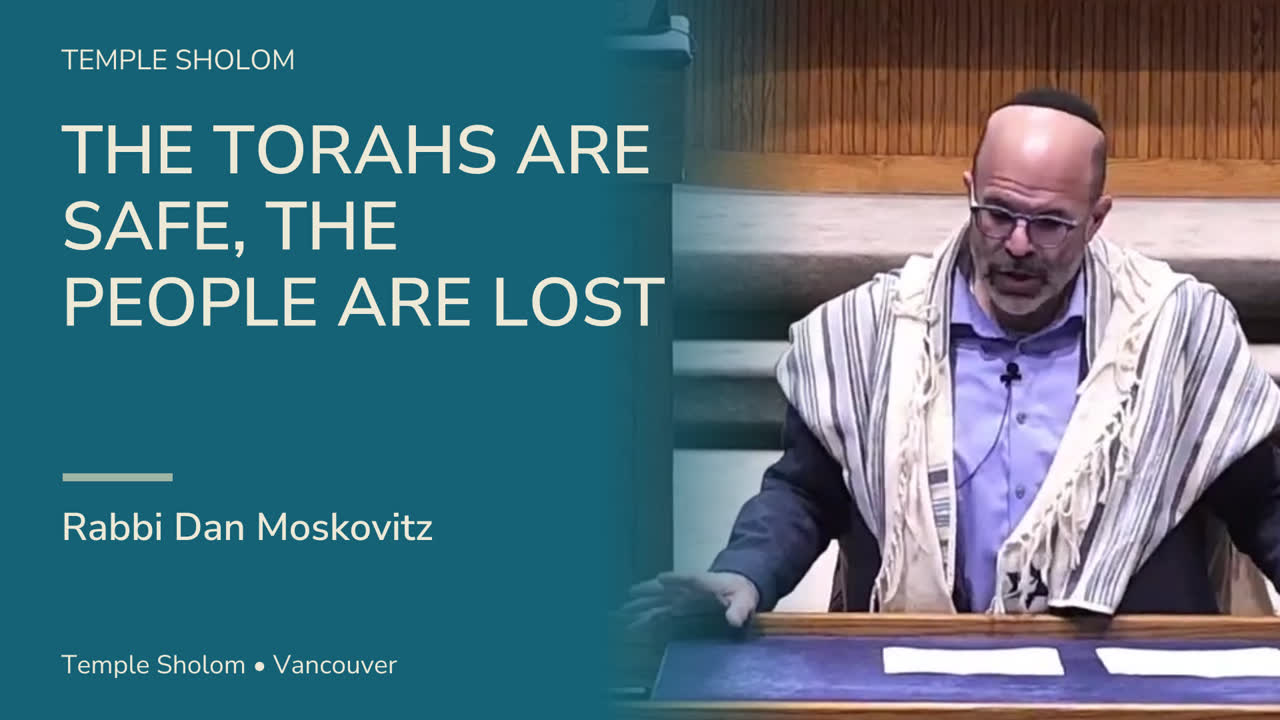
THE TORAHS ARE SAFE THE PEOPLE ARE LOST
Rabbi Dan Moskovitz
Temple Sholom, Vancouver BC Canada
January 10, 2025
VIDEO: https://youtu.be/3Qz9TlWFY6M
“The Torahs are safe.” That was the email message I got from a neighboring synagogue in my former community of Los Angeles. I have been on the email list of Or Ami, a Reform Congregation in the Calabasas area of the San Fernando Valley for more than 20 years. Their Rabbi Paul Kipnes is a good friend and maybe a distant relative, we are not sure, we share a family last name.
I usually ignore his congregational emails, never having taken the time to unsubscribe from an email list that really doesn’t pertain to me. I am glad his shul is having a seniors program, and its nice to know they have an outing plan for their youth group teens but no offence to Rabbi Kipnes but I have my own shul and congregation to worry about.
Until Tuesday, on Tuesday I greeted his email with a small measure of relief, the Torahs were safe, but a far larger measure of heartbreak, worry and dread. I know that area and community, at least according to Facebook I have hundreds of former congregants in harm's way, dozens who have lost their homes, many more who have been evacuated.
Having lived in Los Angeles for 25 years I am very aware of the destruction that Santa Ana wind blown wildfires can have on those communities, but I have never seen anything like this. Even the Oakland Hills fire in my childhood community of the San Francisco Bay Area pales in comparison to what I was seeing on the news.
As it so happens I was in Palm Springs on Tuesday at a Rabbinic Conference with Paul. He rushed back to his community shortly after the fires broke out. He knew what could happen, this was not the first time his neighborhood was engulfed in flames.
I followed him the next day, as I was always planning to come back through LA, visit my in-laws and fly back with my father in law Arthur who is here tonight. They are safe, their home is not in harm’s way in spite of worrying well intentioned calls from friends across the country that don’t understand LA geography or topography looking at a TV screen.
But as we drove in from the desert I saw it with my own eyes, smelled the smoke, felt it in my lungs. That eerie beautiful sunset in the west, trying to discern refracted sunlight from glowing fires.
My college roommate, Rabbi Joshua Grater, the rabbi of the Pasadena Jewish Temple and Center and his wife Franci lost their home and their 100 year old synagogue buildings. Like with Paul I got a message from Josh’s shul, “the Torah’s are safe”, among them the Nehdar Torah a Persian Torah personally returned to the family that commissioned it in Iran in the 1930s by Ayatollah Khomeini, responding to a plea by the family’s patriarch. Its story, described by journalist Rob Eshman, “[itself] one of diaspora and survival through unexpected upheavals — makes it a powerful emblem for a community already determined to rebuild.”
The Torahs are safe but the people are in lost.
We are clear, we know that Judaism prioritizes human life, pikuach nefesh over all material things. There is no halachic question, you do not endanger your life for a scroll, or a picture or a menorah, your ketubah, the shabbes candlesticks your Bubbi carried across the ocean. The Torah proclaims, B’chai b’hem, live by the words of Torah (Leviticus 18:5). Which the rabbis of the Talmud (Sanhedrin 74a and Yoma 85b) explain means that preserving life takes precedence over almost all commandments in the Torah (except for prohibitions like idolatry, sexual immorality, and murder).
The idea encapsulates the view that Torah is a guide for life—promoting health, well-being, and moral living—not a set of rules to be followed at the expense of one's life.
But beyond human life, material things have value, they have profound and transcendent meaning that causes one to rush into a fire to save them.
The first lesson from these fires is a pragmatic and brutal one. What would you take from your home if you only had minutes to grab and go?
If the people are safe, and the pets if you can get to them are out of danger, what do you save next? What are your Torah scrolls? What are your irreplaceable sacred objects that you would take if you only had so much time and so much room?
It's not just a thought experiment. This weekend we should all make a list and make a plan.
When I heard about the fires one of my first thoughts was of Melanie Samuels, a member of our congregation who lost her home and their beloved cat in a house fire a few months ago. I wrote to Melanie, aware that these images must be so emotionally triggering for her and her family.
Melanie was not home when the fire started but she did arrive in time to watch it all burn down. After it was put out, after 7 firetrucks and 3 hours, the Fire Chief allowed her and her son Bram (who had been home at the time and got out safely thank G-d) to go in for 5 minutes.
She told me they took photo albums, Bram took a photo of his grandmother from when she was young that was still hanging on the wall and Melanie took sentimental jewelry that she had kept from her mother, grandmother and family. She says looking back she regrets not taking photos of old photos as those can never be replaced. She wishes she had thought to keep mementos like love letters in a separate place like her office so that those are not lost forever in a house fire.
She lamented that she will never see her Dad’s notes he wrote to her at camp or Greg’s years of love letters again. She said she always imagined she would look at those when she sat at the Brier some day!
Pragmatically she also told me that she wishes she had kept an inventory and taken photos of all her belongings as it is a very daunting task to figure out the replacement value on a lifetime of collecting!
Again if you take nothing else from this sermon, this weekend we should all make a list and make a plan.
The Jewish people are in many ways defined by turning tragedy into lesson. Jewish tradition teaches that even the darkest moments can carry lessons or opportunities for spiritual growth. While suffering is not glorified, it is often framed as a call to introspection or a challenge to reaffirm core values, an impetus to make profound and lasting changes in our lives.
The destruction of the First and Second Temples, for example, led to a transformation in Jewish identity and practice. Without a central Temple, Judaism evolved into a text- and synagogue-centered faith, allowing it to survive and thrive in diaspora.
One of my colleagues calls us the “knocked down, get up again people”. At its core, the Jewish approach to tragedy teaches that hardship should not be the end of the story. Instead, it becomes a catalyst for action, learning, and renewal. By turning grief into growth, both individually and communally, the Jewish people have transformed exile, oppression, and genocide into commitments to justice, education, and the flourishing of Jewish life worldwide.
I asked Melanie “What have you been mourning after the devastation of the fire?”
She confided in me, it has been “the loss of my happy place. That house was our family home and we hosted so many gatherings for friends and families. Our porch was a place that people would stop by on their way home from something in true southern fashion. It was a place of shared joy and sorrows over the years and had some magic about it. When I drive by now it looks like the spirit has left the building.”
This reminded me of an incident in this week’s Torah portion Vayechi. Our parasha tells the story of Joseph and his brother’s burying their father Jacob. If you remember the animosity, violence and conflict between Joseph and his brothers then you can imagine that the brothers all gathering together to bury their father could be a moment fraught with tension.
The Midrash (Tanhuma) imagines the moment: "When Joseph's brothers saw that their father was dead, they grew frightened, 'What if Joseph still bears a grudge against us!” (Genesis 50:15)
What did they see that made them afraid? As they were returning from burying their father, they saw that Joseph turned off the road and went to look at the pit into which his brothers had cast him.”
His brothers thought that Joseph was dwelling on the terrible deed they had done to him years before.
What was Joseph thinking as he peered into that fateful hole? In what way did he remember that bleak moment? The midrash answers: "Joseph stood up and prayed, 'Blessed is God who performed a miracle for me in this place!”
The echo of the message of the Hanukkah dreidel should be heard for us as well. Sometimes, maybe oftentimes we need physical things to trigger emotional memories.
In retrospect, Joseph is able to piece together the harrowing events of his life into a story that reveals God’s intent. “Although you intended me harm,” he says, “Elohim Chashavah l’tovah/ God intended it for good, to bring about the present result— L’hachayot Am Rov/ to keep alive many people" (Genesis 50:20).
My personal theology and I would say broadly Jewish theology is NOT one that says bad things happen for a reason, to teach a lesson. I have said many times from this bema, my reading of Jewish tradition is that, “there is a reason for everything that happens” but not an agenda that things happen for a prescribed reason.
These fires are not divine punishment, they are a natural disaster, perhaps with human made causation. Our task is to not lose faith in ourselves and hope in the future as we stand looking at smoldering ruins, like Joseph looking at the pit of his fraternal torment.
For Melanie the aftermath of the fire showed her how loved and supported her and her children are. How important it is to be good neighbors, to have good friends, a community that surrounds you, holds you up when you are knocked to the ground by circumstance.
For Joseph the lesson is that his survival must mean something, not to waste the second chance at life and the opportunities that come with this reset.
We didn’t die in the fire, but we could have, this could’ve happened to us. It could’ve happened here. It could happen at any time anywhere. If not fire, earthquake or storm or something else. The lesson for me and the lesson from our tradition is that every day is a blessing. A gift, the poet would say, “that’s why it is called the present”.
It’s the oldest sermon in the world. Maybe it’s the only sermon ever given. Don’t waste time, don't waste second chances. The lesson we must take from these fires is that we must live with purpose, gratitude, and urgency.
The Torahs are safe, but the people are in lost. And yet, amid the ashes, we are reminded of the strength we carry as a community and the sacred responsibility we have to one another.
The fires, even a border away, force us to confront what truly matters—not the possessions we accumulate but the love we share, the relationships we nurture, and the values we uphold. What we choose to save, whether a Torah scroll or a family photo, reflects the essence of who we are and what we hold sacred. But even when the material is lost, the meaning endures, held in memory and carried forward in action.
As Joseph stood at the edge of the pit and transformed his pain into a blessing, so too are we called to turn tragedy into renewal. The Jewish people have always rebuilt—homes, communities, identities—turning loss into resilience, despair into hope.
So let us ask ourselves: What will we do with the gift of another day? How will we ensure that our survival has meaning? Let the lesson of the fires be this: That we do not wait for disaster to prioritize what matters most. That we take stock of our lives now, cherishing each moment, mending broken relationships, building stronger connections, and living in alignment with our highest values.
May we emerge from every pit, every fire, every trial, not only intact but transformed. Like Joseph, may we find blessings even in the aftermath of pain. And like Melanie, when the proverbial fire comes, may we lean on community, finding strength in each other to rebuild what has been lost.
This Shabbat, as we reflect on the fires, the pits, and the blessings in our lives, may we rededicate ourselves to living with purpose, gratitude, and love. For every day is a gift, and it is up to us how we will use it. Just please, please don’t waste it.
Shabbat Shalom.