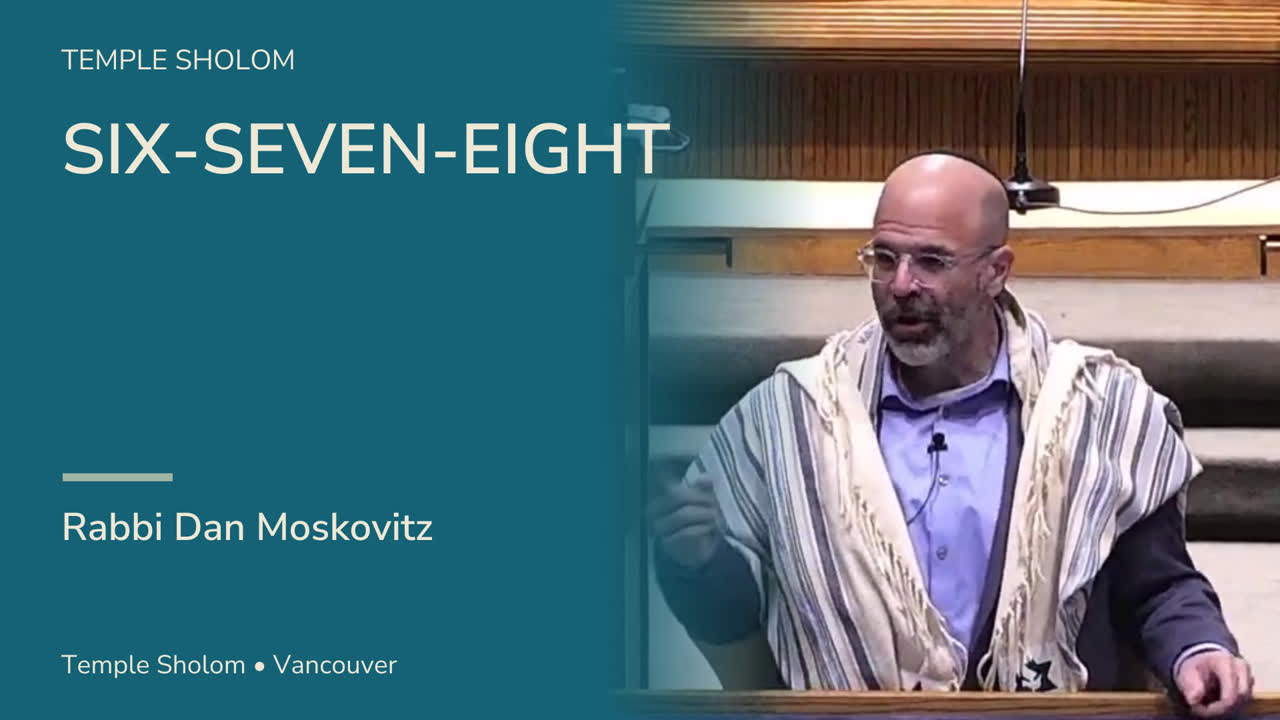
SIX-SEVEN-EIGHT
RABBI DAN MOSKOVITZ
TEMPLE SHOLOM
APRIL 15, 2024
When we think of important Jewish numbers, we think of 3 for the shovels of earth we place in a grave, we think of 10 for the commandments, 18 for chai, for life. 40 for the days Moses was up the mountain, Noah was in the ark and years the Israelites were wandering in the desert. We think of one for the oneness of God.
Tonight I want to talk about six, seven, eight. What do these three numbers represent in Judaism?
Sunday will mark the 6th month since the horrible attacks, massacres, kidnappings and violations of humanity of October 7th. In Judaism the number six is best associated with the six days of creation. It’s not the number for completion that is seven, but six is the number for the cessation of work. After the sixth day you rest, you take stock. This of course is a privilege only available to the safe and the free. One of the indelible aspects of slavery that we recall each year at seder is that for a slave every day is day 1-6, there is no rest, there is no sabbath, there is no end or sense of completion.
In Israel and really throughout the Jewish communities of the world many still consider it October 7th. Many are still very much in the midst of horrors of that moment, there is no aftermath, it is October 7th for the 182nd time.
So what is the significance of this Sunday and its 6 month mark; maybe nothing beyond to note that it is not over. There is no sense of arrival at the destination, just a continuing arduous journey with what feels like no end in sight.
In a war being fought often in tunnels, there is no light yet at the end of this one.
Seven of course is a Jewish number, the sabbath day, the sabbatical year, weeks of the omer. In two weeks we will celebrate Passover, one of two seven-day festivals, sukkot being the other - whose end we will forever recall was when this current war began. Seven is a number of wholeness and of holiness.
Rabbi Abraham Joshua Heschel speaks about “Shabbat Menucha” Heschel explains that "Menuha which we usually translate as 'rest' means much more than withdrawal from labor and exertion, more than freedom from toil and strain or activity of any kind. Menuha is not a negative concept but something real and intrinsically positive…
'What was created on the seventh day? [He asks rhetorically], “Tranquility, serenity, peace, and repose.' (Genesis)…To the biblical mind menuha is the same as happiness and stillness, as peace and harmony.”
This is why the 7th day is holy. To arrive at the 7th of this war on whatever day and in whatever month it occurs will feel like heaven on earth compared to the hell that has been unleashed. But still shabbat is not real time, we don’t in the ethereal world of shabbat, we visit it, but we live and work in the long days between sabbaths. Shabbat is fleeting, the brief repose that the 7th day will bring at the end of this war may last no longer than a heavy sigh and a deep breath and then comes the eighth day.
But as my colleague Rabbi Tom Alpert points out, “if seven is completeness, eight is the number for starting over. For instance, the covenant of circumcision takes place on the eighth day in part because it marks a kind of new beginning for the baby boy, one in which he joins the covenant of the Jewish people. But “the starting over” is never the same. The boy is different after his bris, not just physically but spiritually.”
In Judaism ‘the day after’ is often understood as, ‘the eight day’.
We learn this in large part from this week’s Torah Portion, Shemini which means "the eighth." It refers to the eighth day of the opening of the Tabernacle, which was actually its first real functioning day, after seven days of special inaugural rituals performed by Moses, Aaron, and the other priests.
On this 'official opening day,' Moses commands Aaron and the people to bring sacrifices to the Tabernacle, "for today God will appear to you," which is, after all, the point of the Tabernacle.
Vay’hi b’yom hashmini, the parasha that Kollin will read tomorrow begins, “On the eighth day.”
Rabbi Harold Kushner has written that the ordination ceremony ended the period of heightened awareness that began at Mount Sinai and brought us to a more normal state of affairs. As he writes, “On the eighth day, we are challenged to begin living in the day-to-day world of ordinary events.” This is true, but I’d add that the day-to-day world of ordinary events isn’t the same world that the people knew before they got to Sinai. It isn’t the world of escaped Egyptian slaves. It’s the new world of Torah that they now have to put into practice. A world with new societal rules, ethics, customs and practices. It’s not going back to normal, it's going forward to a new beginning. That’s the eighth day, a new beginning.
While I pray for the 7th day, the sabbath of this war, it is the eighth day that we are working and Israelis are fighting for, not the reprieve but the new beginning. What I fear most is being dismissed on both sides as this war continues is the recognition that there will be a day after, and during those days these two people must find a way to live together. The work that will need to happen to truly make that a new beginning must be done on both sides, and if they can’t or won’t do it. It will be the height of hubris for either side to claim victory when so many innocents have been killed and murdered. There is no winning of this war, both sides have lost an unfathomable amount. But our parasha reminds us that it is human nature to abuse the eighth day. We will forget the lessons of this war just as we forget the lessons of the sabbath. Too often we enter into the eighth day just like we did 1-6 the week before, unchanged, uninformed, unwilling to make a new and different beginning.
Our parsha bears this out in the very next scene on the 8th day.
"Now Aaron's sons, Nadav and Avihu, each took his pan and placed fire in it, and placed on it incense, and brought it before the Lord; a strange fire which he had not commanded them. And a fire went out from before the Lord and consumed them and they died before God… “Vayidom Aharon” and Aaron was silent."
Commentators have speculated for centuries about why they offered the fire and why they suffered that consequence. There are many explanations; they range from the sons being intoxicated to being filled with religious zealotry. Maybe all are correct but the one that I think is relevant for us in this moment and particularly for whatever remains of the leaders of Israel and Gaza after this war is that they were consumed by self importance and power. Now that they had been ordained as priests the power to make sacrifices in their hands they could not wait to use it. They offered a sacrifice not to satisfy G-d but to satisfy their own lust for control.
What they have not speculated on is why Aaron was silent. His reaction in the moment was shock and horror, he had no words to describe his sorrow and loss as his children died before his eyes.
As we reflect on the significance of six, seven, and eight within the context of Judaism, this war and the ongoing struggles faced by our community, we would be wise to learn the profound lessons embedded in these numbers.
The sixth month since the tragic events of October 7th serves as a stark reminder of the relentless suffering endured by many, where rest and reprieve remain elusive. It is a testament to the enduring struggle against oppression, hate and dehumanization, highlighting the urgent need for lasting peace, moral leadership and healing.
As we look towards the seventh day, symbolizing completeness and holiness, we yearn for the tranquility and harmony promised by Shabbat. The prospect of reaching this seventh day of rest amidst conflict is a beacon of hope, signaling a moment of respite and renewal.
However, it is the eighth day that holds the promise of true transformation—a new beginning marked by a departure from the past and a commitment to forging a better future. Just as the Tabernacle was inaugurated on the eighth day, signaling a shift towards a new reality guided by Torah principles, so too must we embrace change and reconciliation in the aftermath of strife, a new beginning, a different way.
And still, the cautionary tale of Nadav and Avihu serves as a sobering reminder of the pitfalls of hubris and self-interest. If we fail to heed the lessons of the past and perpetuate cycles of violence, hate and dehumanization, any semblance of renewal will be marred by the same destructive forces that preceded it.
As we strive towards the eighth day, let us do so with humility, compassion, and a commitment to building a world grounded in justice, peace, and mutual respect. I pray that Jews and Muslims, Israelis and Palestinians will learn one thing from all the pain and loss and death they have inflicted upon each other. May they learn and may we all never forget that life, which both have shed rivers of tears over, is more precious than land, more important than religion or ritual. That on the eighth day both peoples and all peoples will embrace the opportunity for a new beginning, guided by that shared truth. May the shock and horror of parents seeing their children killed before their eyes forever remind us all that we can never, ever allow this to happen again. Not by stronger armies and bigger weapons, self interest or hubris but by greater love, mutual respect and humility before a God we both believe in.