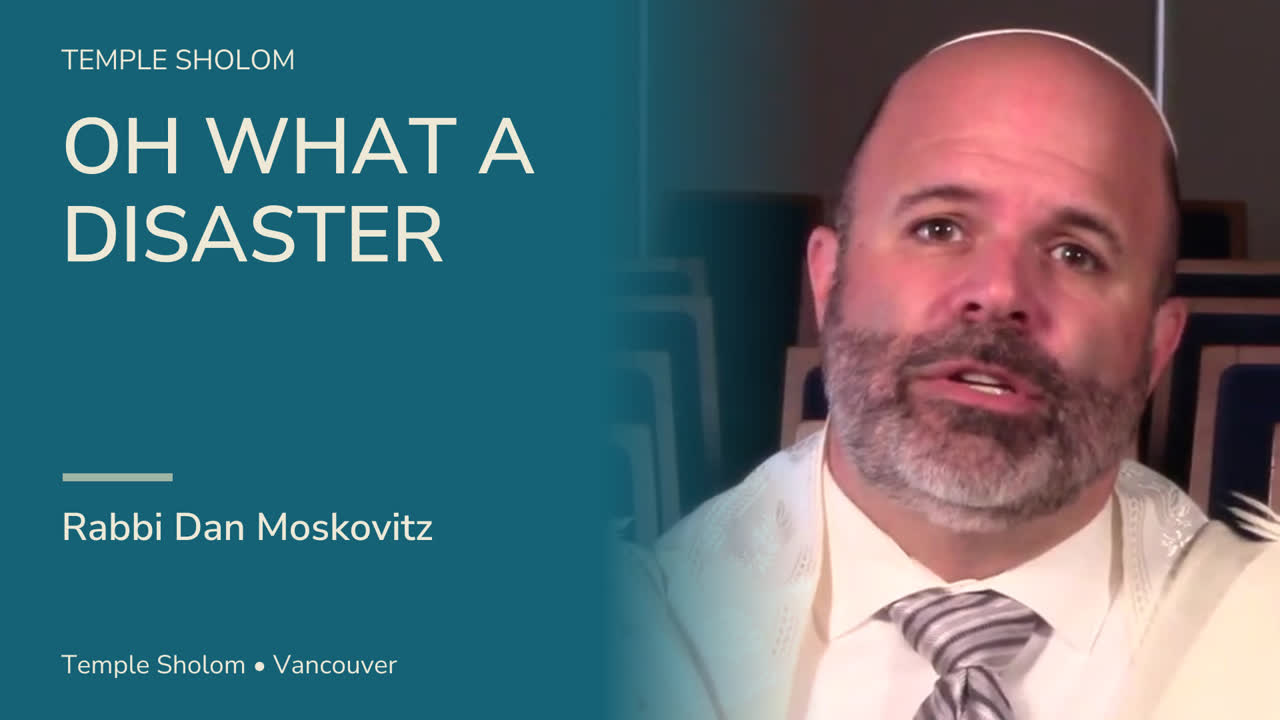
OH WHAT A DISASTER
Rabbi Dan Moskovitz
Temple Sholom, Vancouver BC Canada
Kol Nidrei 5781
This sermon was pre-recorded and produced like an extended television news segment, including on camera interviews and archival
footage. The script is below but it was really written for the screen. That video is here: https://youtu.be/szinMrdzNDU
PICTURES WORDS NOTES
RDM There is a hotel in Jerusalem called The Dan Panorama, I
usually stay there when I visit Jerusalem.
Video of hotel In mid-March, when the Corona Virus emerged around the
globe and Israel went into a severe lockdown the hotel was
used to house COVID-19 positive patients who didn’t need
hospitalization but still needed to be isolated from their
families to prevent further transmission of the virus.
RDM The hotel was given a new name by its 180 residents who
came from many walks of life — Israeli Jews, Palestinian
Arab citizens of Israel, Palestinian residents of Jerusalem,
religious, secular, all forced to live together until they were no
longer infectious.
Image of people jumping on roof with
caption
They called it Hotel Corona.
RDM Something unimaginable happened at Hotel Corona;
something no one expected, not the Israeli army that was
enforcing the quarantine, not the politicians and religious
leaders who objected to such groups being in forced
confinement together, not the skeletal hotel staff that saw all
the ways this could go horribly wrong and certainly not the
residents who were far from family, in an unfamiliar place, facing a deadly disease.
RDM In the midst of a pandemic they built a social paradise.
Video from of the zumba, yoga and
piano singing
Zumba classes in the lobby, Yoga on the roof, multi-cultural
sing-a-longs around the piano.
Seder video During passover the residents actually removed the wall
separating the orthodox and secular seder meals so that they
could eat as one group. Muslims and Christians joined in the
meal as well.
In the most contested piece of land, amongst arguably the
most divided people, the Hotel Corona became a model of
how we can not only live together, but thrive together.
Noam Shuster-Eliassi was one of the residents of Hotel
Corona
CNN Corona Hotel Video
1:13-1:37
the power dynamics and the students activities that exist
outside, I was shocked that they didn't apply to the hotel. We
had the ultra Orthodox people in secular before we had the
Palestinians and Israelis, different fragments of society. And
suddenly we all have a thing in common. We're all got sick
and we're all stuck in this hotel. It almost seemed like we
were in a little bit of like a bubble utopia.
“How does a horrible crisis equip
us to create a better society?”
How does a horrible crisis equip us to create a better society?
That's the subject of tonight’s sermon.
Imagines flash on screen Faced with a litany of seemingly biblical plagues: COVID,
Climate Change, Economic crisis, rampant inequality, Racism, Terrorism, Extremism and Political strife
Some might think that “the end is nigh”
Many no longer believe that a better world, as opposed to a
better life, is possible, and the quest for private well-being
supersedes the public good.
If you watch the news, follow social media, if you listen to the
destructive and demeaning political rhetoric that attempts to
pass for reasoned debate today you would not be wrong to
conclude that people are self-serving and self-interested, that
our base instinct is to take advantage of each other; that were
it not for the thin veneer of civil society we would tear each
other to pieces.
Writer Rebecca Solnit has spent time studying disasters and
the human response to what appears to be the end of the
world.
Rebecca Solnit
11:18-12:11
When you see those stupid disaster movies, those movies
that tell us that we're sheep, that we're selfish, that we're
fearful. You see people panicking, stampeding like sheep
running for the exit trampling each other. That is not what
happens. Actually. We converge on a disaster.
Part of why they had blocked off everything below 14th street in New York, after 9/11, is that so many people wanted to
help that you would have had massive traffic jams
everywhere. And nevertheless, people gave billions of
dollars.
They gave enough blood to fill half an Olympic swimming
pool. They gave food, they gave clothing. They gave medical
skills.
The same was of course true here in Canada, in Gander
where they opened their homes to those stuck on planes and
elsewhere. People rushed to help each other. Rather than fall
apart, people pulled together.
Crises are extraordinarily generative, and through crisis our
better selves emerge.
Crisis and disaster, a pandemic; they have a leveling effect.
Like what happened in the Hotel Corona; the worst of times
can bring out the best in people. It can make a paradise out
of hell.
Definition: Emergency The word emergency comes from emerge, to rise out of. An
emergency is a separation from the familiar, a sudden
emergence into a new atmosphere, one that often demands
we rise to the occasion.
To be kind, be calm, be safe. Our response to a disaster or emergency gives us a glimpse
of who else we could be and what else our society could
become if we were unconstrained by the pressure to keep
doing things as we always do them; and if necessity
demanded that we work together to survive.
When we strip those constraints away, when a pandemic
demands that we stay home for weeks at a time, that we
wear a mask to protect others from the virus, that we revalue the true essential workers in our society, teachers, healthcare
providers, food chain workers; when old assumptions and
behaviours must be abandoned because they have proven
deadly, then we can rewrite the way society operates and we
can take as our new model the way human beings respond in
crisis.
We have felt this, sometimes viscerally, as we have clung to
Provincial Health Officer Dr. Bonnie Henry’s now iconic
instructions to us: To be kind, be calm, be safe.
From this place of simple caring we strive to live as well as
we can under terrible circumstances, and perhaps
remembering that it is indeed human nature to come together
in such times will be a comfort to us.
Interview with Rebecca Solnit
1:00-1:45
Most people in fact in disasters are altruistic, generous,
brave, improvisational, deeply communitarian. And not only
do they behave really well, but they sometimes find in a
disaster, even though it's terrible, even though there's been
loss of life and everything's been disrupted, they find a sense
of community and purpose and agency.
A Paradise Built in
Hell - The
extraordinary
communities that
arise in a disaster.
That's what I have seen in this community and this
congregation these past 6 months.
Hundreds of our members have donated time and resources
to help those hard hit by the multilayered impacts of this
crisis.
Led by our Tikkun Olam GoGos, members of the Jewish
community have made thousands of masks.
Temple Sholom members volunteered to call each family in
the congregation to reach out and check in. Those calls led to
new relationships and breaking down of the rampant social
Can I slip Bonnie
Henry’s words in here
somehow? isolation that existed long before this virus demanded we
socially distance.
Neighborhoods bonded together to create scavenger hunts
and sidewalk chalk mazes for kids stuck at home and limited
to walks around the block. Some neighbors combined their
bubbles to help with childcare and homeschooling.
If there is one picture that I will always cherish from this still
unfolding crisis it's this one of Temple Sholom member Chris
Freidrichs having seder on his sidewalk with all of his
neighbors. Though the pandemic kept us inside our homes
we opened our doors, our minds and our hearts; and found
creative ways to stay connected to each other.
Individuals in this community delivered meals, picked up
groceries, mowed lawns, led exercise classes and discussion
groups online.
Children made cards and pictures for isolated seniors they
would never meet; teens helped someone else' Bubbie learn
how to use Facetime or Zoom.
Things we never had time for or maybe even the inclination
for before the Great Pause became everyday occurrences
and now have become ‘the new normal’.
I have a zoom call with my extended family every Sunday.
I'm home for dinner most nights.
I'm baking bread and driving my car only once or twice a
week.The world is sick, but in some ways each of us and our planet
is getting healthier. We are paying more attention to the
areas that need more attention, like mental health, living
wages and good government.
Over these past 6 months I have so often seen humanity, I
have seen you, so many of you at your best and kindest.
We have shown that when the world seems to be falling
apart, human beings hold each other up, hold each other
together and build community.
Tomorrow afternoon we will read from Leviticus 19:2, The
Holiness Code: "You shall be holy because I the Eternal your
God am holy,"
This obligation is followed by 36 verses that explain in
concrete terms what it means to be holy.
Holiness in the marketplace means to use honest weights
and measures.
Holiness in social relationships is not putting a stumbling
block before the blind or cursing the deaf.
Honoring one's parents is an act of holiness, providing for the
widow the orphan and the stranger, Loving your neighbor as
yourself are acts of holiness.
The verses do not explicitly state what holiness in a
pandemic looks like; but I think we have a pretty good idea.
Holiness in a pandemic looks like each of you striving to not
give in to despair, working to keep yourself and everyone you
come in contact with healthy and safe.Holiness in a pandemic is realizing what has always been
true: We are in this together, we are all connected, what
affects one of us, impacts all of us.
The High Holy Days exist to remind us that we don't need a
crisis. We can and should act this way every day. That's
why mitzvot exist - that's why Judaism is a religion based on
action;
It shouldn’t take a pandemic to teach us to care about and for
each other; but if that is the lesson that we learn from this life
changing event, then let it change our lives and how we live
them for the better.
What will this year be – how will we emerge? We, Jews, are
not into New Year’s resolutions – but perhaps we make an
exception this year.
Perhaps we will resolve to emerge kinder, or gentler, or a
better parent. Perhaps we’ll focus on becoming a more
generous employer. Or to rededicating ourselves to our faith.
History reminds us, and these past six months have shown
us, that human beings are inherently good and that we have
amazing resolve. In the words of Torah, we are k’dai, we are
worthy of being extensions of God’s holiness in the world.
If ever there was a time to set our minds to a task of truly
repairing society, repairing the world…now is the time…
The questions who shall live and who shall die are as much
spiritual as they are physical – tonight, we must ask
ourselves, how will we live a life that emerges from our
current truths? How will we use the emergence of this crisis
to remake our community with holiness? How will we take the
temporary paradises we have built in crisis and make them lasting experiences of heaven on earth for generations to
come?
In 1938, at the onset of the Final Solution a German Jew
approached Rabbi Leo Baeck and asked him: how do we get
through this?
To which Rabbi Baeck answered: we Jews have old eyes.
In this New Year, I pray we see this present crisis with “Old
eyes”, see past it, see through it, so that we might emerge in
a paradise built from a pandemic, better and stronger than
before.
We have known for years that we cannot continue treating
our planet, our social safety net and each other the way we
have been and continue to survive let alone thrive.
Put on your old eyes as we enter this New Year! Look what
this crisis has already enabled us to accomplish between us;
we are repairing the world; not as it was but as it should and
needs to be.
SERMONS & WRITING
Oh What A Disaster
Kol Nidrei 5781