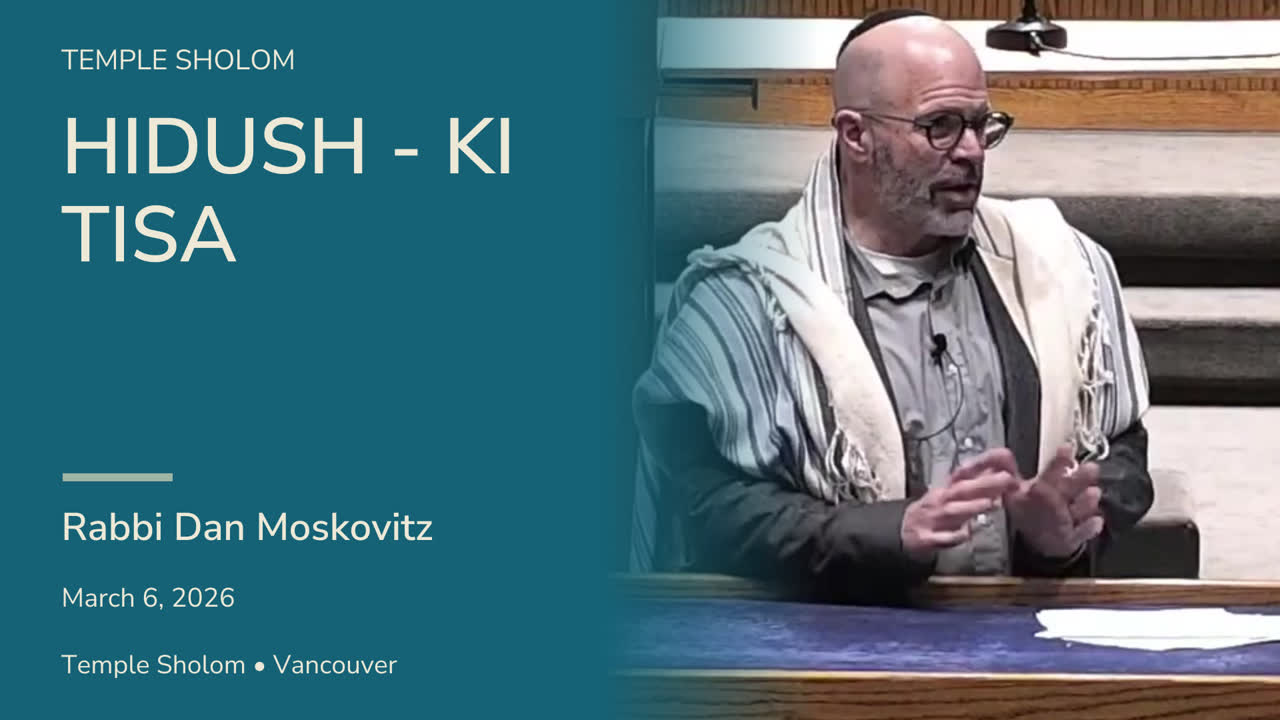
WHEN TO CHANGE YOUR MIND
Rabbi Dan Moskovitz
Temple Sholom - Vancouver BC
March 6, 2026
Have you ever wondered how new ideas enter the world?
How does someone look at a problem that people have struggled with for generations and suddenly see something no one else saw before?
Sometimes the answer is surprisingly simple.
Did you know that the first tanks ever used in warfare could not turn or reverse? Did you know it took science seventy years to figure out how to determine longitude at sea? The handshake originally became common as a way of determining whether someone approaching you was carrying a weapon. In an age when it took two hands to load and fire a gun, grasping someone’s hand meant they could not easily pull the trigger.
Each of those things began the same way.
Someone looked at an old problem and saw it in a new way.
In Hebrew we call that a ḥiddush.
A new insight.
A fresh understanding.
A new way of seeing something we thought we already understood.
Judaism depends on this process.
Without ḥiddush, Torah would remain frozen in the past. With it, Torah becomes a living conversation across generations. Each generation reads the same sacred words and discovers new meaning within them.
The rabbis treasured this process. The Talmud is essentially a record of arguments, reinterpretations, and insights layered upon insights. They believed that Torah contained depths that could be uncovered again and again.
There is a teaching in rabbinic literature that beautifully illustrates this idea of ḥiddush.
When Moses ascended Mount Sinai he saw God drawing crowns onto the letters of the Torah. Moses asked why. God answered that generations later Rabbi Akiva would derive mountains of meaning from those tiny crowns.
Even Moses could not yet see those interpretations.
They were waiting for someone to discover them, to look at something from a different perspective and uncover new meaning.
That is the nature of a ḥiddush.
It requires curiosity, humility, and the willingness to see something we did not see before.
Sometimes that willingness is easy. More often, it is extraordinarily difficult. It has been said that the hardest thing to change is a mind already made up.
There is a fascinating moment in our Torah portion this week, Ki Tisa, that is easy to overlook.
As Moses descends from Mount Sinai with the tablets, Joshua hears the noise from the camp and immediately assumes it must be the sound of war.
But Moses listens more carefully.
And Moses says something remarkable:
“It is not the sound of victory, nor the sound of defeat. It is the sound of singing that I hear.”
Joshua reacts immediately and jumps to a conclusion, and it is the wrong one.
Moses pauses long enough to listen more deeply and understand what is really happening.
That difference between reaction and reflection lies at the heart of the Golden Calf story, which sits at the center of not only this week’s parashah but one of Judaism’s deepest lessons.
When Moses delays on Mount Sinai, the Israelites panic.
Imagine the scene.
The mountain is silent.
Days have passed.
No one knows whether Moses is alive or dead.
The people who stood at Sinai now find themselves alone in the wilderness without the leader who brought them out of Egypt.
And fear begins to spread.
And so they do something that seems shocking to us. They gather their gold, melt it down, and fashion a calf. They create an idol and declare, “This is your god, O Israel, who brought you out of Egypt.”
How could they possibly make that mistake?
These are the very same people who witnessed the plagues in Egypt. They walked through the sea on dry land. They heard the voice of God at Sinai. They have more evidence of God’s active presence in the world than any other people in history, and yet in a moment of anxiety and uncertainty they lost perspective.
Fear narrowed their thinking. Emotion overpowered judgment.
They reacted to the fear of the moment rather than the truth they already knew.
The Golden Calf was not only a failure of faith. It was a failure of judgment.
The Midrash offers a fascinating detail about that moment. It suggests that the Israelites believed Moses had died because they miscalculated the forty days he was meant to remain on the mountain. When the day they expected passed and Moses did not return, panic set in.
They assumed the worst. They concluded he was gone. And in that moment of fear they created the calf.
In other words, the crisis began with a misunderstanding of reality.
And if we are honest, we know how easily that can happen today.
We live in an age where outrage travels faster than reflection. News arrives in fragments. Social media rewards anger more than understanding. We are constantly pushed to react immediately, to take sides instantly, to decide who is righteous and who is wicked before we have even had time to think.
The Golden Calf story reminds us how dangerous that kind of thinking can be. When fear and emotion take over, even good people can lose their perspective.
Jewish tradition responds to that danger with a remarkable discipline: the discipline of argument, reconsideration, and intellectual humility.
The rabbis believed that wisdom emerges through questioning, debate, and the willingness to revisit our assumptions.
Pirkei Avot asks: Who is wise?
The answer: one who learns from every person.
Not only from teachers we admire.
Not only from people who agree with us.
But from every person.
I find this teaching so powerful, so central to my understanding of my responsibilities as a Jew and as a rabbi, that I had it inscribed on the collar of my tallit thirty years ago. Every morning when I wrap myself in these fringes I read those words.
The challenge, of course, is living by them.
The Talmud gives us another powerful example of this core Jewish value in the debates between the schools of Hillel and Shammai.
Students of these debates will note that Jewish law generally follows the school of Hillel, and the rabbis explain why.
It’s because the students of Hillel would first teach the opinions of their opponents before presenting their own.
They made sure they understood the other side before defending their own position.
That discipline required humility.
It also required courage.
Changing one’s mind in light of new understanding was never considered a weakness in Jewish tradition. It was considered wisdom.
Tonight I want to share a personal example of how difficult that discipline can be.
Because the truth is, intellectual humility is easy to praise in theory. It is much harder to practice when the issue is emotional, political, or deeply personal.
Especially when the people involved are leaders we have already formed strong opinions about.
And like everyone else, I have my own strong opinions.
Many of you know that I am not a great admirer of Donald Trump. The same is true of Benjamin Netanyahu. Over the years I have often disagreed with both of them, sometimes strongly.
Often I find aspects of their leadership troubling. At times narcissistic. At times extreme. At times unnecessarily cruel. Many of their policies have struck me as lacking the empathy and moral imagination that I associate with the Jewish and democratic values that guide my own worldview.
Those values matter deeply to me. They come from Torah. They come from the prophets who insisted that power must be balanced by justice and compassion.
And yet here is the ḥiddush that has surprised me and frankly challenged me.
When it comes to the threat posed by Iran and the necessity of confronting that threat, I find myself agreeing with them.
This does not mean I have changed my broader views about their leadership or their politics. I have not. BUT for decades the Iranian regime has declared openly that it seeks the destruction of the State of Israel. It has armed and funded proxy militias across the region and spread violence throughout the Middle East.
And beneath all of that strategy and politics lies something even more troubling.
A regime that openly calls for the destruction of another people forces the world to confront a moral question.
What do we do when hatred becomes policy?
What do we do when threats become persistent and real?
What do we do when the survival of a nation and the safety of millions of people are openly challenged?
Those are not only strategic questions.
They are moral ones.
One thing has become increasingly clear since October 7, 2023: we live in a culture that has trouble distinguishing between war as tragedy and war as barbarism.
Judaism never glorifies war. But neither does it pretend that every use of force is morally identical.
That realization forced me to ask myself an uncomfortable question this past week when the US and Israel took out the leadership of this barbaric regime and set about eliminating Iran as a military threat to Israel, the US and the world.
Am I responding to the facts of the situation?
Or am I responding to my feelings about the people involved?
One of the great tests of intellectual honesty is whether we can separate our judgment of a leader’s character from our judgment of a particular action. If we cannot make that distinction, then we are no longer thinking. We are reacting.
This is where intellectual humility becomes essential.
Part of moral seriousness is the ability to make distinctions. To say that while I oppose much of the leadership of Trump and Netanyahu, I also recognize that the Iranian regime represents a different order of threat altogether.
Maimonides once wrote that a person who truly seeks truth must be willing to follow it wherever it leads, even when it forces them to abandon ideas they once believed were certain.
If we truly believe in reason-based thinking, then we must remain open not only to other people’s ideas but also to the possibility that our own thinking may need to change.
It is easy to say, “I will never agree with that person.”
But sometimes reality challenges that vow.
Sometimes the facts force us to look again.
The Talmud teaches that the opinions of Hillel ultimately prevailed because they were humble and patient, and they studied the teachings of their opponents before their own.
They did not treat disagreement as a reason to stop listening.
They treated it as a reason to listen more carefully.
Intellectual honesty sometimes means disagreeing with our opponents.
But if it’s truly honest then sometimes it means agreeing with them.
Either way, it requires the courage to think for ourselves.
Our loyalty cannot be to personalities.
Our loyalty cannot be to political tribes.
Our loyalty must be to truth and to the moral values that Torah calls us to uphold.
And to remember that wisdom sometimes begins with four very hard words:
I might be wrong.
And perhaps that is why one of the sages of the Talmud once said:
“I have learned much from my teachers, more from my colleagues, but most from my students.”
Jewish wisdom grows in a community where people are willing to listen, to question, and sometimes to reconsider.
That is where ḥiddush begins and wisdom grows.
Eizehu chacham? Halomed mikol adam.
Who is wise? The one who learns from every person.
Perhaps if the Israelites at Sinai had paused long enough to ask that question, the Golden Calf might never have been built.
And in a world that is increasingly certain about everything, the courage to ask that question may be one of the most Jewish things we can do.
Shabbat Shalom.