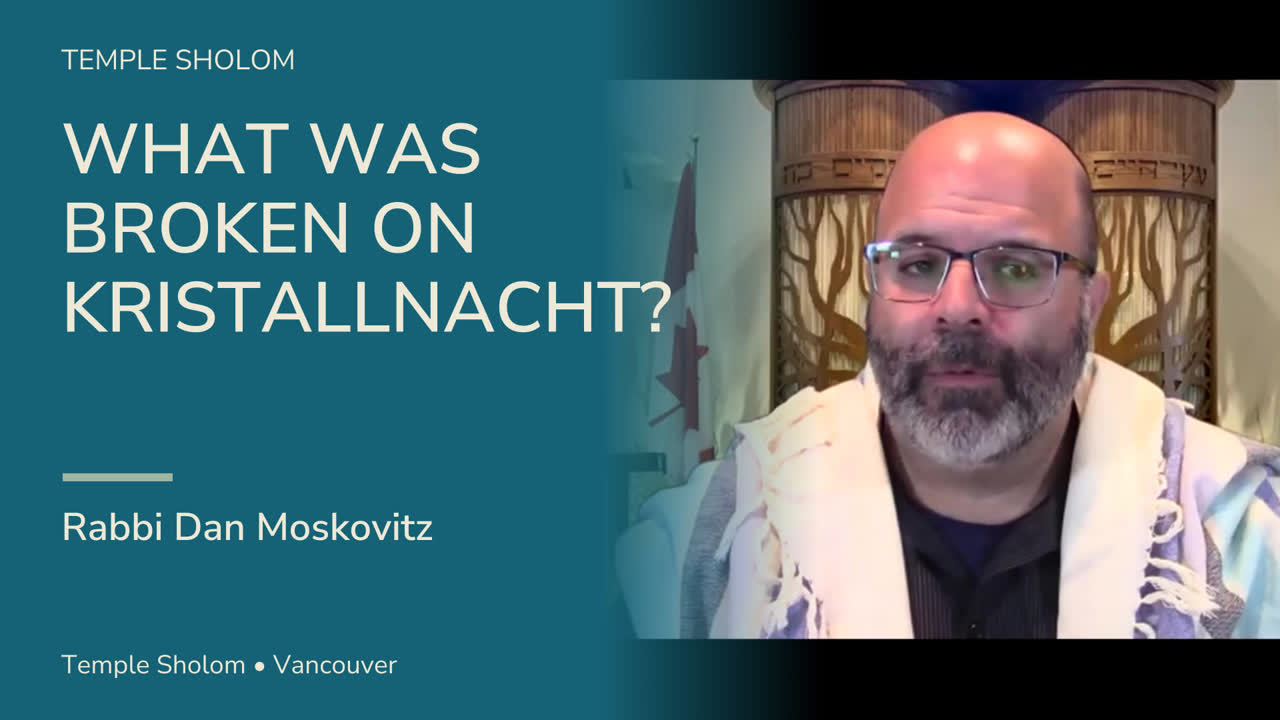
What was Broken on Kristallnacht?
Rabbi Dan Moskovitz
Temple Sholom, Vancouver BC
November 6, 2020
Monday night will mark 82 years since Kristallnacht, the night of broken glass. I
want to preface my remarks tonight by saying that I would have spoken about
Kristallnacht this evening regardless of what was taking place around the world,
regardless of the election results and the simmering social tensions in the US, and
for that matter around the world.
In fact as I looked to my files for notes and materials for this sermon, I found an
incomplete drash that I wrote 8 years ago and have incorporated much of that into
what I want to share tonight.
So while I am painfully and uncomfortably aware of allegory that these thoughts
might have to inform the events of the day, I am perhaps most troubled by the
obvious fact that all too often the lessons of Kristallnacht are relevant to our lives
today, even as we promise and proclaim in full voice, “Never Again!”
The lens of memory that now eclipses the lifespan of nearly all that lived through
and might remember that shattering night at the dawn of the Final Solution tends to
focus on the black and white images of broken shop windows, crudely scrawled
graffiti Jewish homes and business on fire and our brethren molested and beaten in
the streets.
But far more than windows and glass were broken on Kristallnacht, the Night of
Broken Glass. The thin façade of humanity was shattered. Not that Germany was
kind or accepting of Jews before that dark November night, punctuated by flames,
mayhem and wanton destruction of life and property. Established Germany was by
no means a friend or protector of its Jewish citizen even then.
But civilian Germany was up to that point somewhat restrained. If for no other
reason than good citizens follow laws, adhere to social norms and up to that
moment the laws still saw Jews as people worthy of some social standing and civil
rights. Social norms, though bigoted still contained some level of civil restraint;
there were still somethings you didn’t do in broad daylight, and even a few not to be
done in the dark of night.
Until, November 9, 1938. On that night of broken glass, the law was broken. Not the
law of Germany but the laws of humanity. The Talmud declares B’makom sh’ayn
anashim, hishtadel l’hiyot ish / In a place where no one behaves like a human being,
you must strive to be human.
Such was not the case that evening – inhumanity ruled the night. With the few
notable and important exceptions of the righteous among the nations, those that stood up and said no in word and deed whenever everyone else was shouting yes or
cowering in the corners.
Glass is a telling symbol of the events of that evening that lead to the Shoah. Glass
when laid with silver is a mirror, reflecting back all that it sees but with no memory
beyond that moment of reflection. The glass does not remember what it sees only
the people who gaze into it do.
Tonight, and in this moment in democracy we must look it to the glass mirror and
see the reflection of every human being staring back at us. Not our differences but
our similarities. Seventy million people in the United States need to look in the
mirror and see another 70 million people as fellow citizens, let alone fellow human
beings.
That’s not how we normally use a mirror, we usually look into the glass to see what
is wrong, what doesn’t fit right or look right. Tonight, we must look to see what is
right, what is good and what similar in each of us. To see our humanity not our
differences.
The thin fragile pane of humanity and civil society was broken 82 years ago, it has
been replaced and broken again and again many times since; its cracking right now.
We know that broken glass cannot of all things be repaired. Rather it must be
restored, re-laid, glazed and replaced. Tonight, and every night we remember, and
must all engage in the process of restoring what was once shattered. Person by
person, story by story – tonight we rebuild what others would have destroyed for
eternity.
SERMONS & WRITING · 2020
What was broken on kristalnacht
November 6, 2020