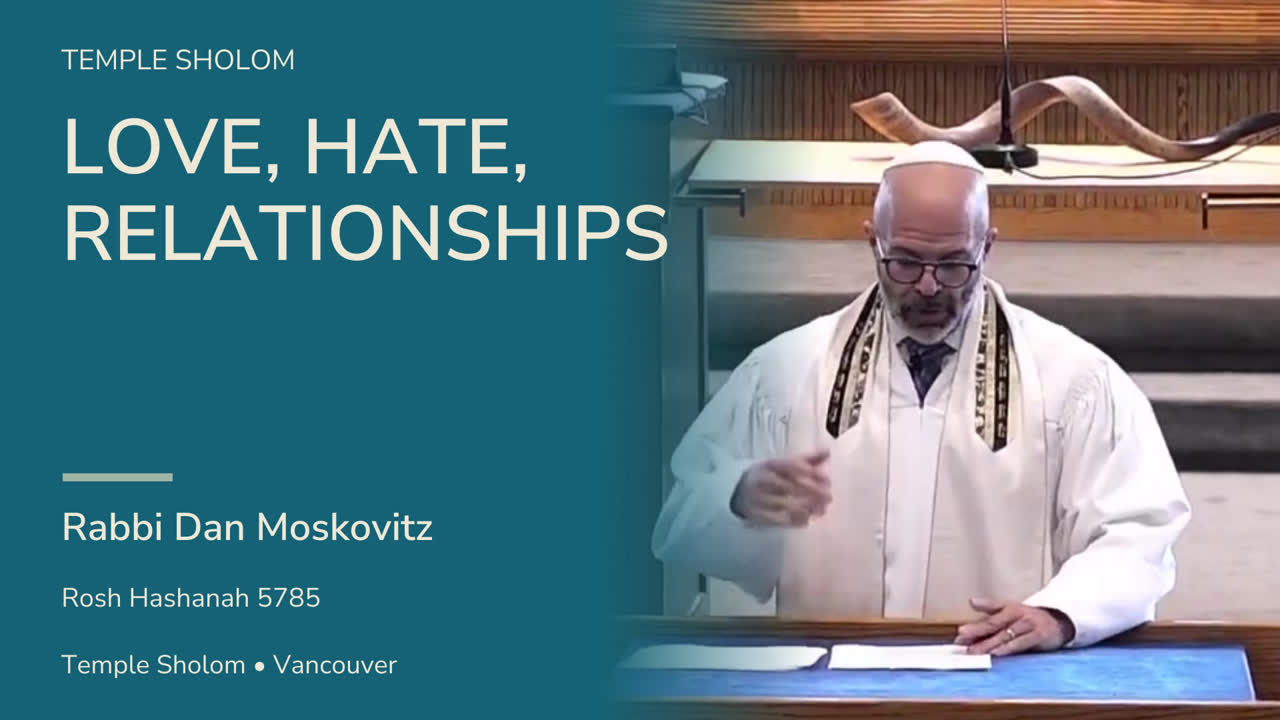
“Love, Hate, Relationships”
Rabbi Dan Moskovitz
Temple Sholom - Vancouver BC
Rosh Hashanah 5785 / October 3, 2024
Link to Video: https://youtu.be/Q7Rz69riOa0
The phone message is always the same: “Rabbi please call so and so as soon as possible, they wouldn’t say what it was about, only that it is important and they need to talk to you.”
In my experience, such a call to the rabbi can only mean one thing, someone is in crisis and it’s too personal, sensitive or complex to share it with the person taking the message or even to leave it on my voicemail.
Since October 7th I get that message at least once a week.
Like the Shofar we just heard, its blasts compared by the Rabbis to both a mother’s weeping over her child, and an urgent alarm, what I am about to share with you is both a cry of pain and a warning.
A cry of pain over what has happened in so many of our families.
And a warning — that we must deal with this moment in Jewish history with wisdom and urgency.
When I call back this is often what I hear, “Rabbi, do you have any advice on how I can talk to my adult child about Israel-Palestine?” It might not be a child, sometimes it's a spouse, sibling, friend or co-worker. But it is always someone who they cannot easily dismiss or ignore. It’s a relationship that is important to them and it is falling apart over this one issue.
We raise our children to be thoughtful and caring, to do something in the world, and to think for themselves. But we never thought members of our own family would charge us with being complicit in genocide, apartheid and colonialism. We never imagined that siblings, friends, mentors would refuse to talk with us, sit with us, would cancel us or that we would feel compelled to do the same to them.
How many in this room, raise your hand, have a family member, friend or co-worker that you can’t talk with or have difficulty having a conversation with, about Israel?
That’s a lot of broken hearts and anguished souls connected to those hands. That’s a lot of parents walking on eggshells around their children, a lot of siblings that get dropped off of family group chats or seated farther and farther apart at family meals. That’s a lot of friends that haven’t really spoken about anything of substance in almost a year or spoken at all.
Families are breaking apart, parents and kids are walking away from each other, lifelong friendships are ending. The war is 6,000 miles away but it’s also right here and it’s devastating.
How do you talk to people who reject or vilify Israel, even when they're people you love?
My answer is ... a question. I know that’s very rabbinic of me. In fact it’s three questions.
When you realize you’re speaking with someone whose views on Israel are very different from your own be they on the left, the right; Jewish or non-Jewish, ask them three questions,
“Why do you care?”
“What do you want?”
“What’s your solution?”
To the first question, “Why do you care about the plight of the Palestinians?”
I often hear some version of, “because the Jewish values they were raised with, the values you taught them in your home, the values we taught them here in synagogue are to care for the needy, to tend to the sick, to empower the powerless.” We taught them “Tikkun Olam, repair of the world” and we taught them that “every human being is created in G-d’s image and worthy of dignity and security.” We taught them to not stand idly by the blood of their neighbor. We taught them to, “love their neighbor as themselves.” We, particularly in Reform Judaism, taught them a Torah of Social Justice.
They will say, they care about the plight of the Palestinians, because they are Jewish, because we raised them to care and take action.
For that answer alone we should celebrate them, celebrate that our children are guided by empathy and moral concern.
That they are trying to apply what they learned at our Seder table, sitting next to you at these High Holy Days year after year, in our Hebrew school, at Jewish summer camp, on Birthright. That they are trying to apply that as a moral guide to how they live in the world is a mitzvah, it’s what we are commanded to do.
That doesn’t mean we have to agree with them but we can agree that they genuinely care about the suffering of the Palestinian people, and that is a good thing, we raised them to care and to act on their concerns.
However, as much as I celebrate their empathy and pursuit of justice, I also feel a need to rebuke and correct them.
Yes we taught them “If I am only for myself, what am I?”, but there is a verse that comes before that one in Hillel’s famous quote, “If I am not for myself who will be for me.” That’s at least as important as the second part. Social justice for others is not to the exclusion of justice for yourself, your family, your people. Maybe it even must come first like oxygen masks on airplanes?!
Our scholar-in-residence Yossi Klein HaLevi has a simple test of when concern for others crosses over the line and puts the Jewish people in danger. His test is that any group or individual that felt the need to be at a rally in support of Israel in early November, in Washington, in Toronto, here in Vancouver is part of the tent. That includes groups that we might have deep and profound disagreements with.
If you were there, if you felt the need after October 7th to be with fellow Jews and to affirm Israel or to decry the attacks, the hostage taking, the murder of innocent Israelis, the sexual crimes. If you stood with the Jewish community on November 7, after the dust settled and the bodies were identified and buried, after the full extent of the horrors Hamas inflicted on the Jewish people and the Jewish State were laid bare, if you stood with your fellow Jews and said, “Never again is now!” then you are in the tent.
But if, on November 7, a month later, when the atrocities were there for all to see. If then you argued that Hamas was justified; that Israel got what it deserved because of its treatment of the Palestinians. If you are advocating and protesting, posting or promoting that Israel as a sovereign Jewish and democratic state is not legitimate, has no right to exist within any borders, from, “the river to the sea” then you have joined with the present and historic enemies of Israel and the Jewish people to undermine Jewish existence and survival.
If you chant, “By any means necessary!” and think that terror will drive the Jews out, dead or alive then you cannot claim with any legitimacy that your Jewish values have led you to take this position. You have divorced yourself from Judaism and the Jewish people. You have left your family, your family did not leave you and I beg you to reflect on that, to find room in your heart for all people, including your own, particularly your own. “If I am not for myself, who will be for me?”
And still there’s a caveat: Yossi’s “test” makes a clear distinction between anti-Zionists who are leaders, who have turned their professional lives into undermining the legitimacy of Israel, and rank and file young people who join Independent Jewish Voices or similar groups out of an expression of their Jewish values as they understand them, even if they are incomplete or incorrect. Our kids, friends and family who see the suffering of innocents, even if it is myopic and only on one side of the border, we can’t reject them. They are our children or our children’s friends. And we don’t reject our kids, no matter what. There is always a seat at the seder table even for the wicked child. Because they are by definition our family.
Criticizing the policies of the Israeli government does not put you outside the tent.
Indeed, vigorously engaging with the complexity of a Jewish and Democratic state existing alongside neighbors that have tried time and again to destroy it and have sworn to keep trying makes Israel stronger.
But joining organizations and movements that undermine the legitimacy and very survival of the Jewish People and/or the Jewish State does put you outside the tent. Protest yes, denial no.
To the question: “What do you want?”
Thoughtful friends and family will say they want equal rights for all people between the Mediterranean Sea and the Jordan River. This is the most generous meaning of the chant, “From the river to the sea, Palestine will be free.”
Ask them if that vision includes Jews and Israelis? If their vision is a land with only Palestinians or for that matter only Jews you know who and what you’re dealing with.
Here it’s appropriate and I would argue necessary to enforce boundaries.
If you find that a friend or family member has core values that devalue you, those you love, or is attacking you based on your identities. It’s ok to say, “we’re just not going to talk about this, I love you too much to hate you and if we keep doing this that’s where this is headed so let’s stop.”
Boundaries are “lines you set for yourself that are followed by actions you take to hold those lines.” Long ago the poet Robert Frost wrote, “Good fences make good neighbors”; fences and boundaries are really important, especially when you’re sharing the same physical or emotional space with another person. They are still invited to Rosh Hashanah lunch and Yom Kippur Break the Fast but they must respect your boundaries and keep those extremist ideas in the car and to themselves around you.
But if, when you ask your adult child, dear friend or family member “What do you want?” and they say, “they want a future where Jews and Muslims, Israelis and Palestinians live side by side in peaceful coexistence in the land both hold as sacred and ancestral” Then ask them the third question, “how?”
Not because they possess the long illusive Israel-Palestinian Peace Plan, but for the thought experiment of just how complex and complicated finding a solution is. Certainly more than either party can articulate in an Instagram post or family group chat.
How would they build a peaceful future after so much bloodshed?
How would they handle the Jewish and Palestinian Right of Return?
How would they deal with violent extremists on both sides?
You can have long, constructive conversations with even the fiercest Israel critics by asking three questions,
“Why do you care?”
“What do you want?”
“How will you achieve it?”
Why, what, how
By the way, this question, “how?” also works when you meet those staunch Israel supporters whose positions you oppose or you view as too extreme.
If they answer, as extreme right wing members of the ruling coalition have said in Israel, “It’s all ours, Gaza and Lebanon,” ask them how exactly Israel can rule over so many people and remain a stable, economically viable democracy? Let alone a Jewish State? Ask them how they propose removing Palestinians from their homes and villages and not doing to them exactly what has been done to Jews throughout history?
The urge to destroy everyone you perceive as the enemy is understandable after Oct. 7, but my follow-up question is always the same: “Then what?”
But please understand, you’re not going to come up with the “Israel-Palestine Peace Plan” on Facebook or over coffee with your adult child or co-worker, but a constructive, values based conversation is what the world needs right now and that can start with the two of you. If two people who genuinely know, love and care about each other can’t have this conversation, it is ludicrous for either of you to expect strangers or even enemies to resolve their differences.
After you have asked your friend, family member or coworker these questions. After you’ve listened and heard from them, you need to do one more thing. Maybe, actually we all need to do this before AND after, after we have listened to their point of view and reasoning. We need to answer those questions for ourselves.
Here are my answers… to why, what, how.
I don’t care about Israel because of antisemitism or anti Zionism. The hate of others does not define me. I care about Israel because the physical and spiritual place it holds is the focus of my prayers as it has been the focus of the prayers of my people for thousands of years.
I care about Israel because it is imperfect, and yet guided by Jewish and democratic values, it must always strive to be more perfect. Because its founding principles are the foundation of my life and the lens through which I view the world. For those values to be true and enduring they must be proven to work in real life, in the present tense. Israel is the experiment that proves the theory of Judaism as a way of life.
I care about Israel because our people’s story of return and redemption is the manifestation of not just Jewish but all of humanity’s yearning to be a free people in their own land. Many have prayed for it but our people, rising from the ashes of the Shoah, did it. Hatikvah - we realized the hope of 2,000 years.
Israel is an everlasting symbol of life over death, hope over despair. Israel has taken a barren land and made it bloom again, it has taken an ancient language and made it speak again, it’s taken a tattered and shattered nation and made it live again.
What do I want? I want peace between Israel and its neighbors. Not merely the absence of war but the flourishing of harmony, cooperation and coexistence between peoples who share a love for the land and are guided by faith in the very same God. A God who demands of them the same sacred respect for human life, and adherence to its sacred teachings of justice and compassion. Extremist Jews and extremist Muslims do not define either faith, they are the exception not the rule.
How do we achieve this vision of peace and coexistence? We must root out and defeat extremists on the left and right, amongst Jews and Muslims. In Israel, in Palestine, in Canada, at the UN and among those who exploit this conflict for power or political gain around the world.
Neither people are pawns and Jewish survival is not a game, nor is it up for debate.
Harmony is found in the balance between things, in the center, in the middle ground. So both must be willing to compromise. But not on our very existence as a nation and a people.
Peace and coexistence begins with abandoning the destructive notion that either people can be pushed out of the land by force or terror; or that either’s claim to the land entitles it to rule over the other. The Jewish people have returned home after being exiled for more than 2,000 years. In spite of all efforts to defeat, destroy and deny us we are back and we aren’t going anywhere.
Peace is not possible till the world, particularly the Arab world, Hamas, Hezbollah and Iran included accepts that immutable truth. Ayn Eretz Acheret - we have no other land and we never have.
One last thing, now it’s your turn. Go home and answer these three questions for yourself. Write a letter to your children, your grandchildren, your dear friend or colleague. Put down on paper what is in your heart. Why does Israel matter to you and what do you hope to see for its future? Ask them to write the same back to you about Israel, about the people of Gaza, about Palestinians in general. Engage in the conversation from a place of values and curiosity.
The gates of t'shuvah, return and repair are open, these 10 days in particular are the time to reflect and reconcile with your friends, family and community.
Like sounding the Shofar, put some effort into it. Give voice to the pain, over what has happened between you. Sound the warning over what you think this moment means for your Judaism, for Israel and for the Jewish people.
You may not solve the Israeli-Palestinian conflict but you might heal your own relationship with each other, and that is how we start to truly heal the world. And wouldn’t that be the greatest of blessings and hope in the New Year? I can’t think of a better place or better time to start. I hope at least on that first step we can ALL agree.
SERMONS & WRITING · 2024
“Love, Hate, Relationships”
Rosh Hashanah 5785 / October 3, 2024