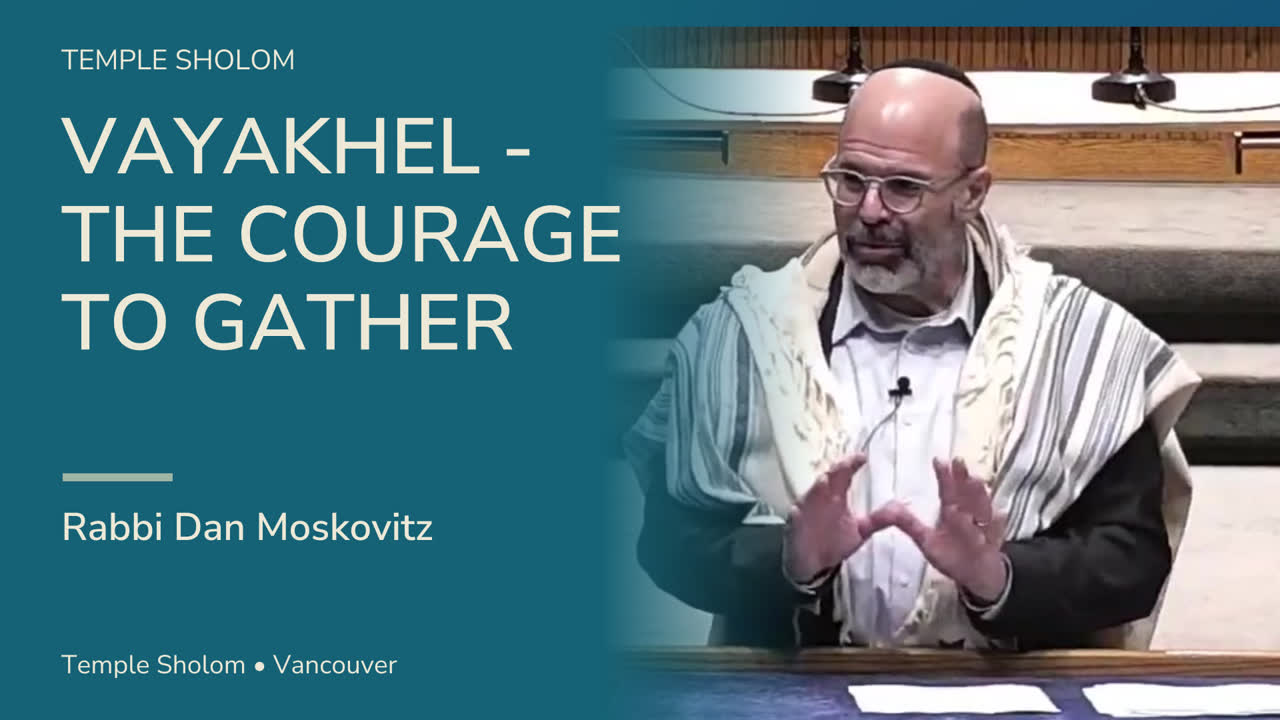
Vayakhel: The Courage to Gather
Rabbi Dan Moskovitz
Temple Sholom - Vancouver BC Canada
March 13, 2026
The year was 70 CE.
Jerusalem was burning.
The Romans had destroyed the Temple, the center of Jewish life for nearly a thousand years. No one was alive to remember when the Babylonians had done the same thing 500 years before, or when the Syrian Greeks had ransacked the sacred space 300 years after that, the event that would ultimately lead to the holiday of hanukkah.
No one was that old but the wound was, the generational trauma was. The story of our sacred temple being attacked again and again was passed down from parent to child, as much a Jewish legacy of L’dor v’dor as bubbi’s recipe for matzo ball soup. Which had not yet been invented but would one day soothe the weary Jewish soul as much as any prayer.
For generations the Temple had been the place where Jews gathered. It was where the people came for the festivals, where they prayed, where they brought offerings, where they felt the presence of God most deeply.
And now it was gone; again. They say history doesn’t repeat itself, it rhymes. For Jews it can feel more like a recurring nightmare.
The rabbis tell a story.
Rabbi Yohanan ben Zakkai and Rabbi Joshua were walking among the ruins of Jerusalem. Stones were scattered everywhere. Smoke still hung in the air. The Temple Mount lay in silence.
Rabbi Joshua looked at the devastation and began to cry.
“How terrible,” he said. “The place where Israel found atonement for its sins lies in ruins.”
Rabbi Yohanan ben Zakkai looked at his student and said something remarkable.
“My son, do not grieve. We have another form of atonement just as powerful.”
And then Rabbi Yohanan ben Zakkai quoted from the prophet Hosea:
“I desire lovingkindness and not sacrifice.”
Rabbi Joshua looked back at him puzzled, “Master what does that mean?”
Rabbi Yohanan ben Zakkai patiently explained,
“The Temple was gone, but Jewish life would continue.” Because, he said with confident eyes that had seen this heartbreak in the kaleidoscope of collective memory, “Jews would gather”.
And his prophecy was correct, without the Temple, Jews began meeting in homes, courtyards, and study halls. Ten Jews would come together to pray. They would study Torah. They would support one another.
Those gatherings became the synagogue.
Judaism survived because Jews kept gathering.
This week’s Torah portion takes place in the wilderness a thousand years before Rabbi Yohanan ben Zakkai walked through the ruins of the Temple. And it begins with a single word.
Vayakhel - “Moses gathered the people.”
Before the Mishkan, the portable sanctuary of the Exodus could be built.
Before sacred space could exist.
Before the presence of God could dwell among the people.
The community had to assemble.
The Torah does not begin the story of holiness with architecture; it begins with gathering.
God later tells the Israelites:
“Let them make Me a sanctuary that I may dwell among them.”
Not in it.
Among them.
The rabbis noticed that detail.
God does not dwell in buildings.
God dwells in communities.
Sacred space exists when people gather together with shared purpose.
From the Mishkan in the desert to the Temple in Jerusalem.
From Tree of Life in Pittsburgh to Temple Israel in West Bloomfield.
From Temple Emanu-El, to the BAYT, to Shaarei Shomayim in Toronto, to Temple Sholom on West 10th here in Vancouver.
Jewish community has never been built by individuals working alone.
It was built by a people who chose to assemble, to gather together, not in spaces, but in times and seasons and moments.
For most of Jewish history, gathering together has been the most ordinary and in light of the forces aligned against us the most extraordinary thing we do.
We gather for Shabbat.
We gather to pray.
We gather to study Torah.
We gather to celebrate.
We gather to mourn.
But there have always been moments in Jewish history when gathering required courage.
Moments when Jews had reason to stay home.
Moments when walking into a synagogue meant risking something.
And yet Jews gathered anyway.
After the Temple was destroyed.
After expulsions from Spain.
After pogroms.
After the Holocaust.
After October 7th
Again and again, Jews chose to gather.
Because gathering is how Jewish life survives.
We are living through one of those moments now.
Across North America and around the world we are seeing violence directed at Jewish communities.
Synagogues have been attacked.
Jewish schools require security.
In Toronto, Montreal, in the United States, in Europe and elsewhere, Jews have been targeted simply for being Jews.
When a synagogue is attacked, it is not only a building that is targeted.
It is the very idea that Jews gather together in public, proudly and visibly as Jews.
The goal of antisemitism has always been the same: to frighten Jews into disappearing from public life.
Into staying home.
Into not gathering.
These events create real fear.
And yet something remarkable is also happening.
Jewish life feels vibrant.
People are showing up.
Communities are gathering.
Shabbat tables are fuller.
Synagogues are fuller.
People are searching for connection, for meaning, for one another.
And they are finding it through each other. The buildings are just the container, the literal meaning of Mishkan, but no building can contain the spirit and courage of this people.
In Israel and across the diaspora, Jews are discovering again how essential community really is.
I can say something honestly.
Even in the darkness of these times for our people, I have never felt more proud to be a Jew. Judaism is a light, a shining example, a beacon of hope.
Proud of our resilience.
Proud of the values Judaism teaches.
Proud of a tradition that insists every human being is created in the image of God.
Proud of our insistence that the world can be better, that human beings can be better, and our stubborn refusal to accept things as they are.
Grateful for the moral lens Judaism gives us through which to see the world.
There is a line from the Grateful Dead that has been echoing in my mind lately. (That happens more often than you might think. At the end of May we’ll be joining Temple DeHirsch Sinai in Seattle for a Jewish Grateful Dead Shabbaton at Camp Kalsman. Watch your email next week.)
The lyric written by Robert Hunter and Jerry Garcia of blessed memory is:
“Wake up to find out that you are the eyes of the world.”
Judaism has always understood something like this.
When we gather, we do more than comfort one another.
We learn to see the world through Jewish eyes.
Through the teachings of Torah.
Through a tradition that demands justice, compassion, and responsibility.
And there is a beautiful detail in the Torah that captures this idea.
When we recite the Shema, something unusual appears in the Torah scroll.
In fact you can see it for yourself in your siddur if you turn to pages 152 and 153 in your siddur.
Go ahead, take a few seconds and turn there, pages 152 & 153.
The last letter of the word Shema and the last letter of Echad are written larger than the others. This is also how the verse is written in the sefer torah
The letter ayin.
The letter dalet.
They are larger than all the other letters not only in the Shema, but in the entire torah scroll.
Together they spell the Hebrew word עד.
Witness.
The rabbis understood that when we say the Shema, we are doing more than declaring our faith.
We are accepting a role.
We are accepting the responsibility to be witnesses.
Witnesses to the presence of God in the world.
Witnesses to justice.
Witnesses to compassion.
Witnesses to the sacred dignity of every human life.
And gathering makes that possible.
When Jews gather, something extraordinary happens.
A scattered people becomes a community.
Fear gives way to courage.
And the presence of God finds a place to dwell among us.
The Talmud teaches that when ten Jews gather to pray, the Shechinah, the presence of God, rests among them.
Not above them.
Not far away in heaven.
Among them.
The Mishkan existed because the people gathered.
The synagogue exists because Jews continue to gather.
It’s the opposite of the line from Field of Dreams. We didn’t build it and the people came. The people came, and continue to come generation after generation for more than 3500 years and as small in number as we are no building can contain us or the power of our ideas, the insight of our hard earned perspective.
They can drive trucks into our synagogues and shoot bullets at our buildings, throw molotov cocktails into our sanctuaries [PAUSE] but we will still gather.
And every time we gather, we reaffirm who we are.
Not just a people of memory.
But a people of responsibility.
Witnesses to a moral vision that the world desperately needs.
The eyes of the world
So tonight we gather.
Like our ancestors in the wilderness.
Like those first Jews who gathered after the Temple fell.
Like generations of Jews who refused to disappear.
We gather not in hiding.
But in pride.
Because every time Jews gather, the story of our people continues.
And every time we gather, we become witnesses.
Witnesses to hope.
Witnesses to courage.
Witnesses to the enduring truth that has carried our people through every generation.
And witnesses, our Torah teaches, must speak the truth.
Shema Yisrael, Adonai Eloheinu, Adonai Echad.