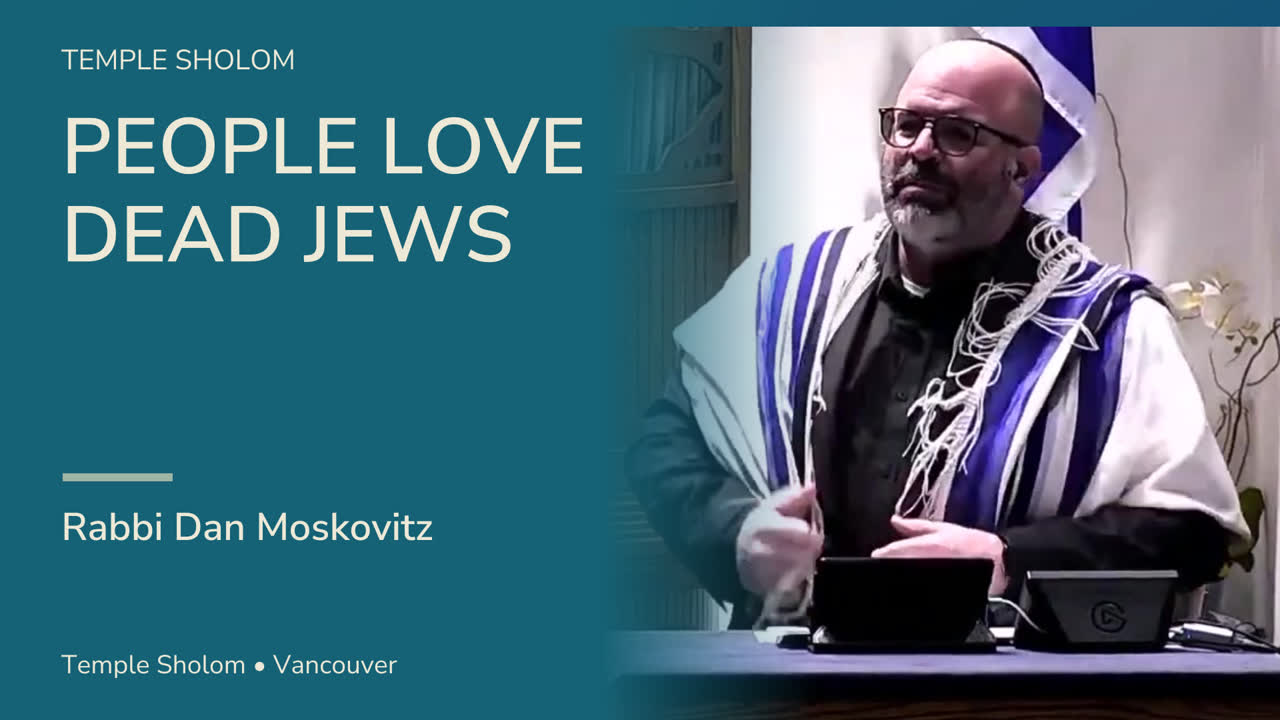
PEOPLE LOVE DEAD JEWS
Rabbi Dan Moskovitz
Temple Sholom - Vancouver BC Canada
January 21, 2022
No more than 36 hours after our friend and colleague, Rabbi Charlie Cytron-Walker escape an
armed terrorist with 2 members of his congregation from a sanctuary very much like this one I
got a call from CBC News.
They asked if I could do a TV interview via zoom; they wanted to get my reaction to the news. I
was not surprised by the call; in fact I was hoping for it; I wanted to talk about Texas and my
colleague, his heroism and our communal trauma of having three attacks with guns on Jews at
prayer in a synagogue in less than 5 years. Far more if you count street violence and vandalism.
The reporter came on the phone and asked her first question, “What did I think of the news that
Anne Frank and her family were turned in by a fellow Jew as had been reported in a new book
out this week?”
“Anne Frank? Anne Frank?, you want to talk about Anne Frank? Why do we need to talk about
antisemitism that happened 70 years ago in Europe when we can talk about what happened
less than 2 days ago in Texas?”
So many thoughts in my head, too many thoughts. The first was the title of Dara Horn’s award
winning book, “People Love Dead Jews”. Of course the CBC wants to talk about Anne Frank,
Anne and almost her entire family died. People love talking about dead Jews.
Horn, whose book by that title just won the national Jewish Book award, has been writing
essays about Jews and the Jewish community for decades. The title of her book comes from
her troubling realization that what all of these assignments had in common: was that she was
being asked to write about dead Jews, never about living ones.
In her book Horn explores the not so shocking attacks on the American Jewish community in
recent years, to which we can now add Colleyville TX to the list. She reveals the subtler
dehumanization built into the public piety that surrounds the Jewish past, from which this Anne
Frank question clearly derives.
Horn’s main insight is that much of the way we’ve developed to remember and narrate Jewish
history is, at best, self-deception. The 12 essays in her brilliant book explore how the different
ways we commemorate Jewish tragedy, how we write about the Holocaust, how the media
presents antisemitic events, how we establish museums to honour Jewish heritage, how we
read literature with Jewish protagonists and even how we praise the “righteous among the
nations” (those who saved Jews during the war), are all distractions from the main issue, which
is the very concrete, specific death of Jews.2
Of course they wanted to talk about Anne Frank, the Jews in Texas miraculously survived,
where is the story in that?
The other reason I hazard to guess is that the revelation that it was a fellow Jew who turned in
Frank and other families in hiding to save his own family from the gas chambers absolves the
non-Jewish world of accountability for the murder of this bright eyed teenage Jewish girl who
inspired the world with her diary and perhaps its most famous, most quoted sentence — “I still
believe, in spite of everything, that people are truly good at heart”. Considering how things
ended for Anne, we find it astounding that she’s still able to believe in people’s essential
goodness.
But here is Horn’s straightforward response: “It is far more gratifying to believe that an innocent
dead girl has offered us grace than to recognize the obvious: Frank wrote about people being
‘truly good at heart’ before meeting people who weren’t. Three weeks after writing those words,
she met people who weren’t.”
The ways we remember are inextricable from the way we relate to what is happening today.
Horn claims that setting the Holocaust as the bar for anti-Semitism means that “anything short
of the Holocaust is, well, not the Holocaust. The bar is rather high.” According to Horn, this
might explain the limited shelf life, so to speak, of current events like the gunning down of Jews
in Pittsburgh, in San Diego, in New Jersey and the hostage taking in Texas.
It shouldn’t shock me, but it still does that people don’t want to talk about antisemitism; if it’s not
the Holocaust it doesn’t count.
I know that is a bold and audacious statement but let’s unpack the events of these past few
years. Let’s start with Texas you would think Jew Hatred could not be a more obvious cause for
pointing a gun at my colleague and his congregants but in the first press conference after the
daring escape F.B.I. special agent in charge, Matthew DeSarno, said, “[the perpetrator], was
singularly focused on one issue, and it was not specifically related to the Jewish community, but
we are continuing to work to find motive,”
Both The Associated Press and the BBC parroted the line, with the BBC tweeting, “Texas
synagogue hostage standoff not related to Jewish community — F.B.I.” They all later changed
their story but the first headline; the first inclination was to deny that an attack on Jews in a
synagogue had anything to do with them being Jews.
Brett Stephens in today’s NY Times observes.
“Instead, there was a focus on the assailant’s supposed mental illness, along with additional
reporting on the ever-increasing security-consciousness of synagogues worldwide.
Compare that to the mountain of reporting regarding the anti-Asian hate that allegedly animated
the killer in last year’s attacks on Atlanta-area massage parlors. Or compare it to the coverage
of the unquestionably racist attack on Muslim worshipers at the mosque in Quebec City. For that 3
matter, compare it to the naked Jew-hatred that drove the killer in the 2018 synagogue
massacre in Pittsburgh, which has been extensively reported and discussed; but then again to
quote Dara Horn, “people love dead Jews.”
Stephens asks and I echo his question, “How is it that Jews should be victimized twice? First, by
being physically targeted for being Jewish; second, by being begrudged the universal
recognition that we were morally targeted, too? And how can it be that in this era of heightened
sensitivity to every kind of hatred, bias, stereotype, -ism and -phobia, both conscious and
unconscious, there’s so much caviling, caveating and outright denying when it comes to calling
out bias aimed at Jews?”
The answer begins with the shapeshifting nature of antisemitism, which some perpetrate, others
participate in (sometimes unwittingly), and a still greater number fail to recognize for what it is —
in part because each successive mutation doesn’t exactly resemble its predecessor.
But it’s more than that. At the core of antisemitism from the days of blood libels and the
Protocols of the Elders of Zion is a conspiracy theory that Jews are all powerful, that we control
the banks, the media and in the mind of the Texas terrorist the US Government. Such unhinged
and corrosive conspiracy theories are demonstratively dangerious as has been the history of
our people.
Again Brett Stephens observes, “A moral conviction of our time… is that the powerful are
presumptively bad while the powerless are presumptively good.”
So the image of a British Muslim of Pakistani descent. Not white. Not privileged. Not right-wing.
In the binary narrative of the powerful versus the powerless, his naked antisemitism just doesn’t
compute: Powerless people are supposed to be victims, not murderous bigots.
But if Jews are all powerful as the troupe goes then everyone is powerless in the face of them
and thus on some deranged and absurd level attacks on Jews are justified as a rebellion
against power, as a righting of some historical wrong as old as Shakespeare’s Shylock, as
noble as Robin Hood taking from the rich to give to the poor.
It’s why the Holocaust is the last acceptable reference to antisemitism because Jews were so
powerless in the face of Nazi jugernaught; needing to be saved by white Christian soldiers who
came nobeley to their aid. It also why antisemitism mascarading as Anti-Zionism is acceptable,
because Israel is a symbol of Jewish power and power even when necessary to defend your
people and your land is suspect at best; pure evil in the eyes of those less powerful.
Understanding the root causes of Jew Hatred is of absolutely no comfort or consolation; and the
CBC reporter doesn’t want to hear any of that anyway. She wants a nice sound bite, “isn’t it
comforting to know who turned in poor Anne Frank and her family after all these years?”4
No it’s not, it points to the extreme and unimaginable circumstances Jews were put in during
that time, where the only way to save their families was to turn on each other. The Hunger
Games in real life.
Nor is it comforting to see police cars parked outside synagogues on the High Holy Days and
guards at the synagogue doors every Shabbat. It’s not comforting, churches don’t have them,
mosques don’t have them. Only synagogues only Jews. What would be comforting would be to
live in a society where such things were not accepted as necessary for Jews to pray in a free
society. What would be comforting would be the world to be in shock and horror that Jews were
attached in a synagogue in North America. But that’s not shocking and if no one dies it’s hardly
news the next day.
SERMONS & WRITING · 2022
People Love Dead Jews
January 21, 2022