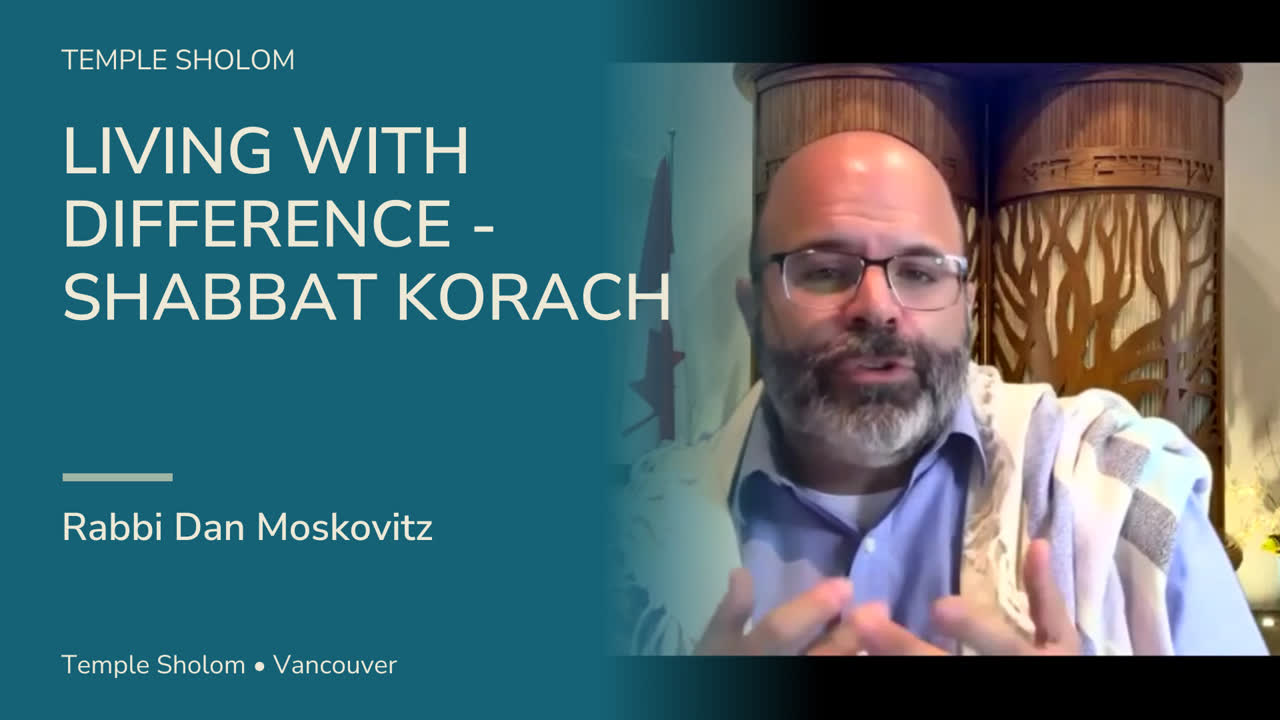
SHABBAT KORACH: LIVING WITH DIFFERENCE
TEMPLE SHOLOM, VANCOUVER BC CANADA
RABBI DAN MOSKOVITZ
JUNE 27, 2020
“You have gone too far! For all the community are holy, all of them,
and the Eternal is in their midst. Why then do you raise yourselves
above the Eternal’s congregation?” (Numbers 16:3)
Thus says Korach – the instigator of a great rebellion against Moses
in this morning’s Torah portion. And so, begins one of the most
problematic episodes in a Torah filled with problematic episodes.
Korach challenges Moses’ authority. Moses demurs and says I am
only doing what God asked me to do. If you want to be the leader
then let’s put it before God and see who God chooses.
The next day God makes God’s choice and kills Korach and his
followers with an earthquake and a plague.
Pretty much the fantasy of every extremist opposition party or
movement on the planet. If only the [fill in the blank] would be wiped
off the face of the earth, then we could have the country we want. Or
as I explain to my wedding couples when doing pre-marital
counselling, relationships would be so much easier if they didn’t
involve other people.
But of course, they do, and only in the Torah or in horribly totalitarian
regimes do those who disagree with you get wiped off the face of the
earth by divine fiat.
I would say, “Thank God” but that obscures who does the wiping in
this instance.
And so, the question: What did Korach do that was so wrong that it
deserved that he and all his followers be killed?2
My short answer is they shouldn’t have been killed for their rebellion;
at least not by divine hand.
But let’s go back to the question, what was so bad about what Korach
did?
[On the eve of the revelation at Mount Sinai, God calls to Moses and
tells him to inform the people of Israel:] “You shall be to Me a
kingdom of priests and a holy nation. These are the words that you
shall speak to the children of Israel” (Exodus 19:6)
Korah's tragic error, according to Martin Buber, was to misread the
verse in Exodus 19. Korah reads the verse as descriptive: the people
are already holy, each one, and the presence of God is within each
one. They therefore have no need of instruction, authority, or further
spiritual growth.
Martin Buber writes:
"Both Moses and Korah desired the people to be the people of
YHVH, a holy people. But for Moses this was the goal. In order to
reach it, generation after generation had to chose again and again . .
. . For Korah the people, as being the people of YHVH, were already
holy. They had been chosen by God and [God] dwelled in their midst,
so why should there be further need of ways and choice? The people
was holy just as it was, and all those within it were holy just as they
were" (Martin Buber, Moses: The Revelation and the Covenant [New
York: Harper & Row, 1958], p. 189).
What Korach is advocating is rights and privileges based on privilege.
The privilege of being born to a certain people. Call it Holy Privilege.
Because of what his ancestors did in their time, because of how they
acted with God through covenantal relationship Korach argues that
the holiness is passed down L’dor v’Dor – from generation to
generation without having to do what those before them had done to
earn such privilege.3
There are obvious correlations for us today, indeed I cannot read
Torah this morning and ignore the lessons of Korach:
o One with regard to White Privilege and how it contributes
to systemic racism.
o Another concerning American Exceptionalism – which
posits that America is great or will be great again through
divine right not the hard-incremental work of continually
renewing democracy and the social contract.
§ This is most frustratingly self-evident in the contrast
between how Canada and the United States have
approached the containment of the Corona Virus
and public health in general. But there re many
examples
What is lacking in Korach and in the United States today is humility. A
self-awareness that you don’t have all the answers; that we always
have something to learn and to quote the passage from Mishnah that
is on the attarah (the collar) of my synagogue tallit, az hu chacham,
halomed me kola dam, who is wise the one (or the nation) that learns
from all people.
Moses had humility – for him being the leader of the people was not a
privilege, it was a sacred responsibility to God and to the people he
led to get it right. It was not about him it was about us. Moses
responds to Korach. ‘Maybe you’re right and you should be the
leader, I am just doing what God told me to do, let’s ask God and see
who God wants?’
It is there that God should have made God’s choice known and let the
people work out the details.
But God responds with rage and anger. Very human emotions,
dangerous in the hands of an omnipotent deity. The line from
Spiderman would have been helpful here, “With great power comes
great responsibility.”
But I think God misreads the moment and what is required.4
The conflict between Moses and Korach was not one of personality or
the centralization of spiritual authority: rather, it was the inability of
Korach to imagine that he (and the community) still needed to
spiritually grow for, as Buber also taught "not being but becoming is
[our] task . . . . " and although the "realization of the divine on earth. .
. has its beginning in the life of [the] individual, it is consummated only
in the life of true community" (The Way of Response, p. 162)
The story of Jewish peoplehood has always been complicated by two
different stories, the Covenant of Being and the Covenant of
Becoming. In the Covenant of Being which is Korach perspective,
Jews are defined by who we are, and not by what we do. In this
ethnic, familial identity, Jewishness is permanent and unconditional.
The second is the story of our Covenant of Becoming, which
classifies Jewishness in opposite terms, as a people whose identity is
expressed precisely in terms of what we do and what we believe, a
people who aspire to live a life of meaning and greatness. This is
Moses’ approach – yes we are ‘God’s Chosen People” but that only
gets you a ticket for entry, once inside the covenant you have to earn
that designation through deeds; holy acts.
The question always comes up when reading this parasha, why did
God choose to kill Korach and his followers rather than tolerate
difference in the community?
And here I think is an example of where the Torah teaches us the
danger of fanaticism, not on the side of Korach but as concerning the
actions attributed to God.
Korach should not have died for his sin of hubris and egotism; rather
the story would have been even more powerful if he and his
decedents were still in the picture for the next 40 years of wandering
in the desert.
Not only powerful but more realistic. 5
Because as we see today those that express indignance do not get
swallowed up by the earth as happens in the biblical story. They stick
around, their grievances when not addressed fester and grow and
ultimately boil over. You can’t push them out you have to deal with
them and find a way to live together. Its true in Canada, its true
between left and right, black and white, Red and Blue in the US and
all over the world. Its true in Israel as the Netanyahu Government
move closer toward annexation of the West Bank.
In Judaism the Covenant of Being which was Korach’s position
ultimately obligates tolerance and acceptance of others. In the
Covenant of Being, regardless of who you are as a person, and what
you do, your Jewishness is maintained. Jewishness is larger and
broader than simply a system of faith, belief and actions. There are
no good Jews or bad Jews.
Everyone is equal with a guaranteed place at the Jewish people’s
table. Jewish identity is permanent and unconditional and there is
nothing any individual can do to alter one’s membership status. This
applies not only to those born into the family, but to converts as well.
Once a Jew – even if only for a minute – always a Jew. The Talmud
formulates this idea of Jewishness as “beingness” through the
pronouncement: "Even though they have sinned, they are still Israel.”
(Sanhedrin 44a)
Since all Jews remain members in full standing regardless of what
they do or believe, we are obligated to live with difference; to
accommodate difference as an expression of our commitment to the
Covenant.
Both God and Moses missed that. In many ways Korach even though
his motivations were self-serving saw the challenge in a Judaism of
Being. I’m here, I have my views and you have to deal with them, you
cannot silence me and still be holy.
In the Covenant of Becoming, the position of Moses; Jews are
defined by what they do. In this mission‐based, aspirational
Jewishness, identity is shaped around shared beliefs and practices.6
It is in the response to this calling that Jewish identity is endowed with
purpose and is transformed from an accident or privilege of birth into
a choice and a mission to create a life of value and a just society.
You are not born great or privileged, you are born k’dai, you are born
worthy, everyone is – BUT you have to earn holiness. The Covenant
of Becoming expects of the Jewish people excellence, nothing short
of the emulation of God. "You shall be holy, for I, the Lord your God,
am holy" (Leviticus 19)
The insight our Torah gives us this morning is not that those who
espouse privilege and exceptionalism by right of birth should be cast
out from the community, while people may be removed those ways of
thinking will remain and the seeds planted will grow. Rather Korach
and his followers needed to be heard, the community must address
their perspective though dialogue, shared learning and compromise.
We work tirelessly to address these differences through peaceful
means and shared values but sometimes there is protest, sometimes
there’s conflict and even violence as human beings try to resolve
what we cannot agree on. But when the shouting and fighting is over,
there must be reconciliation. We have to learn to live with difference
it’s an essential part of what it means to be holy.
We need both stories of the Jewish people Being and Becoming, we
need Korach and Moses – and honestly God should stay out of it.
SERMONS & WRITING · 2020
Shabbat Korach: Living With Difference
JUNE 27, 2020