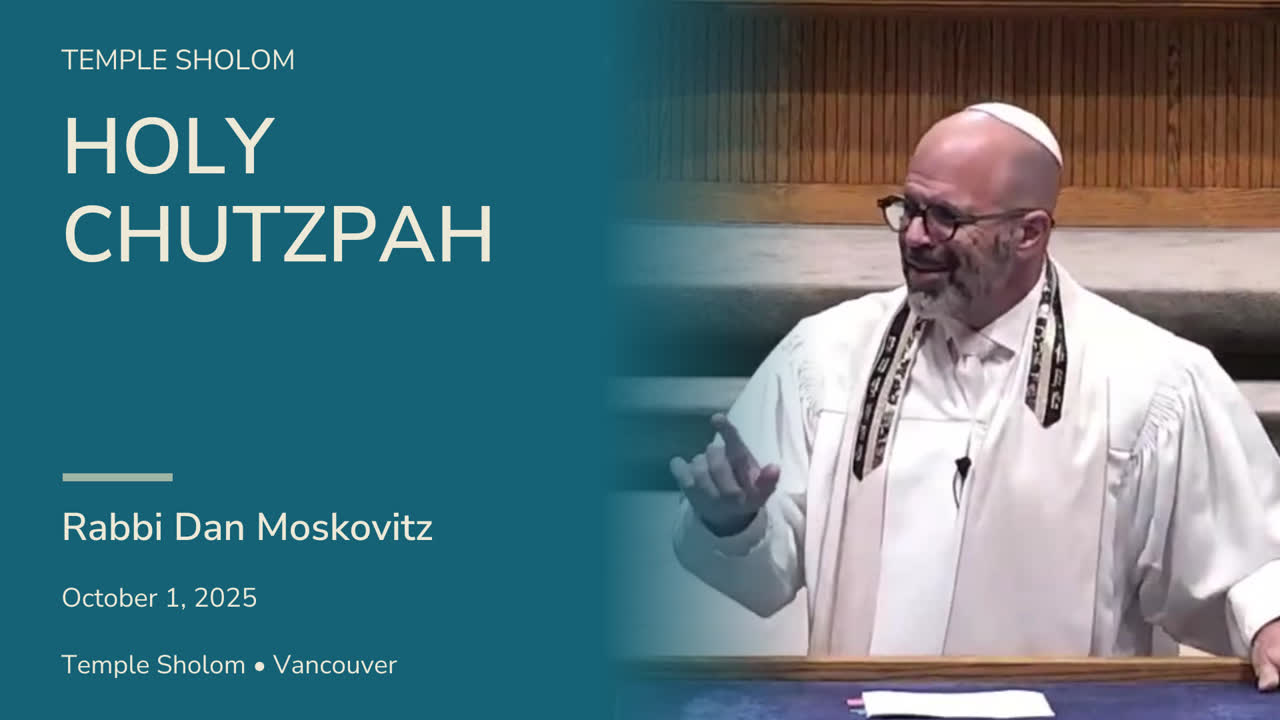
Holy Chutzpah
Rabbi Dan Moskovitz
Temple Sholom, Vancouver BC
Kol Nidrei 5786 - October 1, 2025
Video link: https://youtu.be/yIxU5RT9u4c
I will confess something to you on this holiest night of the year, on this night of confession:
I can’t read the news anymore.
I can’t bear the headlines.
Everything feels upside down.
And yet as we sit here tonight, I’m once again glued to them, filled with cautious hope about the new peace plan and yet also I feel the familiar ache of uncertainty, dread, skepticism. And if I’m being truly honest I worry no matter how this plays out the world will still blame the Jews.
It’s all so unbelievable, yet undeniable; the countries and leaders I once respected speak with voices that are unmistakably antisemitic. The politicians I disagree with on almost everything else have become — strangely, unnervingly — the loudest defenders of Jews, though too often for reasons that have nothing to do with love of our people and everything to do with scoring points, punishing opponents, or feeding their own ambitions.
Olam Hafuch - the world is upside down, or maybe, hopefully as regards the promises of the proposed peace plan right side up? I don’t know.
What I do know is I watch police and media outlets defend antisemites and Jew-haters of every stripe as if their bile is “protected speech.” I watch my own people blamed, collectively and absurdly, for the actions of Israel, for the enforcement of anti-hate laws, for daring even to demand protection from harassment and fear.
And I see how feeble, how slow, the response so often is — after the intimidation, the vandalism, the assaults — always delayed for “further investigation.”
I scroll through reports of extremism on the left and right, through the dismantling of democratic norms by those who cannot win in the light of day. I watch it unfold in the U.S through manipulated maps, gerrymandered votes and stacked courts, that twist the system into a weapon.
And I feel its ripples here in Canada — in the polarization of our own politics, in the erosion of cherished Canadian civility, in the emboldening of antisemitism even on our own streets. The counter protests, the graffiti on our institutions, the uneasy looks many of us have felt walking through the city wearing a kippah or Star of David.
I’ll confess something else, I take off my kippah when I go into Starbucks because I don’t want them to spit in my coffee. And I don’t think if Hamas surrenders that fear of antisemitic bile is going to change.
Maybe that last line was too literal, but you get the point.
I want my life back. I want it to be safe to be a Jew again.
I want to focus on my children’s education, not antisemitism on campus. I want to take a vacation without being pulled away by breaking news. I want to walk the dog, be fully present with my family, make dinner and laugh with friends without the weight of the world on my chest and my phone buzzing with the latest assault on reason. I want to have a conversation with someone without wondering whether the person leans left or right, worried a simple conversation will stumble into a political minefield, so I say nothing and so do they.
And yet — and here is the part I want you to hear most clearly — I know that this despair, this exhaustion, is exactly what the haters and extremists want. They want me — they want us — to give up. To stop reading, stop showing up, stop resisting, stop fighting for decency, for dignity, for democracy. They want us so weary that we simply bow our heads and accept it. So terrified to say anything that we say nothing.
And so here I stand, on Kol Nidrei, with the Torah scrolls before us, with the melodies we have carried for centuries in our ears, and I confess all these sins.
I confess that I am tired of being cautiously optimistic.
I confess that I’m in disbelief that my hopes for the future are in the hands of leaders, left and right I wouldn’t trust for a minute.
I confess that I’m fearful that the golden age of North American Judaism I enjoyed as a child of the 70s, 80s and 90s was the exception to the rule. I confess I fear they will always hate us, always blame us.
I confess how quickly hope can be poisoned by cynicism, how quick I am to dismiss possibility before even giving it a chance.
I confess my fear that the plan will collapse, that extremism will reassert itself, that blood will flow again.
I confess I have more despair than hope.
For more than a thousand years Jews have gathered on this night and chanted Kol Nidrei.
We annul our vows, we say aloud: All the promises and commitments I made that I cannot fulfill, all the words I spoke but could not carry — let them be undone, let them be lifted.
We admit that we are finite. That we overpromise. That we are not as strong as we want to be. That the burdens we take on — from the world, from our community, from ourselves — sometimes crush us.
I admit all of that.
Isn’t it striking though? That on the holiest night of the Jewish year, the prayer that opens the gates of heaven is not a hymn of praise, not a declaration of faith. It is a cry of limitation. A recognition that our words, our commitments, our very selves cannot always keep up with what the world demands of us.
On this night, our tradition says: you can lay some of it down, you can step back, you can step away.
That is my prayer on this sacred night: not to pretend the world is better than it is, not to deny the hatred and hypocrisy and despair, but simply to lay some of it down. To release it, even for a moment, so we can breathe again, so I can breath again, even if just for this holy day of atonement.
Our tradition does not ignore despair. It gives us language for it.
Jeremiah, the weeping prophet, laments over a Jerusalem in ruins: “My eyes fail from weeping, I am in torment within; my heart is poured out on the ground because my people are destroyed.”[1]
That’s not from the 7th of October, that’s from the 7th century -— BCE! We’re not the first Jews to feel this way, we’re the latest.
Our ancestors did not shrink from naming the reality of despair. They didn’t say, “Cheer up, it will all be fine.” They wrote it into the Psalms, into the Prophets, into the very canon of Torah. They gave despair a voice because they knew that to pretend otherwise is dishonest.
And yet — and this is crucial — despair is never the last word in Judaism.
Rabbi Nachman of Bratzlav, himself a man who battled depression and darkness, taught the famous line: “Kol ha’olam kulo gesher tzar me’od, v’ha’ikar lo l’fached klal” — The whole world is a very narrow bridge, and the most important thing is not to be afraid. The world is perilous, danger on every side, and still we must walk across the bridge, we have to journey through it, carefully but without fear.
Yet perhaps even more relevant for us tonight is another teaching of his, less well-known but more searing: “Asur l’hitya’eish / It is forbidden to despair.”
Why? Because despair is a kind of death before death. The premature end of hope.
Because to despair is to say that the world cannot change, that people can’t change, that we can’t change. And we know we can, we know we have and do all the time. We call it growth.
To despair is to say that justice cannot return, that love and faith and community are not stronger than hatred. And they are. We call that progress.
To despair is to surrender the very covenant that binds us, a covenant of obligation to fix what is broken in ourselves and in our world, l’taken olam b’malchut shadi. To repair the world as God intended it.
Judaism insists: cry out, lament, rage — but do not give up.
Rabbi Jonathan Sacks wrote: “Judaism is the voice of hope in the conversation of humankind.”
He observed a truth as old as this night of prayer itself; our people have had every reason to give into despair — exile, persecution, antisemitism, pogroms — and yet, somehow, we have held on. We are here tonight because our ancestors refused to let despair have the final word.
We are here tonight because we have holy chutzpah. The unmitigated gall to believe we can change, ourselves and the world for the better.
Kol Nidrei is not denial. It is not naivete. It is a spiritual pause, a sacred release, that allows us to breathe again, so that tomorrow we can rise with renewed strength to face what must be faced, to change what must be changed personally and collectively.
Kol Nidrei doesn’t end the service; it begins it. We do not stay in release; we move into prayer, into song, from confession to renewal. The release makes space — space for us to be reshaped, renewed, restored, returned to ourselves.
That is the rhythm we need for our lives in this upside-down world. We cannot carry it all or make sense of it all.
If you need permission from your rabbi, and let me be clear you don’t need my permission, but if you think you do I’m giving it to you.
On this holiest of days you can put down the burden, take a sacred and needed pause, a fast from news and worry and debate and turmoil and restore your soul. It’s literally a mitzvah.
And then restored, as I hope we will be after these High Holy Days, pick back up what you need to carry, what you can’t live without and begin again.
I began tonight with my own confession, my own Vidui:
I can’t bear the news anymore. I am disgusted by the hypocrisy, the extremism, the hatred, the way antisemitism is excused or even encouraged. That I am exhausted by crushed hopes, broken promises and being used as the world’s scapegoat. That even in my cautious optimism about the peace plan I’m under no illusion that the world will finally love us, accept us or simply leave us the hell alone.
But I end tonight with this truth: I will not give up. We will not give up.
We will not give up because our children need to inherit a better world.
We will not give up because our parents dedicated their lives to make a better world for us.
We will not give up because we are an Or L’goyim a light unto the nations and the world and its leaders are stumbling in darkness.
We will not give up because our tradition commands us to hope.
Because our history has shown us that despair never had the last word for the Jewish people — not in Egypt, not in Babylon, not in Europe, not in Be’eri, not at Nova, not in the tunnels of Gaza where former hostages told us they clung to faith, to hope. And not here in Vancouver.
We will not give up because, as the Talmud says, Kol Yisrael arevim zeh bazeh — all Israel is responsible for one another. And not only Israel, but all humanity. What’s too heavy for me to carry alone, we can all carry together. That’s why this room is full tonight. We need each other more than ever.
The very fact that we are here tonight — in this sanctuary, with our neighbors, with our congregation, with our people — is itself an act of resistance.
To pray together, to stand shoulder to shoulder, to sing melodies carried for generations — that is how we push back against despair.
They want us to be silent. Instead, we sing.
They want us to retreat. Instead, we gather.
They want us to give up. Instead, we return.
Don’t measure your lives by headlines. We are not defined by those who weaponize hatred for power.
We are defined by what endures:
by memory — of who we are and where we come from,
by covenant — with one another and with God,
by acts of justice and compassion,
by the bonds of community,
by the hope our tradition insists upon.
Put down what you cannot carry. Rest when you grow weary.
And then rise, again and again rise, rise together to face the world with courage, with faith, with holy chutzpah.
Ken yehi ratzon. May it be God’s will and our’s.
________________
[1] Lamentations 2:11